• TalkBass has been independent since 1998. Add your voice.
    Create a free account to reply to discussions, view embedded media, and browse with fewer display ads.
    Join freeLog in
    Want zero display ads or expanded classifieds tools? Compare plans.

Light weight cabinet build

I’m considering building a bass cabinet. I play 4 string using either a Peavey Mark III XP (150 watt @ 8 Ohms) or a much lighter Markbass Blackline 250 ( also 150 watts @ 8 Ohms).

I have a JBL K140 (genuine E140 recone), a zero cost option. It weighs 15 lbs and, on paper, doesn’t go above 2500 hz. I may add an Eminence BGH 25-8 to extend the range.

I want a smaller cabinet, 3-5 cubic feet, and no more than 45 lbs loaded. I have a sheet of 12mm C2 7- ply poplar core birch faced plywood, that weighs 1.2-1.3 lbs per sqft and 1/4 sheet of 18mm for a baffle. If I use 23 sqft or less of plywood (about 30 lbs), the K140 should work.

I have been modeling different boxes and tunings in WinISD. Somewhere, I read there may be issues with port specifications in WinISD and also that using an outside panel as part of the port can affect tuning.

I’m looking for input on:

  • Any suggestions, on lightweight bracing for 12mm plywood. Rabbitted/dado/flush glued bracing? Do’s and Don’ts? Corner ports that double as bracing?
  • Inexpensive tools and methods to verify port tuning. Anyone use a Volt/Ohm meter? DATS v3? Accuracy?
  • Is there a downside of higher port tuning? Power handling? Excursion Issues? In WinISD a 4.2 cubic foot box tuned to 40 hz has a shelf with spl 3 db down around 43-44 hz , 6 db at 40 hz (Butterworth?). Increasing the tuning frequency to 50-55 hz gives a flatter response, but it rolls off sharper at a higher frequency. I read the fundamental of a note is 10 db, or more, lower than the first harmonic and the fundamental is actually masked to the point it can be removed without perceived loss (below 100 hz anyway). See Greenboy’s discussion in the thread “Bass frequency/waterfall plots: what they mean to rigs”. Bit of a rabbit hole! I’d just like to safely test the different tunings.
Thanks for reading this far!
 
I think you will find your target weight to be a challenge, and for that large of a cabinet 22mm ply will be a real challenge to brace.

As far as weight, what about the hardware, covering, bracing, grille?

Measurements (accurate) is MUCH harder to do (even if you are a pro).
 
I think you will find your target weight to be a challenge, and for that large of a cabinet 22mm ply will be a real challenge to brace.

As far as weight, what about the hardware, covering, bracing, grille?

Measurements (accurate) is MUCH harder to do (even if you are a pro).
Thank you for dropping in. I highly respect your input and have read many, many of your posts.

Bracing is a challenge. And, not an easy one. I see this as an engineering problem to be solved. The goal is zero deflection of any panel, but that's unrealistic. The areas where panels meet are braced by the adjoining panels. These locations may not need bracing for some distance away from the joint. I've built larger RC aircraft and removing some material can reduce weight while maintaining structural integrity, like in wing ribs and spars. I'm not in a rush. It will take some thought.

The bracing was assumed to come from the 23 sqft of plywood, so included. I don't think I'll actually use 23 sqft. However, I could also swap in other engineered materials for bracing if lighter. I may have some aircraft grade plywood, but not going there yet. The hardware and covering will add weight. There are choices on what is used. The weight issue is a math/engineering problem as I see it. There is no emotion in this. It works or doesn't.

I am not a pro designer, nor do I desire to become one. Still, getting some measurements on the tuning is going to be better than none.

Again, I appreciate your comments. Spot on!
 
I wouldn't suggest that zero deflection is the goal, in fact some deflection (depending on how it's accomplished and the end result) may in fact be desirable. How much is a judgement and taste issue.
 
I wouldn't suggest that zero deflection is the goal, in fact some deflection (depending on how it's accomplished and the end result) may in fact be desirable. How much is a judgement and taste issue.
Yeah, I had to chuckle reading your comment. A Helmhotz resonator does have to resonate. I've made some acoustic guitars (Helmhotz resonator) and the soundboard does have to move. There's a lot of discussion on how much and which frequencies to emphasize.

I'll work this project out on paper before plugging the saw in.

Hoping this thread provides something interesting for you.
 
  • Like
Reactions: agedhorse
The air is what resonates with the cavity. The enclosure flexing a little can add some interesting flavor, but like everything flavor oriented, it’s quite easy to overdo it too.
Some cabinets do seem more musical. Using 12mm plywood may be more prone to resonance, particularly at standing wave frequencies. That will be focused energy. Or it could absorb energy too. I don't think a guitar is a good analogy to a speaker because the soundboard is specifically designed to resonate at many frequencies. Kind of the opposite direction, really. My bad. I'm going to get more information on the component weights. The Eminence BGH 25 would add 2 pounds by itself. First steps first.
 
  • Like
Reactions: agedhorse
Thanks!
This is an anwser to a question I always wanted to ask you.
I experienced flexing on some DIY cabs where it was benificial at living room volume.
It can be, if you are a skilled designer… or very lucky.
 
  • Like
Reactions: TonH
I've put together a list of parts that would be needed and listed the weights provided by the retailer/manufacturer. The added weight is roughly 8- to 9 lbs. I also contacted the plywood supplier and he states the manufacturer lists 38 lbs per 4X8 sheet, or 1.2 lbs per sqft. That's 27.6 lbs for 23 sqft. The 18mm baffle will lose material for the speaker (approximate 14" circle) and some for ports, so will probably still be around 1.2 per sqft to the area. I'll have to weigh the sheet. As it sits the weight would probably come out in the low 50's. I see compromises in my future. Anyway, here's the list.

Plastic Cabinet Handle 6-3/4" x 3-3/4" (2) .2 lbs
Stacking Cabinet Corners (8) .375 lbs
Eminence BGH 25 2.45 lbs
X02W-2.5K crossover 2500 hz 1.00 lbs
Plastic 1/4" Jack Plate .054 lbs
Switchcraft 11 1/4" Jack .1 lbs
Wire .1 lbs
Tolex (2 yard x 54) 2.4 lbs
Glue/misc screws .2 lbs
Black Grill Cloth (36X36) 2.00 lbs

Total weight: 8.87 lbs

Alternatives:

No BGH25/crossover (lose 3.45 lbs)
2 ounce fiberglass (4 ounces per square yard) or resin over stain (lose ~1.6 lbs of the Tolex weight)
Steel circular grill at 1 lbs (lose 1 lbs)
Weight savings: about 6 pounds - if the plywood is 1.2 lbs sqft, I might be close.
 
You will still need a grille frame of some type if using a fabric grille.

Just note that I personally HATE the round grilles... nothing says "no class" on an otherwise nice build than a round grille.
 
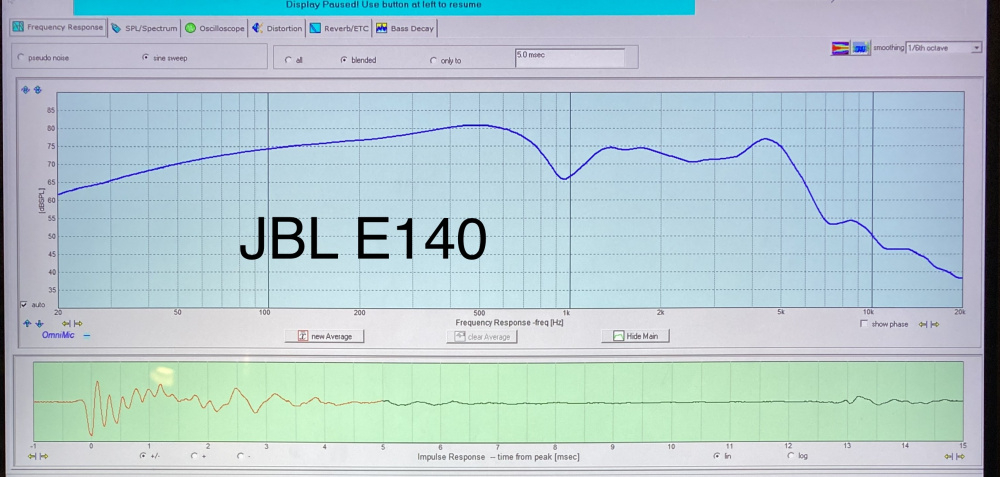
If you look at my frequency response measurement, a proper E-140 doesn't really need mid/tweeter. IMO they do quite well up top for bass guitar, but from what you stated, yours isn't exactly an E-140.
 
You will still need a grille frame of some type if using a fabric grille.

Just note that I personally HATE the round grilles... nothing says "no class" on an otherwise nice build than a round grille.
I agree. The round grills do not really work. The grill also has to have enough of a recess to sit in a bit and not be flush with the cabinet sides. Inset just looks better. The side thickness around the recess should also be thicker than 12mm. They should look 3/4" to 1", I would guess.
 
If you look at my frequency response measurement, a proper E-140 doesn't really need mid/tweeter. IMO they do quite well up top for bass guitar, but from what you stated, yours isn't exactly an E-140.
Thanks for the link in your original post. I looked at it again and realized you were using DATS for measurements. Which version? How easy was it to use? Would definitely want to hear your impression of it. My driver is an E-140 kit in a K140 frame, so alnico (Flux 1.2 T) and much lighter than the E140 (Flux 1.3T). I think the E140 is close to 22.5 pounds, like the 2226's. I've wondered how the difference in the motor will affect my driver's specs. Xmax on the E-140 is smaller than the K-140, so I've got that excursion limit. I really should get the TS parameters for this particular driver. Many years ago I used 2 K-140's in a Sunn 215BH cabinet. I always felt the high frequencies just weren't quite enough with that rig. A little more top end would have been nice. I'm thinking of building without the horn and if weight limits allow, I can add it later.
 
I was using DATS V2 back then, I have the V3 now. Great piece to have if you're into building speakers and such.

I'm pretty sure Agedhorse is right. The E series was the next step, besting the K in xmax and power handling. Your situation is hard to predict.
 
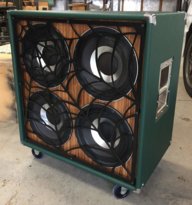
This is a lightweight 1x15 i built for myself. Top, bottom and back are 6mm plywood, but with the mesh bracing, also 6mm plywood, end on. The top and bottom work fine, but the back, which was intended to be removeable, resonated excessively and I had to upgrade it heavily (in both senses). The baffle is a sandwich of ply with a fibreboard core, end grain balsa would be better.

There were two big lessons I learned. The first is that a removable back was a mistake, its better to accept the inconvenience of having to remove the driver and have the bracing integrated into the corners and edges.

The second lesson, which builds on the first , is that cross bracing and diagonal cross bracing are enormously weight efficient, and very much something to incorporate. Idid soon a subsequent 1x10.

All this complexity is of course hopelessly time consuming and expensive outside home building. The cab is under 30lbs, but I reckon if I did another with those lessons I could be around 25.
FB_IMG_1766344227732.jpg