• TalkBass has been independent since 1998. Add your voice.
    Create a free account to reply to discussions, view embedded media, and browse with fewer display ads.
    Join freeLog in
    Want zero display ads or expanded classifieds tools? Compare plans.

Light weight headstock?

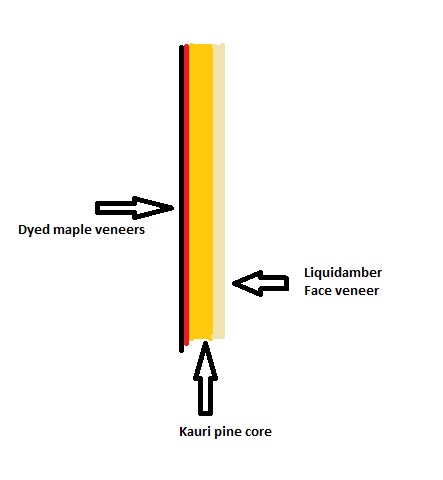
As many of you know, I'm always looking for crazy new ways of reducing weight. What I'm thinking about doing is using a core of kauri pine as a headstock.
headstock_zpsd4c7f0d6.jpg


The timber is 50yo, well dried and extremely stable. It'll be scarf jointed on the neck with a died maple veneer on the back and a face veneer of liquidambar (as hard as rock maple). I'll then add another veneer to the back of the headstock once the scarf joint is finished. What I'm concerned about is whether I'm substantially weakening the neck by doing this?

Thoughts? Concerns?
 
The highest stress area on the headstock is on the back, within an inch of the nut. That spot takes all the tensile load of the strings, and is the most likely place to snap when you slap the headstock upside an errant band mate's head. The rest of the headstock doesn't really matter structurally, as long as you keep it to the nominal 5/8" thick.

If you are really trying to save every ounce, my recommendation would be to chamber the headstock. Use a good strong wood like maple for the core, so you have plenty of strength in the high-stress area. Then hog away wood in the outboard areas with a router, leaving just enough to support the tuners. Or drill a bunch of holes. Make it like Swiss Cheeze. Cover both sides with a thin cap/veneer, and it will be almost as strong as if it were solid maple.

As a bonus, you can tell people that you've added Tone Chambers to the headstock.
 
Most of the weight at the end of the neck comes from the hardware, not the wood. I am reasonably certain that all of the wood in one of my headstocks weighs about as much as or less than a single "normal" bass tuner.

Of course the Rev uses guitar tuners, so he saves some weight there. I do not like this solution myself, as it makes the stringing and tuning process a lot more tedious.

I think there's really only so much weight that you can save from a practicality perspective. I think it'd be better to focus on balance in the design stage, and then save weight where you can and where it makes sense. Aluminum hardware instead of brass, etc.
 
  • Like
Reactions: Barnaby and tjclem
For what it's worth, I've done a semi-hollow headstock on a guitar, but that was for tonal reasons instead of making things lighter. I think there's more potential to think along those lines, especially considering, as noted, the amount of weight in the hardware. I was shocked by the weight of Gotoh tuners when I made my first bass recently, after several years of guitars. The next one will probably be headless...
 
For what it's worth, I've done a semi-hollow headstock on a guitar, but that was for tonal reasons instead of making things lighter. I think there's more potential to think along those lines, especially considering, as noted, the amount of weight in the hardware. I was shocked by the weight of Gotoh tuners when I made my first bass recently, after several years of guitars. The next one will probably be headless...

...and as far as I'm concerned, chambering a headstock for tonal reasons is like predicting the weather using tea leaves. While it may be viewed as legitimate in some circles, I see it as completely non-correlative and non-causal. Sorry, B, that's just how my mind works.

On the other hand, there are some impressively light bass tuners available now. The lightest that I am aware of is the (coincidentally) Gotoh Res-O-Lite GB350, clocking in at a mere 40 grams per unit, the same as a standard Schaller M6 guitar tuner. The traditional massive elephant-ear bass tuners of yesteryear are well and truly obsolete.
 
  • Like
Reactions: Barnaby
...and as far as I'm concerned, chambering a headstock for tonal reasons is like predicting the weather using tea leaves. While it may be viewed as legitimate in some circles, I see it as completely non-correlative and non-causal. Sorry, B, that's just how my mind works.

No need to apologise and I have no problem with your perspective at all - it was an experiment in building and I'm happy with the resulting instrument, but have no real way of knowing what actual tonal difference it made, if any. Of course, clamping on a bit of extra weight or 'deadening' the headstock with a hand changes the acoustic sound of the guitar a bit, but it's pretty negligible.