- Apr 18, 2008
- 16,007
- 1
- 31,705
- Disclosures
- I'm highly opinionated and extremely self-assured
I've been busy building BFM PA cabs, but this little guy's been stewing off and on some too.
It all started when I bought a body blank on eBay advertised as mahogany. It's not mahogany. It's much too blonde and much too light in color to be mahogany. But it was cheap, and I am in need of some lightweight basses, so I stashed it away until the right opportunity presented itself.
Meanwhile....
I love Gibson shapes, and while the EB/SG shape is iconic and very rock-n-roll looking, something is just, well, off in its proportions. I think it has something to do with the relative sizes of the upper and lower bouts, and how the lower bout just isn't beefy enough...
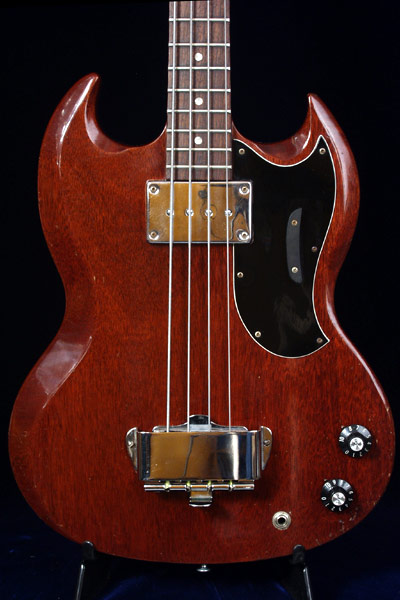
But I love the ideals behind the design; namely, the thin, light body and the chiseled look of the bevels.
I'm also a big fan of several of the B.C. Rich body shapes, particularly the Eagle. I remember coming very close to snatching a Warmoth version back when they were available, but never did. Unlike many Rich models, the Eagle is graceful, elegant, and sexy!
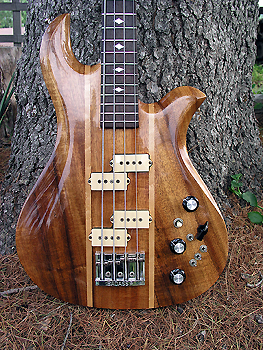
My very first decent guitar was an Electra Phoenix X150, a fantastic gem from the Matsumoku plant, with the best-sounding pickups I've ever heard, and a devilishly handsome faux-neck-through body. I always liked the way they combined the graceful Strat-style lower bout with the pointed (yet still offset) horns of the upper bout.
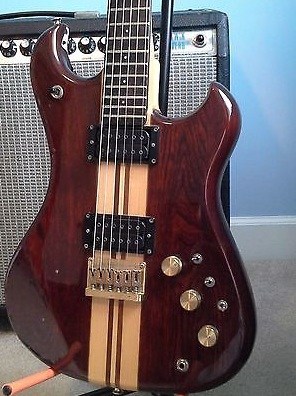
As I've said before, the great thing about building basses is the complete freedom to combine attributes of existing models into something that previously didn't exist. With that approach in mind, I decided to use the Phoenix silhouette with the bevels of the EB/SG, yielding something resembling the Eagle!
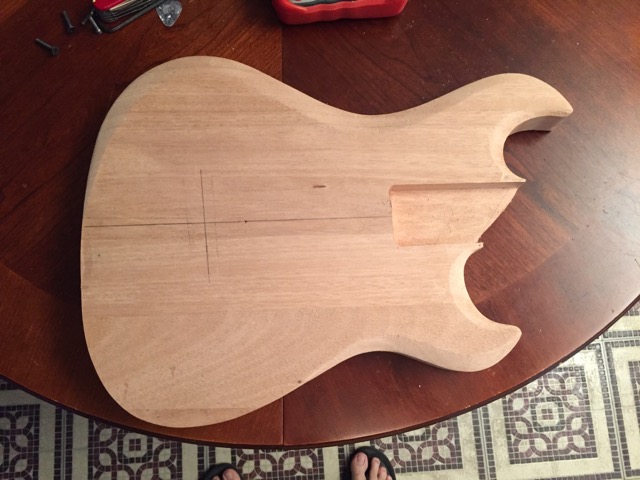
But what the hell kind of wood is this anyway?
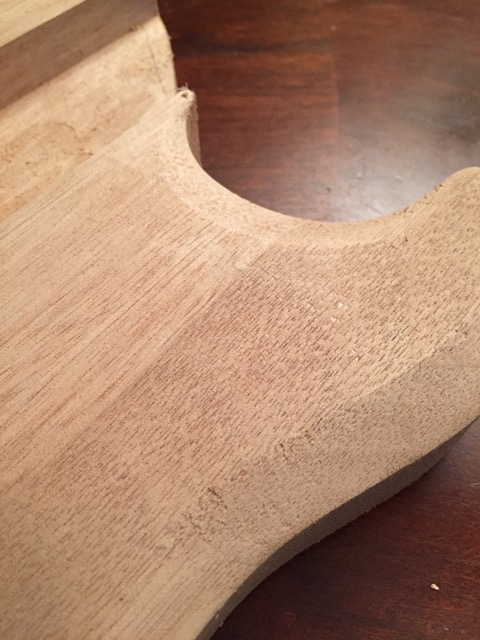
It's very lightweight (currently exactly 3 lb as pictured above), fairly open-pored, and rather stiff. It has a bright "tap tone", for those of you who believe in such things. My best guess so far is the much-maligned Paulownia, but I'm no expert...
Meanwhile....
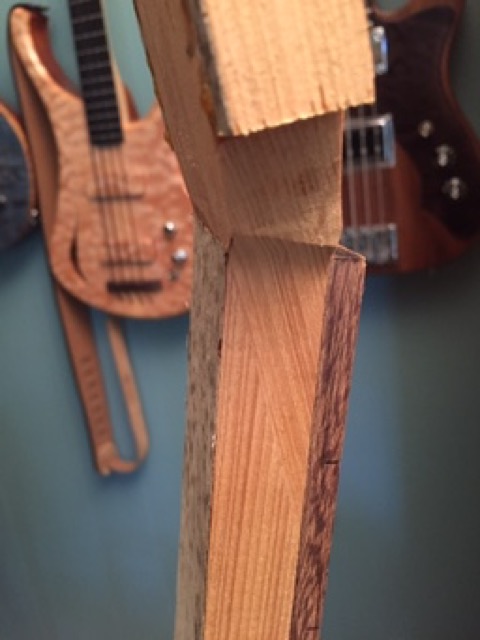
My wife's uncle refurbishes homes in the historic New Orleans Vieux Carre. He knows that I dabble in wood, so he brought me a board a couple years back. He told me that it was a baseboard from an old home they were doing, and handed it to me complete with a thick layer of vintage lead-based paint! I was able to work around the nail holes enough to extract a decent neck blank from it. It's beautifully straight-grained, with a velvety orange color and very fine closed grain. I think it's Cypress, but I'm not sure. I know that Cypress isn't a traditional neck wood, but I don't care, I'm going to build a neck out of it anyway. In fact, the neck is nearly done now, needing only shaping. The fingerboard is a Granadillo board from LMII, slotted to 32" scale. Here's a shot of the side, showing my scarf joint:
Pickups will be a pair of DiMarzio Model Ones, because I've always wanted to try them. The neck will have a long tenon, extending about an inch and a half past the 24th fret. Narrow string spacing, using a Hipshot .669 bridge.
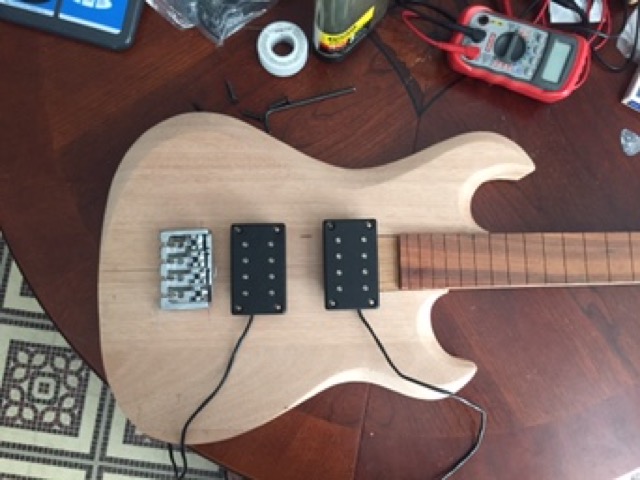
I think this body will need a decently hard finish, so I'm gonna try MinWax PolyShades in Bombay Mahogany on a test piece.
So how 'bout it, luthiers? What kind of woods do I have here, and who wants to take bets on whether this will wind up as a decent bass?
It all started when I bought a body blank on eBay advertised as mahogany. It's not mahogany. It's much too blonde and much too light in color to be mahogany. But it was cheap, and I am in need of some lightweight basses, so I stashed it away until the right opportunity presented itself.
Meanwhile....
I love Gibson shapes, and while the EB/SG shape is iconic and very rock-n-roll looking, something is just, well, off in its proportions. I think it has something to do with the relative sizes of the upper and lower bouts, and how the lower bout just isn't beefy enough...
But I love the ideals behind the design; namely, the thin, light body and the chiseled look of the bevels.
I'm also a big fan of several of the B.C. Rich body shapes, particularly the Eagle. I remember coming very close to snatching a Warmoth version back when they were available, but never did. Unlike many Rich models, the Eagle is graceful, elegant, and sexy!
My very first decent guitar was an Electra Phoenix X150, a fantastic gem from the Matsumoku plant, with the best-sounding pickups I've ever heard, and a devilishly handsome faux-neck-through body. I always liked the way they combined the graceful Strat-style lower bout with the pointed (yet still offset) horns of the upper bout.
As I've said before, the great thing about building basses is the complete freedom to combine attributes of existing models into something that previously didn't exist. With that approach in mind, I decided to use the Phoenix silhouette with the bevels of the EB/SG, yielding something resembling the Eagle!
But what the hell kind of wood is this anyway?
It's very lightweight (currently exactly 3 lb as pictured above), fairly open-pored, and rather stiff. It has a bright "tap tone", for those of you who believe in such things. My best guess so far is the much-maligned Paulownia, but I'm no expert...
Meanwhile....
My wife's uncle refurbishes homes in the historic New Orleans Vieux Carre. He knows that I dabble in wood, so he brought me a board a couple years back. He told me that it was a baseboard from an old home they were doing, and handed it to me complete with a thick layer of vintage lead-based paint! I was able to work around the nail holes enough to extract a decent neck blank from it. It's beautifully straight-grained, with a velvety orange color and very fine closed grain. I think it's Cypress, but I'm not sure. I know that Cypress isn't a traditional neck wood, but I don't care, I'm going to build a neck out of it anyway. In fact, the neck is nearly done now, needing only shaping. The fingerboard is a Granadillo board from LMII, slotted to 32" scale. Here's a shot of the side, showing my scarf joint:
Pickups will be a pair of DiMarzio Model Ones, because I've always wanted to try them. The neck will have a long tenon, extending about an inch and a half past the 24th fret. Narrow string spacing, using a Hipshot .669 bridge.
I think this body will need a decently hard finish, so I'm gonna try MinWax PolyShades in Bombay Mahogany on a test piece.
So how 'bout it, luthiers? What kind of woods do I have here, and who wants to take bets on whether this will wind up as a decent bass?