I just got a new set of Helicores and there are little round felt doo-hickies with them. What are they for? I am new to double bass so this may be a stupid question. Thanx, Vic.

Enjoy the benefits of a premium membership!
Upgrade Account
-
TalkBass has been independent since 1998. Add your voice.
Create a free account to reply to discussions, view embedded media, and browse with fewer display ads.
Join free Log in
Want zero display ads or expanded classifieds tools? Compare plans.
You are using an out of date browser. It may not display this or other websites correctly.
You should upgrade or use an alternative browser.
You should upgrade or use an alternative browser.
Double Bass Little round felt doo-hickies?
- Thread starter daddy-o496
- Start date
More options
Who Replied?
I'm NO Expert on this- as I've been a elec bassist since I was 9 in the 70's but started on an EUB 6 yrs ago & Recently grabbed an Acoustic uprite.
AFAIK the li'l felt 'rings' are for placing on the bottom end of yr string, between the 'ball-end' & the string retainer- thus giving the bass(& String retainer) a little bit of 'cushioning' between the metal ring/ball ends & the wood retainer.
That's what I gathered they were for anyway.
If they AIN'T for this purpose, I'd LOVE for someone more experienced to enlighten ME too!
AFAIK the li'l felt 'rings' are for placing on the bottom end of yr string, between the 'ball-end' & the string retainer- thus giving the bass(& String retainer) a little bit of 'cushioning' between the metal ring/ball ends & the wood retainer.
That's what I gathered they were for anyway.
If they AIN'T for this purpose, I'd LOVE for someone more experienced to enlighten ME too!

Yep. They go against the ball end of the string when you string em up. Some people use em, some don't.

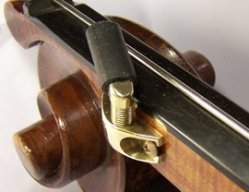
But what is the 1cm long clear plastic tubey thing that goes round the tail wrapping on a Spiro D?
- Aug 1, 2005
- 3,546
- 1,421
- Disclosures
- Private Inventor - Bass Capos
Yes, the felt washer is meant to protect the tailpiece from possibly being damaged by the metal ball end. I don't think they are really necessary, but I've always used them. I'm sure there are those out there who will claim some tonal benefit to using/not using them. I don't know.
Also, Spiro sets used to also include a rubber washer which could be placed on the bridge under the G-string to dampen it, which was very useful on my first bass. Do they still do that?
I've never seen that, but I bet it is meant to be placed on the silk over the G or A peg to reduce friction. Depending on the scroll, there can be a significant break angle over either of these tuners on the way to the D-peg, so I applaud Thomastik for thinking of this.
Also, Spiro sets used to also include a rubber washer which could be placed on the bridge under the G-string to dampen it, which was very useful on my first bass. Do they still do that?
But what is the 1cm long clear plastic tubey thing that goes round the tail wrapping on a Spiro D?
I've never seen that, but I bet it is meant to be placed on the silk over the G or A peg to reduce friction. Depending on the scroll, there can be a significant break angle over either of these tuners on the way to the D-peg, so I applaud Thomastik for thinking of this.

. . .
Also, Spiro sets used to also include a rubber washer which could be placed on the bridge under the G-string to dampen it, which was very useful on my first bass. Do they still do that?
I've never seen that, but I bet it is meant to be placed on the silk over the G or A peg to reduce friction. Depending on the scroll, there can be a significant break angle over either of these tuners on the way to the D-peg, so I applaud Thomastik for thinking of this.
This little tube - why only one and why on the d string?
Sorry, I can't agree with dampening (well maybe) or easing friction (break-over relief?). Typically the worst nut angles are the E (wont fit) and then the G (not that bad) and the D is the slightest angle.
So . . .

Maybe it is not about playing but installation - so one can easily visually tell the A-D-G apart while installing.
I know for sure the thing can buzz if not on the silk.

That's Pirastro, not T-I.Also, Spiro sets used to also include a rubber washer which could be placed on the bridge under the G-string to dampen it, which was very useful on my first bass. Do they still do that?
I'm not sure if they still include them with their metal G strings though...
Jake deVilliers
Commercial User
- May 24, 2006
- 6,349
- 607
- Disclosures
- Owner of The Bass Spa, String Repairman at Long & McQuade Vancouver
This little tube - why only one and why on the d string?
Sorry, I can't agree with dampening (well maybe) or easing friction (break-over relief?). Typically the worst nut angles are the E (wont fit) and then the G (not that bad) and the D is the slightest angle.
So . . .
Maybe it is not about playing but installation - so one can easily visually tell the A-D-G apart while installing.
I know for sure the thing can buzz if not on the silk.
The 'D' string is the only string that bears on another capstan in the pegbox. The string angle from the nut is pretty shallow by the time you get to the 'D' capstan, so the little sleeve provides a slippery buffer between the 'D' string and the next capstan down.
Yep. They go against the ball end of the string when you string em up. Some people use em, some don't.
Ahhh Glad I got that right!!

Cheers

I thought you were talking about the 'little felt doohickies' that I use as a really cheap way of protecting the edges of my bass when I set it down on rough surfaces. Yup, I'm using stick-on furniture pads, cut to size... Hey, it works and costs about $3.
I use the felt washers supplied with heli's to protect the wood on the bottom of my WAV bass where the strings wrap around. It's a weird design choice IMO, but hey it's a really cheap bass. I don't particularly love heli's on the WAV; I've got some obli's that will go on someday <didn't work out on the Juzek> and I plan on using the felt washers from the heli's.
I use the felt washers supplied with heli's to protect the wood on the bottom of my WAV bass where the strings wrap around. It's a weird design choice IMO, but hey it's a really cheap bass. I don't particularly love heli's on the WAV; I've got some obli's that will go on someday <didn't work out on the Juzek> and I plan on using the felt washers from the heli's.


