• TalkBass has been independent since 1998. Add your voice.
    Create a free account to reply to discussions, view embedded media, and browse with fewer display ads.
    Join freeLog in
    Want zero display ads or expanded classifieds tools? Compare plans.

Live Amplitube Rig (showing, not asking)

Blackaddr

Guest
Commercial User
Sep 2, 2013
29
11
Hamilton, Ontario
www.blackaddr.com
Disclosures
Blackaddr Audio
LONG MULTI-POST WARNING

This was a big project for me in terms of planning, and required a LOT of thought. I'll break down the whole story in multiple posts. Anyone interested in building a similar rig I'm sure would appreciate the extra detail.

However, check out the pics in the first post for ideas if you're not interested in the details.

OVERVIEW

I've followed DSP audio processing for a while, I'm an engineer by trade. Only with Amplitube 3 and cheap modern laptops did I recently feel the software was good enough to consider replacing my pedalboard.

So, I thought I'd show off the rig I'm using for live which is based around Forte/Amplitube. Might give people some ideas for their own, I spent a lot of time planning the rig design to meet my requirements. I've been playing with it for about 6 weeks now, but just added my rack tuner this week which was on back order.

Requirements:

1) Fits in a reasonable sized (4U) shallow depth rack enclosure.
2) As close as possible to 'plug in and start playing'. No mucking around with computer booting/clicking/crashing nonsense. It should *feel* like a hardware rig.
3) Backup plan. If the software crashes, computer won't boot, etc. I must have some kind of usable sound again within seconds, and with minimal effort.
4) bass amp in the rack as well to drive my on stage cabinet.
5) lightweight, lightweight, lightweight. I love gear. I hate slugging gear. I want the rack unit to be about the size of a case of beer and not weigh too much more than that. Final weight went over, probably a little over 40 lbs.
6) I don't mic bass cabs. I'm too impatient to get the sound right when setting up and the band expects me to double as sound guy. Since I'm using software, I want a balanced output going to the PA WITH cabinet simulation. I want another output going to my on stage amp WITHOUT cabinet simulation.
7) I also play guitar on the side, I want this rig to do both. In this scenario I don't use the bass cabinet, I just use a regular monitor on stage, no guitar cab. With software, the rig does both guitar and bass! Actually it's my keyboard rig too!

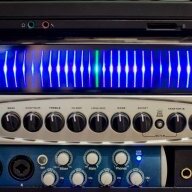
I've attached some pics of the setup. While it's not included in the photos, I place the unit on top of my Traynor TC210NEO cab which completes my on-stage setup. My singer throws a hissy fit when he feeds back and gives me the evil eye, "Why can't you make the equipment work?" So, my band tries to keep stage volume as quiet as possible and let the PA do the work. Therefore, my onstage power requirements are pretty moderate. The Traynor cab is 400W, and it's driven by an MB500 that puts 350W into one cab, or 500W into two.

Too keep information a little organized, I'll cover the design choices and details in the next post.
 

Attachments

  • 0_front_rs.jpg
    0_front_rs.jpg
    119.7 KB · Views: 992
  • 1_rear_rack_rs.jpg
    1_rear_rack_rs.jpg
    116.8 KB · Views: 882
  • 2_rear_light_rs.jpg
    2_rear_light_rs.jpg
    206.5 KB · Views: 792
  • 3_laptop_rs.jpg
    3_laptop_rs.jpg
    131.5 KB · Views: 1,130
  • 4_laptop_closed_rs.jpg
    4_laptop_closed_rs.jpg
    80.4 KB · Views: 678
Last edited:
CHOOSING THE RIGHT RACK ENCLOSURE

I wanted an enclosure that could fit the following:
- my laptop on a sliding shelf (1U)
- my MB500 with rack ears (1U)
- my audio interface, eventually an in-ear-monitor, misc stuff (like power bricks, etc). 1U fixed rack shelf.
- a rack tuner (1U).

So, that adds up to 4U. The laptop is the deepest component in the system, I determined I need a minimum of 12" depth for the laptop and plugs. I wanted a rack case with rugged front and rear mount caps and latches. Some cases (SKB) have a really nice front cap, and cheap plastic latches on the back cap. No good.

WINNER: Gator GR-4S. 12" deep rail to rail, 14.25" possible depth front rail to the inside of the back cap.
CONCLUSIONS: I like the case, it's more than rugged enough for gigs where you move your own gear. I wouldn't consider it a flight case, i.e. I wouldn't check it as baggage on a flight. But I don't tour so no problem there.

I bought it off amazon for $165 CAD.
 
Last edited:
REUSED COMPONENTS:

I was already using a Lenovo Thinkpad T500 as part of my software based rig. I originally carried it in a laptop bag. This stayed in the rack rig because it has dimensions that work nicely for a 1U space.

I already owned a Presonus 22VSL. I originally chose it because it's small, lightweight, and can be powered by USB. Very handy when you are NOT RACKED, and you manually cable up and tear down everything.

I already owned an MB500. This was my main amp. Before switching to a laptop, I use to run into my pedalboard (about the same footprint as the rack enclosure!) so I'm glad not to haul that anymore.

NEW COMPONENTS:

ART PB4X4, $53.50 CAD at Long & McQuade
I purchased a rack mount power bar with some basic filtering and surge protection. I'm an electrical engineer by trade, those 'power conditioning units" don't do much of anything beyond what a basic filtering unit does. Sorry.

KENDALL HOWARD K102-1148, 12" depth.
I need a 1U fixed rack shelf with lots of vent holes to make it easy to zip-tie things down. I would have loved an aluminum one, but couldn't find a shallow one for a good price. Steel is very, very, very heavy. Too bad.

SLIDING TRAY FOR LAPTOP (PENN ELCOM R1206 rack ears)
I came up bust here, I could not find a 12" depth sliding tray, let alone one that was light weight and at a good price. I had to fabricate my own. Not that tough. I bought universal 5" rack ears, picked up some drawer slides from the hardware store, picked up some 2" x 3" (L shaped) extruded aluminum from a metal supply store. Cut the L's down to 1.5" x 3", put a 1" wide piece of aluminum across them for support, painted it black, screwed it all together and called it good enough.

KORG PITCHBLACK PRO
This a new product, it was on back order for about 6 weeks. It's super light weight, affordably price (got mine for $95 CAD through a price match at Long & McQuade). I've only been using it for a few days, but my initial impression is tuning accuracy is better than my pedalboard's TU-3, and as good and probably better than the tuner build-into Amplitube. It does use a wall wart which is either pro or a con depending on your point of view. If the unit is super shallow because it has no build in transformer, this mean you can pick where the transform goes (as a wall wart). On the other hand, if you have the space for the unit to be deeper, I'm sure you would have preferred it was build in. I have mine plugged directly into my power bar, off to the side where there is space because the MB500 has vent spacing on each side.
 
Last edited:
ASSEMBLY

Figuring out the assembly BEFORE you start buying this is essential. It's like solving a 3D puzzle that's in your mind, not in front of you. I did my best and still nearly got burned.

Some things I had not considered cropped up immediately. I forgot to account for the space needed for the usb plugs on the side of the laptop. I could have just shoved the laptop off to the other side, but then it wasn't balanced well on the sliding tray, so I found a right-angled usb cable.

My 22VSL is advertised as 1/3U. I also have a 44VSL I use at home advertised at 1/2U. Ummm, no. the 44VSL is wider that half a rackand both of them are 2.0" tall. Since they can't be ear mounted, they have to go on a fixed shelf, and those don't have zero thickness. CHECK THE MANUFACTURES DIMENSIONS IN THE MANUL. Dont' rely on statements of 1/2U, etc.

I noticed that the rack enclosure has a about an 1/4" of extra space below the bottom slot, and above the top slot. This turned out to be critical. I modified the mounting holes on my KENDALL HOWARD shelf to let it mount 1/4" lower than it is supposed to in the slot. There is also some extra space below this as well inside the enclosure. I had to bend the shelf slightly down. This, plus the extra 1/4" allowed me to fit a 2" tall USB interface, on a fixed shelf, below the MB500 mounted in the slot above. BARELY. This nearly threw my whole plan out the window because it never occured to me the 22VSL would not be 1.75" (1U) tall. Even then, I was forgetting about the shelf thickness. I got lucky here, but it means the fixed shelf can only, ever go in the bottom slot.

I had similar problem with the laptop sliding shelf. The thickness of the shelf, plus the laptop was a little over 1.75" tall, so it can only go in the top slot where i've got that extra 1/4" of headroom.

The rack layout goes at the front:
laptop
tuner
amp
shelf with audio interface and accessories.

The rack power supply is about 6" deep, so it can live in the same space as the tuner, there is room for the tuner, tuner plugs in the back, power unit and power plugs.
 
Last edited:
OPERATION and BACKUP

The problem with using a software solution like a computer running Windows 7 is the inevitable crashes. There's a lot you can do to mitigate a crash in the first place, and you can stil have a backup plan if it does occur.

The laptop is dedicated to this purpose. For about $200 on craigslist, you an easily get a laptop powerful enough to run a nice rig in amplitube. It has windows installed, it is setup for optimized audio (I get excellent latency, no dropouts) and it has pretty much Forte and Amplitube installed and nothing else. It's set to load Forte on startup, which automatically loads the software side of my rig.

I used a cheap solid state drive (about $70 CAD). This means power on to sound is about 10 to 15 seconds tops. It also means the laptop is vibration resistant, it's not going to crash from the hardrive skipping.

With such a lean setup, I've probably booted it about 200 times so far, not a single crash or dropout.

But when that day does come, I HAVE A PLAN!

The 22VSL (and 44vSL) have a mix knob that allows you to blend the input channels with the software processed audio and send them out. Normally you have this set to 100% software. If the software crashes, the 22VSL can run standalone if you turn the knob to 100% input.

So, something does wrong, as long as the laptop still has power, the USB still has power, and I reach over, turn the knob to 100% INPUT and I've at least got a DI path still going to both the PA and my amp. I roll off the treble and I keep playing, turning a potential disaster into a hiccup.

The 44VSL is powered by a wall wart. So, with that unit, even if the laptop totally dies, the VSL will still have power and keep running.

If for some reason the laptop totally dies and can't simply reboot, at the next song or break, I can plug into the preamp on the MB500, and switch the PA feed to the Direct Out on the MB500. I keep the preamp configured for a sound I like, the amp has an overdrive channel. All I've really lost is the effects.
 
Last edited:
  • Like
Reactions: eukatheude
SOFTWARE CONFIG

The 22VSL is a 2 in, 2 out device. I only need one input for my guitar. I make use of the two outputs to solve the cabinet sim problem.

My signal path in amplitube is split into two after the effects chain. One channel (left) goes to my amp sim, and my cabinet sim. This channel goes to the PA. The second channel (right) goes to a duplicate of the amp (configured the same) but the cabinet is bypassed. This goes to the return on my MB500 (I only use the power amp), which drives my on stage cabinet.

Forte is an excellent VST host even for amplitube, though getting sound inputs working correctly took some fiddling with the ASIO settigns. While amplitube can store all the different settings for different songs I need as presets, Forte makes it stupid simple. Each setting can be customized and named each song and simply click 'next' on the laptop for the next song. Very nice.

IMMEDIATE IMPROVEMENTS

Okay, the first time I tried loading in at rehearsal I realized
- the laptop tray was sliding back and forth. The rubbers stops on the drawer slides can't keep it in place during transport. Solution was to attach some brackets to the rear rack and use a carabiner to lock it in place for transport. I then remove it and put it in the adjacent non-locking hole during use. You can see this in the photos in the first post. The carbiner is red, on the right side.

- second thing I realized is when trying to plug in my PA line, I couldn't see a damn thing in there. I added a battery powed led light on a goose neck. It's a reading light I had kicking around. Works great for doing anything in the dark and is easier than grabbing a flashlight from the gig bag.

FUTURE IMPROVEMENTS

Right now, when I load in, I hit the power on the rear supply, this powers my amp up because it's got a latching power button. I then slide out the laptop, and hit the power button. 15 seconds later, the software is totally ready to go.

I plan to add a midi foot controller so that I can change songs, and alter settings with the laptop closed, which means it really never slides out and opens up unless there is a problem. This would be nice because when the laptop is extended, you have to squat down to see the other gear (like the tuner). With a midi controller, under normal use no one will likely notice I'm using a laptop. However, that doesn't help turning the thing on in the first place. So, I'm going to open up the laptop and tie in another momentary switch that will be mounted on teh rack enclosure. This allows me to startup and shutdown the laptop without ever sliding it out or opening the lid.

I'd like the rear connections to be easier so I don't have to reach way in to plug in my PA line and cabinet. I'm going to install a 1U patch panel on the rear at the bottom for those connections. That way, I'm never sticking my hand inside to plug/unplug things. This would be a great place to mount the laptop power switch as well.

Might add a 1/2 rack in ear monitor system to the fixed shelf for super tight stages where I can't even fit my bass cab and will go 100% PA only.

CONCLUSION

Previously before I tried amplitube, I had a pedalboard where most of the pedals were all custom built by myself with custom graphics I did myself. I really don't want to damage them, and the the board was yet another piece of gear to carry.

I'm loving my software based, rack enclosed rig. Don't think I'll go back to 100% hardware.

One last issue is the midi foot controllers. The commercial ones suck (okay that's harsh, they don't meet the requirements of my ideal foot controller). Lots of midi control surfaces (lots of knobs faders, but no stomp switches you can smash during a gig.) The foot controllers have stomp switches and nothing else, no knobs.

Well screw that, I'll custom build by own midi foot contoller with stomp switches, rotary encoders, and a graphics display for song and effect selection and controller, once again, no need to ever open the laptop.

I think once that's complete I'll be as close to totally satisfied as I"m gonna get.
 
Last edited:
I think this is pretty interesting. I just made the switch to all software also. I'm using a Universal Audio Apollo Duo. It has built in DSP processing and I can run the plug-ins off of it. No latency. To the OP, do you think a tablet or a phone even could be substituted for the laptop?
 
To the OP, do you think a tablet or a phone even could be substituted for the laptop?

Absolutely! I know Amplitube has a stand alone iPad version. While I could run just amplitube, hosting it in Forte is SO nicer for live shows and rehearsals.

As for a tablet, in fact, what I've been doing at home when practicing is using my Android tablet to remote (WiFi) into the laptop via remote desktop software (Teamcenter). That way I don't have have the laptop out and open. I don't do this live though because I don't want to rely on network access, and more importantly, a tablet has "steal me" written all over it, or is likely to get broken at a gig.

I originally was going to use this as my primary method, because it's a perfectly viable solution. But aside from the cost of the laptop, there is a bit of an "image" issue that I need to be aware of in terms of the rest of the band and the audience.

By that, I mean I don't want to deal with other musicians in the audience prejudicing the band because I've got a laptop out or worse, a tablet running my sound. If it sounds good, and they can't see the man behind the curtain, then everything is just easier.
 
Nice job!
For midi you could take a look at the many low cost android tablets and use touchosc

http://hexler.net/software/touchosc-android
Clip it on a mic stand.

For a foot controller I like my McMillen 12-step, but I am thinking about a IK Blueboard
Less wires, laptops and tablets all have bluetooth. But ripping apart a bluetooth keyboard you could have many foot switches.

I looked a lot at tablet/phone based midi, but in the end, I decided against it for live stage use for the reasons in the above post (I don't want people seeing me mucking about with laptops, tablets or phones). I also don't want to rely on any wireless technology like WiFi, bluetooth, etc. I have no control over the RF noise in the environment and I don't want my rig to go flaky just because I'm near some noisy lighting. So I'm going to try to stay fully wired.

I could get by with just a midi foot controller with just stomp switches. Since everything is preloaded in the laptop, I really just tap the "next song" button in Forte. But, I'd still like a little bit of tweaking during a sound check, and again after warm bodies show up. At the moment I've doing everything on the laptop itself, but I want to be able to reach down and tweak settings on the midi foot controller with knobs. I really don't know why manufacturers aren't putting knobs on their MFCs. I can't believe there's no market for it.

Since I can't find exactly what I want, I'm just gonna build it. I'm a little OCD with attention to detail, so I know that if I bought a foot controller I'd end up building a custom one eventually anyway.

The important thing is to try to figure out what you'll be happy with, and try not to spend too much money getting there. Everyone has different needs, and different budgets.

I'm glad to see interest in software based live rigs! I hope everybody's got their own idea brewing. I'd love to see some threads of your own rigs.
 
Last edited:
Nice, but if I were you I'd throw amplitube away and use TH2. Not a lot of experience with either, but TH2 seemed way more flexible.

I've never used TH2, though I suspect sims are much like guitars. It's all personal preference and taste because they're all generally great products. It depends highly on what you need, and if the sim gets the sounds you want. All of them support MIDI control, and I prefer to use a dedicated VST host (like Forte) which makes it completely moot how the sim itself handles presets, etc. You can even run different amp sims simultaneously if you used a dedicated VST host.

I believe the key to a gig-able VST based rig is getting as close as possible to having the same physical interaction you would with a fully hardware based rig, and get the reliability needed for live use. Any amp sim or VST host should work just fine on the software side.
 
I've never used TH2, though I suspect sims are much like guitars. It's all personal preference and taste because they're all generally great products. It depends highly on what you need, and if the sim gets the sounds you want. All of them support MIDI control, and I prefer to use a dedicated VST host (like Forte) which makes it completely moot how the sim itself handles presets, etc. You can even run different amp sims simultaneously if you used a dedicated VST host.

I believe the key to a gig-able VST based rig is getting as close as possible to having the same physical interaction you would with a fully hardware based rig, and get the reliability needed for live use. Any amp sim or VST host should work just fine on the software side.

I agree; I suggest however checking it out nonetheless as it has lots of interesting features, like crating sidechains with all sorts of crossovers etc.
Me, I'd like to explore the hardware side first!
 
I was very intrigued by going the laptop/digi i/o software simulator route a few years ago. Unfortunately, I found it to be more trouble than it was worth and had difficulty gigging it with any confidence. Subsequently I went the hardware route (Fractal Audio AxeFx for serious stuff, ZOOM B-3 for grab and go simple gigs) and have not looked back. I do appreciate a good rack rig though, and I'm sure that recent developments in computer technology and plug-ins have made the process a bit less head scratching. But even so, the old school player in me still finds comfort in the simplicity and road-worthiness of dedicated hardware, provided it sounds good. I dunno...maybe some day I'll revisit...I packed it in after Guitar Rig 4. The AxeFx II is so flexible and comprehensive that makes it awful hard to want to go back. Perhaps if someone came up with a laptop with hi quality digital I/O already installed, and tweaked for high performance low latency, with software packages already pre-loaded, for under $2000 US, I'd take a serious look. I'd need the laptop/software solution to be simple, intuitive, roadworthy, bug free, and sonically excellent. Hardware racks/pedals usually already have this licked from the start.
 
I can understand your disappointment with software sims. I had the same experience about 5 years ago. It's only with amplitube 3 and guitar rig 5 and it's comparable competitors that the simulation has gotten good enough that it meets my requirements for algorithm quality in live work. Its also only recently (past couple years) you could by the processing power in a used laptop that could handle processing a decent sized effects and amp chain. The only hardware DSP solutions that meet my requirements are the AxeFx and it's comparable brethern, but suffice it to say that nothing really under $2000 will do it for me there. But, a $200 laptop, and a couple hundred dollars of software is way better than what you get in a hardware DSP for $500 and less.

Now that laptop/PC based effects are of real usable quality, the issue is assembling a system that has the reliability and physical interface required for live work. That's what I've tried to address in opening up this thread, not so much the specific software, but the challenges and solutions of building a reliable, rackable software based solution itself.
 
  • Like
Reactions: jimfist
I use it live. No problems.

The keyboard players piano cut out. No output, but midi was working.
Plug it in and Kontakt saved the gig, and it was a much better sounding piano.

Many things have a "computer" or two inside. Turn off updating on a regular computer and it's very reliable. If it's a laptop you never have to open the lid if you have a midi knob box. Amplitube is great, but it's a snap to any plugin you'd ever want. And it moves to a new computer if you ever update.
 
I'll have to give this another shot some day. I'd expect the improvements made to hardware and software these days make it easier to implement. It's just a matter of the desire to move off of hardware that I'm very happy with, to a laptop based live rig that, in practice, won't represent anything I feel will necessarily provide more or better than what I've got. This is not to say there are not benefits - I've no fear of digital/software solutions, and appreciate/use music software - but just that at the moment am not doing any gigs that necessarily warrant anything more than my B3 stomp, or my 2 space AxeFx and FCB1010 MIDI board.

This is an interesting thread, though, and I'm pleased to see more and more bassists using non-traditional digital and/or software based live rigs. I've always been a fan of exploring the path less traveled.
 
Motivation is the key here, why bother if you don't need to and are already happy?

Here was my process (I'm complainer by the way)

- I'm sick of hauling my cabinet, amp, guitar, and bulky pedal board as individual items, and making so many trips to the car. My pedal board is populated with custom 1-offs that I personally made and did the graphics on. They have extreme sentimental value to me and I'd hate to see them lost/stolen/damaged, so I ditch the pedalboard and replace it with a laptop and audio interface.

- now I'm REALLY sick of how many cables I have to deal with, and especially figuring out where to put the laptop where it won't get knocked over or damaged or beer'd on.

- find a way to get it into a rack so I plug in my guitar, plug in my line to the PA, plug in my speaker cab, maybe plug in a midi controller, and I'm done, and my gear's all protected.

- now I'm happy!