That one is outside my area of expertise. Maybe try using a stapler?Would love to try those, but it’s a headless bass and I was told round core strings wouldn’t hold


TalkBass has been independent since 1998. Add your voice.
Create a free account to reply to discussions, view embedded media, and browse with fewer display ads.
Join free Log in
Want zero display ads or expanded classifieds tools? Compare plans.
That one is outside my area of expertise. Maybe try using a stapler?Would love to try those, but it’s a headless bass and I was told round core strings wouldn’t hold
I haven’t had a chance to play with the tension calculator, and I will, but that’s what’s keeping me from making my own set. There are so many variables I am unaware of (tension balance vs output balance vs feel, etc.) I assume the string companies have made the experiences and sell what they believe makes most sense. I guess I could always contact them.You’ve already gotten the suggestions I’d have made and then some, but in answer to this specific question, widening intervals between strings as they increase in diameter makes sense (to a point). If you play around with the Stringjoy tension calculator someone helpfully provided above, you’ll see that sets with an even .020 between them tend to have uneven tension from string to string, enough that it can feel awkward. It can take a surprisingly thick string on the low end to even out tension between strings, especially if you go down to B0 or lower.
That said, you can obsess over crafting the most perfectly balanced set in terms of tension only to find that it becomes imbalanced in terms of output, or that the biggest string just feels too stiff. It even says in fine print near the bottom of the page containing Stringjoy’s tension calculator that you might want to go a bit lighter on the low end for these reasons. I do like balanced tension and feel, but I like balanced output and sound quality more.

I'm a former "balanced tension enthusiast" who used to live and die by the tension figures. What I've learned over the years, though, is "balanced tension" doesn't necessarily guarantee "balanced tone", and conversely, a set of strings don't necessarily have to be balanced in tension to be balanced in tone or in playing feel. That's why I try not to be too hung up on the numbers these days.I haven’t had a chance to play with the tension calculator, and I will, but that’s what’s keeping me from making my own set. There are so many variables I am unaware of (tension balance vs output balance vs feel, etc.) I assume the string companies have made the experiences and sell what they believe makes most sense. I guess I could always contact them.

They have to consider what will sell well enough to justify manufacturing and packaging at scale, so while I presume most manufacturers have the knowledge to put together a good light gauge 6-string set, they don’t have the incentive to do so. As you suggest, I bet at least some of the manufacturers known to have good customer service would happily help you put together a good set for your purposes from their singles, but it would likely cost a little to a lot more than a comparable packaged set.I haven’t had a chance to play with the tension calculator, and I will, but that’s what’s keeping me from making my own set. There are so many variables I am unaware of (tension balance vs output balance vs feel, etc.) I assume the string companies have made the experiences and sell what they believe makes most sense. I guess I could always contact them.
 —it has been worth it. For the record, I used short scale GHS Bass Boomers for the .120 and .095, and Guitar Boomers for the .074, .054, .042, and .030.
One other part of this worth addressing: the string diameter doesn’t tell the whole story. You could try a fairly standard .130 B-string from every manufacturer on the same bass (@michael_t probably hasIs there a reason you’re using such light strings for C-E, but a 125 B? I’m relatively new to the B string and the gauges seem all over the place (118, 120, 125 and 130; I think I’ve even seen sets with 130+). Thanks!
) and find they feel and behave quite differently due to construction materials and techniques.
They have to consider what will sell well enough to justify manufacturing and packaging at scale, so while I presume most manufacturers have the knowledge to put together a good light gauge 6-string set, they don’t have the incentive to do so. As you suggest, I bet at least some of the manufacturers known to have good customer service would happily help you put together a good set for your purposes from their singles, but it would likely cost a little to a lot more than a comparable packaged set.
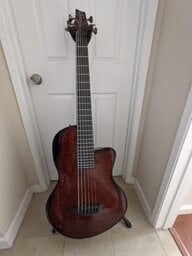
In my experience—most notably putting together a set of strings for B0–B2 on this 30”–28.5” 6-string bass
View attachment 7147971
You might want to try something like this:
View attachment 7147973
… though if Stringjoy still does custom bass sets, they’ve recently made them impossible for me to find on their website

Just e-mail them. They should be able to hook you up.The custom section on the Stringjoy Website doesn't include bass Stringjoy Custom Guitar Strings | The Original Custom String Sets
WHY ON EARTH would they take that off the website?! That was literally what brought them to my attention. Yes, I’m sure it’s a money thing, but taking away the very thing that got people’s attention and set Stringjoy apart seems like a bad move long term. They had already reduced their custom offerings, dropping a lot of those “in-between” gauges that would be perfect for @Just Wrong ’s situation.Just e-mail them. They should be able to hook you up.

The OP is in Canada (I think...). The same set is listed for $35.50 CAD on amazon.ca.Amazon usually has the SIT Foundations light six string (30 40 60 80 100 120) set for about 20 bucks...
Yep, I’m in CanadaThe OP is in Canada (I think...). The same set is listed for $35.50 CAD on amazon.ca.
SIT Strings Foundations Nickel Bass Guitar Strings (S.I.T.), 6-String Bass Custom Light 30-120, FN630120L : Amazon.ca: Musical Instruments, Stage & Studio
SIT Strings Foundations Nickel Bass Guitar Strings (S.I.T.), 6-String Bass Custom Light 30-120, FN630120L : Amazon.ca: Musical Instruments, Stage & Studiowww.amazon.ca

I definitely find nickel strings to be warmer sounding, easier on my hands too for some reason. there’s something I don’t like in the midrange of every stainless steel string I’ve tried lately, I put them on and then a few days later end up taking them off again.So I restrung my bass this morning with my last set of La Bella RX-N6A, and they’re much brighter than I would like. I guess my previous set was quite old (they’d been on for about 6 months).
Are nickel strings warmer sounding than nickel plated strings? I was going to try the SIT Power Wounds a try, but now I’m wondering if I should be looking elsewhere…
Keep in mind most "nickel strings" are nickel-plated steel. And there are different degrees of brightness within the "nickel-plated steel rounds". I would rate the SIT Power Wound Nickel to be somewhere in the middle of the brightness scale for "nickel strings". Not overly zingy but not quite as dark and grindy as, lets say, GHS Boomers. They're plenty warm when broken in without losing clarity and definition.Are nickel strings warmer sounding than nickel plated strings? I was going to try the SIT Power Wounds a try, but now I’m wondering if I should be looking elsewhere…
Keep in mind most "nickel strings" are nickel-plated steel. And there are different degrees of brightness within the "nickel-plated steel rounds". I would rate the SIT Power Wound Nickel to be somewhere in the middle of the brightness scale for "nickel strings". Not overly zingy but not quite as dark and grindy as, lets say, GHS Boomers. They're plenty warm when broken in without losing clarity and definition.
Pure nickel rounds tend to be warmer but there aren't very many of them around.

Naturally, tastes differ, but that kind of set, for me, seems like it's going in precisely the wrong direction. The maker may not be "on to something" so much as having a case of inertia from what they're used to making. Besides, there are plenty of sets that don't go that way, like the Smith set above, and they might be "on to something" too. Smith was actually the first set I ever played that used "in-between" gauges (ie, not ending on 5 or 0), and they immediately felt better to me than the "usual suspects."There seems to be quite a few six-string sets with 45 G, 65 D, 80 A and 100 E (as opposed to 40 G and 60 D). Maybe they're onto something, and I should look into that...