
Enjoy the benefits of a premium membership!
Upgrade Account
-
TalkBass has been independent since 1998. Add your voice.
Create a free account to reply to discussions, view embedded media, and browse with fewer display ads.
Join free Log in
Want zero display ads or expanded classifieds tools? Compare plans.
You are using an out of date browser. It may not display this or other websites correctly.
You should upgrade or use an alternative browser.
You should upgrade or use an alternative browser.
Double Bass Lowering the action of a dB.
- Thread starter EAME
- Start date
More options
Who Replied?
Start at the bridge. The fingerboard stats as it is unless you get rattling spots, then the fingerboard needs to be planed (more a task for a luthier if you are unsure how to do that).
There is nothing to do at the tailpiece. If you still have a solid wire it would be a good idea to replace this with an aircraft cable and a clamp.
There is nothing to do at the tailpiece. If you still have a solid wire it would be a good idea to replace this with an aircraft cable and a clamp.


Might want to make sure the nut is slotted for optimal string clearance from the fingerboard before starting to mess with the bridge.

This. A high nut is a pain.Might want to make sure the nut is slotted for optimal string clearance from the fingerboard before starting to mess with the bridge.

And while I am NO expert, I have heard over the years that many players go back to a
higher ( but sane ) action because they can't get the sound that they want with low action.
Not to mention the chance for possibly more fingerboard buzzing with a too-low action.
higher ( but sane ) action because they can't get the sound that they want with low action.
Not to mention the chance for possibly more fingerboard buzzing with a too-low action.
Does this make sense and if so,what does it mean
: If you measure from the middle of the bar to the mid-point of the bass and double the measurement, you now know the proper measurement of the bridge's feet when measured from center to
center.
Middle of the bar to mid point of the bass??
How’s that done?
Sorry ,but I don’t get it!?
Cheers
: If you measure from the middle of the bar to the mid-point of the bass and double the measurement, you now know the proper measurement of the bridge's feet when measured from center to
center.
Middle of the bar to mid point of the bass??
How’s that done?
Sorry ,but I don’t get it!?
Cheers

Well it has nothing to do with the height of the bridge, but the width of the bridge, which can only be changed by getting a new bridge. The bass bar is the longitudinal reinforcement bar under the E-side of the front of the bass. Basically, if you don't have an adjustable bridge, you have to file down the slots for the strings to get lower height. Afterwards you can file/sand down the top of the bridge, to avoid having too deep slots.Does this make sense and if so,what does it mean
: If you measure from the middle of the bar to the mid-point of the bass and double the measurement, you now know the proper measurement of the bridge's feet when measured from center to
center.
Middle of the bar to mid point of the bass??
How’s that done?
Sorry ,but I don’t get it!?
Cheers
Last edited:

Greg Clinkingbeard
Commercial User
In my experience, it starts with the fingerboard. There's a limit to how low the string height at the bridge can be if there is too much scoop in the board, or if it isn't perfectly consistent. I can set the heights as low as 3mm -6mm G-D if I do the fingerboard. That's lower than I like, but........

Greg Clinkingbeard
Commercial User
All three aspects have to be evaluated. If one is off it will be hard to get the action you want. After evaluation I think, neck, nut bridge makes the most sense.
Height at he nut is possibly the most overlooked aspect of playability. Most players spend most of their time in the lower positions, because that's where the money is.
Assuming the fingerboard is good, I like the strings almost laying on the board. Certainly no more than a business card of space. Often, the neck is bowed making it difficult to get things right due to instability.
Thank you,but I’m still not getting what he is saying .
Yes of course I know what the bar is and it’s placement,but:
1:How is he measuring it?
In position,or out of the bass?
2:From the middle of the bar,to the mid point of the bass:
How is that carried out ?
What does it mean?
Yes of course I know what the bar is and it’s placement,but:
1:How is he measuring it?
In position,or out of the bass?
2:From the middle of the bar,to the mid point of the bass:
How is that carried out ?
What does it mean?
But the adjustable bridges seem to be the same hight fully wound down as the original bridge,so I need to cut the adjustable one down,like out of the middle of it then?If your nut and fingerboard are where they should be, then all you should need is a bridge adjustment. Many bridges have screw adjusters built in to allow you to raise or lower your string height on the fly.
Greg Clinkingbeard
Commercial User
But the adjustable bridges seem to be the same hight fully wound down as the original bridge,so I need to cut the adjustable one down,like out of the middle of it then?
I mean no disrespect, but why don't you take your bass to a pro? It's a bit like someone nothing but a pair of pliers asking a mechanic how to do a timing belt. At least with car repair, there are YouTube videos to help. We're not there yet, thankfully.
All aspects of setting up a double bass require the proper tools and bench time, gaining the experience to make the right decisions. You might fit your first bridge with a jigsaw, belt sander and chainsaw file, but I would be surprised.
Assuming your bridge is OK, how's your fingerboard? Did you properly set your soundpost first? That can change your string heights.
I worked on my own basses long before I got proper training. Looking back on the mistakes I made is embarrassing.
In my experience, most customers who want their string heights lowered have other issues which must be addressed first. Most luthiers will evaluate your bass and give an estimate achieving your desired result.
Edit: You might want to read the newbie links above.
Last edited:
Yes of course I should take it to a pro, but as I’ve repaired it myself from a broken neck,then I may as well continue trying to fix the string height,besides I haven’t the money to pay for such professional help at the moment and it’s very expensive at least here in the UK!
My mistakes were embarrassing on the repair at first but with help from the good people here,I managed a good repair,on my own that has restored playability to what it was beforehand,and it is ‘only a cheap model probably unworthy of a Luthier’s attention,so I will have to do it with a sander carefully by degrees I think
My mistakes were embarrassing on the repair at first but with help from the good people here,I managed a good repair,on my own that has restored playability to what it was beforehand,and it is ‘only a cheap model probably unworthy of a Luthier’s attention,so I will have to do it with a sander carefully by degrees I think
That's OK. Just go down in small steps, if the curvature is good all strings by the same amount.
The lower you go at the bridge, the more you can hear uneven spots on the fingerboard. So, if you don't have adjusters, stop lowering the action when it feels playable. If you have adjusters you can go a little bit lower and turn up the adjusters if the sound suffers, the strings are hard to grab or you get problems with the fingerboard.
I think it would be a good idea to do 1/2 mm steps and play for a week before you get lower. With adjusters you can do 1 mm steps.
The lower you go at the bridge, the more you can hear uneven spots on the fingerboard. So, if you don't have adjusters, stop lowering the action when it feels playable. If you have adjusters you can go a little bit lower and turn up the adjusters if the sound suffers, the strings are hard to grab or you get problems with the fingerboard.
I think it would be a good idea to do 1/2 mm steps and play for a week before you get lower. With adjusters you can do 1 mm steps.
Well,I finally got this done,just a whisker now off the G string but will leave it and play it in for a while to see how much the grooves in the bridge will sink in..That's OK. Just go down in small steps, if the curvature is good all strings by the same amount.
The lower you go at the bridge, the more you can hear uneven spots on the fingerboard. So, if you don't have adjusters, stop lowering the action when it feels playable. If you have adjusters you can go a little bit lower and turn up the adjusters if the sound suffers, the strings are hard to grab or you get problems with the fingerboard.
I think it would be a good idea to do 1/2 mm steps and play for a week before you get lower. With adjusters you can do 1 mm steps.
Basically if anyone’s interested,if you do this by lowering to the same contour in small steps (I did it in 3,removing a good inch half of original bridge) you will be good...A small jigsaw and a sander is all ( a bridge blank spare should it go badly!)and a bit of patience
 I should of done before n after,but let’s just say it was so far off the fingerboard and very hard to play in the end positions....I’ll see how much volume has changed over the weekend and get a feel of the ‘new’ bass and fingerboard ...Saved a fortune and knowing you can do it in a cash strapped emergency is a relief and ensures you can get plenty of practice setting up your strings and bridge as a bonus!
Thanks all for giving me the confidence to try in the first place,ok,have a pleasant weekends with your basses as much as I will,ok!
Yes I’ve managed to keep this with good clearance now.Might want to make sure the nut is slotted for optimal string clearance from the fingerboard before starting to mess with the bridge.
I just had my luthier lower the bridge height on my Upton Standard. He loosened each string individually and filed down the string notches 1 mm each. Then we replaced the strings, tuned it up, checked the action, and repeated as necessary until it felt right (minus 2.5 mm). Then he removed the bridge and sanded off the excess with a power sander. Seems like a good way to avoid taking too much off.Well,I finally got this done,just a whisker now off the G string but will leave it and play it in for a while to see how much the grooves in the bridge will sink in..
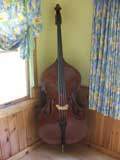
Basically if anyone’s interested,if you do this by lowering to the same contour in small steps (I did it in 3,removing a good inch half of original bridge) you will be good...A small jigsaw and a sander is all ( a bridge blank spare should it go badly!)and a bit of patience View attachment 2795001 I should of done before n after,but let’s just say it was so far off the fingerboard and very hard to play in the end positions....I’ll see how much volume has changed over the weekend and get a feel of the ‘new’ bass and fingerboard ...Saved a fortune and knowing you can do it in a cash strapped emergency is a relief and ensures you can get plenty of practice setting up your strings and bridge as a bonus!
Thanks all for giving me the confidence to try in the first place,ok,have a pleasant weekends with your basses as much as I will,ok!View attachment 2795002View attachment 2795001


