• TalkBass has been independent since 1998. Add your voice.
    Create a free account to reply to discussions, view embedded media, and browse with fewer display ads.
    Join freeLog in
    Want zero display ads or expanded classifieds tools? Compare plans.

Luthier to Convert a Long Scale Bass Into Medium Scale?

It's not absolutely insane at all. Replacing the neck in a neck-thru bass is a complicated and moderately expensive job, but many of us Luthiers do this fairly often. I wouldn't say it's routine, but it's a job we do when needed. Replacing it with a neck of a different scale length isn't much extra complexity. The new neck would be laid out to work with the existing bridge and pickup positions. Changing to 32" scale, the new neck would probably end up at 24 frets, rather than 26.

And yes, we can get the right woods and build a replacement neck that's equal in feel and quality to the original Warwick neck.

Super rough guess on what it would cost? Are we talking $500, $1k, $2k? It sounds like a pretty complex job and a lot of work.
 
  • Like
Reactions: St_G
Any Luthier who takes this on for less than $2000 isn't trying to make a profit. In many parts of the US they'd lose money at $2k. This is a new neck build, with all of the associated materials, which is damn near the same amount of work as building a bass from scratch on a neck-through. The only labor they'd save is having to shape the body. Then again trying to glue curvy carved Warwick body wings and clamp them might take more time than making new ones anyway.

If a luthier quoted $1000 for this I would run...fast. They'd have to be either an amateur doing it for fun or won't be in business long.
 
  • Like
Reactions: n1as and St_G
Just play the NT. Even Tina Weymouth had no issue playing a 34 inch scale bass.
The real issue here is that the Thumb has horrible balance issues and takes a super long left arm reach. It makes it unbearable for a lot of people.
Converting it to 32" would make the issue easier to work with.
Of course there's always buying a bass with proper balance in the first place but where would the fun be?
 
Super rough guess on what it would cost? Are we talking $500, $1k, $2k? It sounds like a pretty complex job and a lot of work.

I was over in Keith's shop a half hour ago and I told him about this thread. He's not interested in the job, because he's just too busy with other things, but he guessed the job at about $1600. That's assuming that the customer wanted to really closely match Warwick's details and woods. That's higher than my quick estimate, but then, I'm pretty efficient at making custom necks. That's what I do here. I could probably do the job for about $1000, and make reasonable money at it. But I'm not offering to do it, because I'm too busy too.

If you are thinking, well, how much would a complete custom 32" scale neck-through bass, closely resembling a Warwick Thumb be, it would be around $2800 to $3000. That's buying it directly from small custom builders like us. A fancy custom finish could add another $500. So why does a Warwick cost you $4000 or $5000? They build parts and buy materials in larger quantities, so their production cost per instrument is lower, probably in the range of $2000 to $2500. But, the rest of that cost is for distribution, advertising, and dealer markup. We small builders have almost none of that cost.
 
  • Like
Reactions: Kubicki Fan
Can someone recommend a luthier who would be able (and willing) to convert a Warwick Thumb NT4 from a 34-inch long scale to a 32-inch medium scale?

I've checked with Warwick and their dealers: a new, custom-made, medium scale, 32-inch Thumb NT4 costs way, way too much!
By the time the the dust settles, you will for intents and purposes be creating a custom made bass with a cost to match. JMO. I like the capo suggestion, just make sure the capo is really tights as for the position markers, a little paint (removable of course) will solve that issue.
 
Can someone recommend a luthier who would be able (and willing) to convert a Warwick Thumb NT4 from a 34-inch long scale to a 32-inch medium scale?

But why? I've read your reasons but they just don't make sense to me. It's just a bass. Sure the Warwick may be nice but at the end of the day it is just a bass. Be somewhat flexible. You can probably play any number of non Warwick basses and be happy.

If you want a Warwick, play what you have. If you want a 32" bass, get a different one. I echo the Warmoth recommendation. If you must have the 32" Warwick despite the insanity of making it happen, go the capo route and have a luthier shift your fret markers accordingly. Be prepared to take a big hit in value making the true cost of the conversion much higher.

And by all means, be wise and try the capo thing first to ensure that you like the sound you'll be getting.
 
Any Luthier who takes this on for less than $2000 isn't trying to make a profit. In many parts of the US they'd lose money at $2k. This is a new neck build, with all of the associated materials, which is damn near the same amount of work as building a bass from scratch on a neck-through. The only labor they'd save is having to shape the body. Then again trying to glue curvy carved Warwick body wings and clamp them might take more time than making new ones anyway.

If a luthier quoted $1000 for this I would run...fast. They'd have to be either an amateur doing it for fun or won't be in business long.

No, that's wrong. I'm a pro Luthier who's been at it for many years. I could do this conversion job for around $1000 or so and make a reasonable wage at it. I'm not wildly guessing in the air. I've replaced the necks in neck-thru basses probably 20 times over the years, and I remember doing at least one Warwick. I've built about 1200 custom instrument necks of all sizes and shapes, including many scale conversion necks.

Building a replacement neck, and installing it into an existing neck-thru instrument ends up being about 1/3 the cost of buying that same instrument new. A replacement neck for a bolt-on bass is about 1/4 the cost of the whole instrument. That doesn't seem to make sense until you realize that about half the cost of a new instrument is for the distribution, advertising, and dealer markups. The other half is for the wood, metal, and shop labor to build it. A small custom shop doing a repair/conversion job isn't charging you for distribution, advertising, and dealer markup.
 
Spoke to my local luthier today and, thanks to the many fine suggestions of this group, we're going to try a zero fret at the current first fret position. If that works and is stable, we're done. If and when I want to sell the bass, it will be an easily reversible modification.

If we find that the strings shift around too much on the zero fret, we'll consider placing a nut there. That will also be relatively easy to reverse.

He wants to also be sure that the string break angle over the new zero fret (or nut) will work. If not, he has a few non-destructive ideas about what we can try.

About fret markers: the Thumb NT4 has no top-of-fretboard markers - it only has side markers. It looks to be real simple to cover the current markers and add some temporary ones at the new correct positions.

Thanks to you, we have what could be a very simple and elegant solution!

-----

For me, the Thumb NT4 has absolutely perfect balance, and it's left arm reach makes me smile a lot - like with a "wow - that's great!" a few times each gig. With these minimal 32-inch mods, none of that will change.

I'm expecting its voice to remain unchanged too, other than what the new string gauges will bring.

-----

I have to thank you all for responding to my original post. One thing that's clear is that we have lots of helpful folks here, with lots of great know-how.

We're also very diverse in what we want/expect from our basses.

Some here love their bolt-on Warmoth basses. For me, I play my bolt-on basses only once in a while - I just enjoy the sleek Thumb neckthough so much.

Some folks love their short scale basses. For me, short scales are fun once in a while (I have two of 'em), and my long scale Fenders and the Rick are great (once in a while), but mediums are the most comfortable and fun for me. (For the record and for Bruce: I remember the now-long-gone 35-inch Ampeg Devil Bass and AEB-1 as being great fun too!)

Some folks suggested I simply live with a 34-inch scale bass. Well, if I can improve my bass so that I enjoy playing it even more, that's what I'm gonna do. I really don't get the "live with it" attitude.

I'll post some photos after the mods.
 
Last edited:
check out post #8 on this thread and his thoughts about having the nut slots cut so low that they serve as a string guide...

Is it possible to add a "zero fret" to a bass

esp.: "...the string slots are each cut to a depth so that the strings do not rest on the bottom of the slots - this provides maximum downward string pressure where it should be ... on the zero fret"
 
  • Like
Reactions: LenMinNJ
I'll post some photos after the mods.

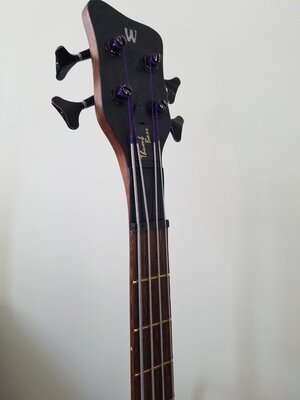
The conversion of my Warwick Thumb NT4 to 32-inch scale is 95% complete.

Ian Davlin, the incredible luthier at Lark Street Music in Teaneck NJ, removed the first fret, removed the fretboard between the nut and the first fret, and relocated the nut to the first fret position. He covered the neck where the nut and fretboard were with a finish that well-matches the front of the headstock.

Voila - a Warwick Thumb NT4 with a 32-inch scale!

It plays very nicely, and now I can comfortably do the stretches at the low frets. And the reach to the nut is a bit shorter (though I didn't mind the original reach).

I'll play it for a few weeks, and if I like it, I'll ask Ian to move the fretboard side marker dots. In the meantime I'm using stick-on dots.

If and when I decide to sell it, it's going to be very easy to convert it back.
32-inch-scale-conversion1.jpg

32-inch-scale-conversion2.jpg
 
Last edited:
Ian (the incredibly talented luthier at Lark Street Music) virtually erased the original long scale fretboard side dot markers.

Instead, what you see in these photos are white pearloid stick-on dot markers at the third and fifth frets of the new medium-scale fretboard. The stick-ons were bought on eBay from a fellow in China. They look very real, and feel just fine to me.

The old markers were at what are now the second and fourth frets. They're now gone (really gone!), along with all the rest of the original dot markers!

This long-scale to medium-scale conversion made my 2000 Warwick Thumb NT4 into my favorite bass.

Total cost of the conversion was under $250.
 

Attachments

  • 32-inch-scale-conversion-fret-markers1.jpg
    32-inch-scale-conversion-fret-markers1.jpg
    453.2 KB · Views: 36
  • 32-inch-scale-conversion-fret-markers2.jpg
    32-inch-scale-conversion-fret-markers2.jpg
    467.9 KB · Views: 40
  • 32-inch-scale-conversion-fret-markers3.jpg
    32-inch-scale-conversion-fret-markers3.jpg
    554.3 KB · Views: 54
Last edited: