• TalkBass has been independent since 1998. Add your voice.
    Create a free account to reply to discussions, view embedded media, and browse with fewer display ads.
    Join freeLog in
    Want zero display ads or expanded classifieds tools? Compare plans.

Magnets & Copper Wire: A Pickup Building Thread

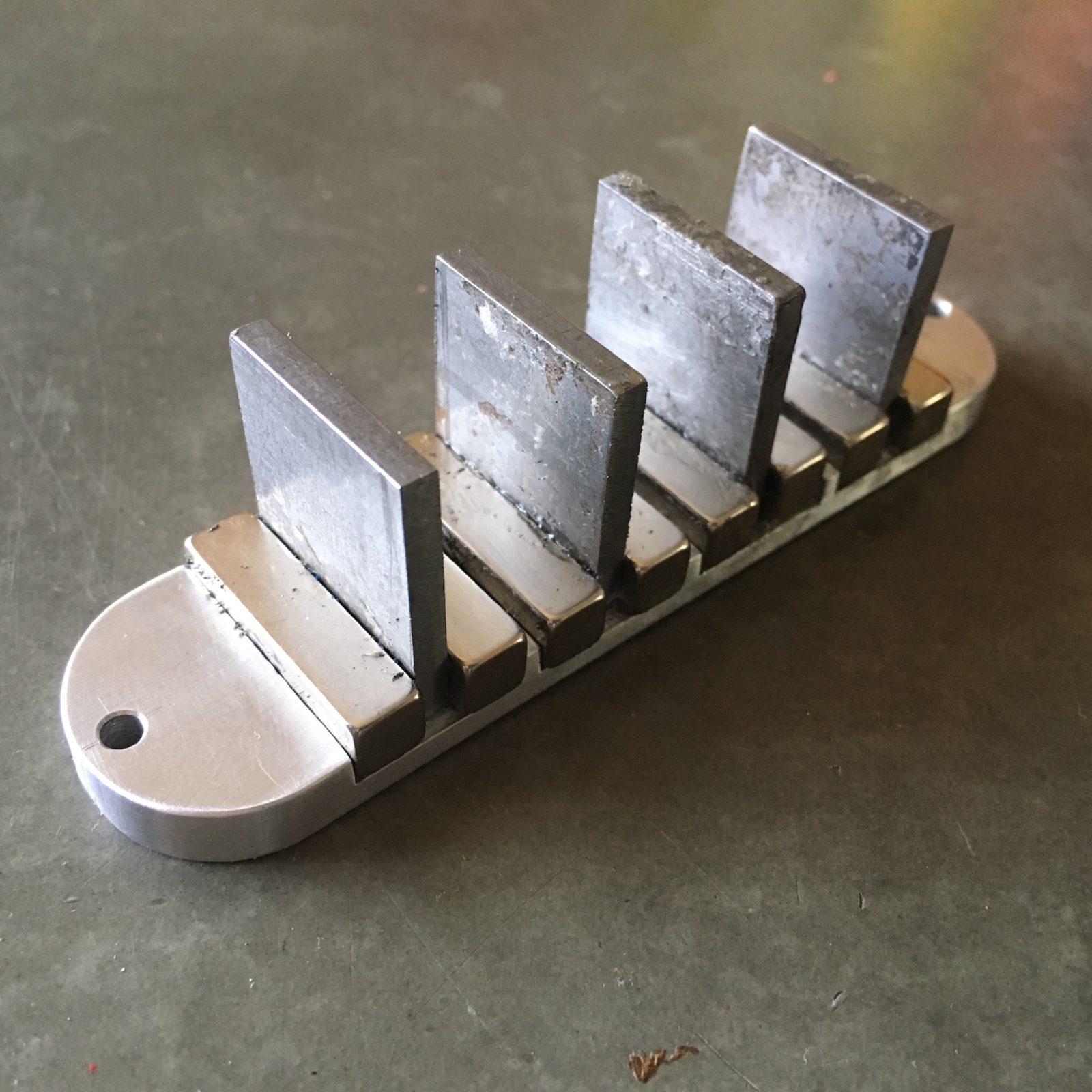
speaking of wild magnets, this thing was a prototype magnet holder segment from an undulator i designed and built for one of our national labs some years ago. encased in epoxy and brass, these little praseodymium mags are incredibly strong. their poles are arranged in a up, rt, dwn, rt orientation in tandem, and basically required a ton lot of clamping and fixturing to corral them into place. flyouts can be pretty dangerous as these guys will shatter and send shrapnel whizzing about. one of our people got hit in a tooth with a piece and chipped it. assemblers working on high power magnets need face shields, cotton gloves, and no watches, cell phones, pacemakers, or other sensitive inplants. magnetic tools and objects need to be at least 3 feet away from the mags when building these structures.View attachment 3474386

Wow!

That’s real science stuff! I’d never heard of an undulator nor praseodymium until today. Far out!
 
Last edited:
  • Like
Reactions: wraub
Here’s that piece I assembled last night:

img_6376.jpg
 
Yeah, I’m sweating about how I’m going to wire it. This assembly will help to keep the poles from crashing into each other and breaking the coils, and that’ll be a really big help. That was a big problem on my first two prototypes.

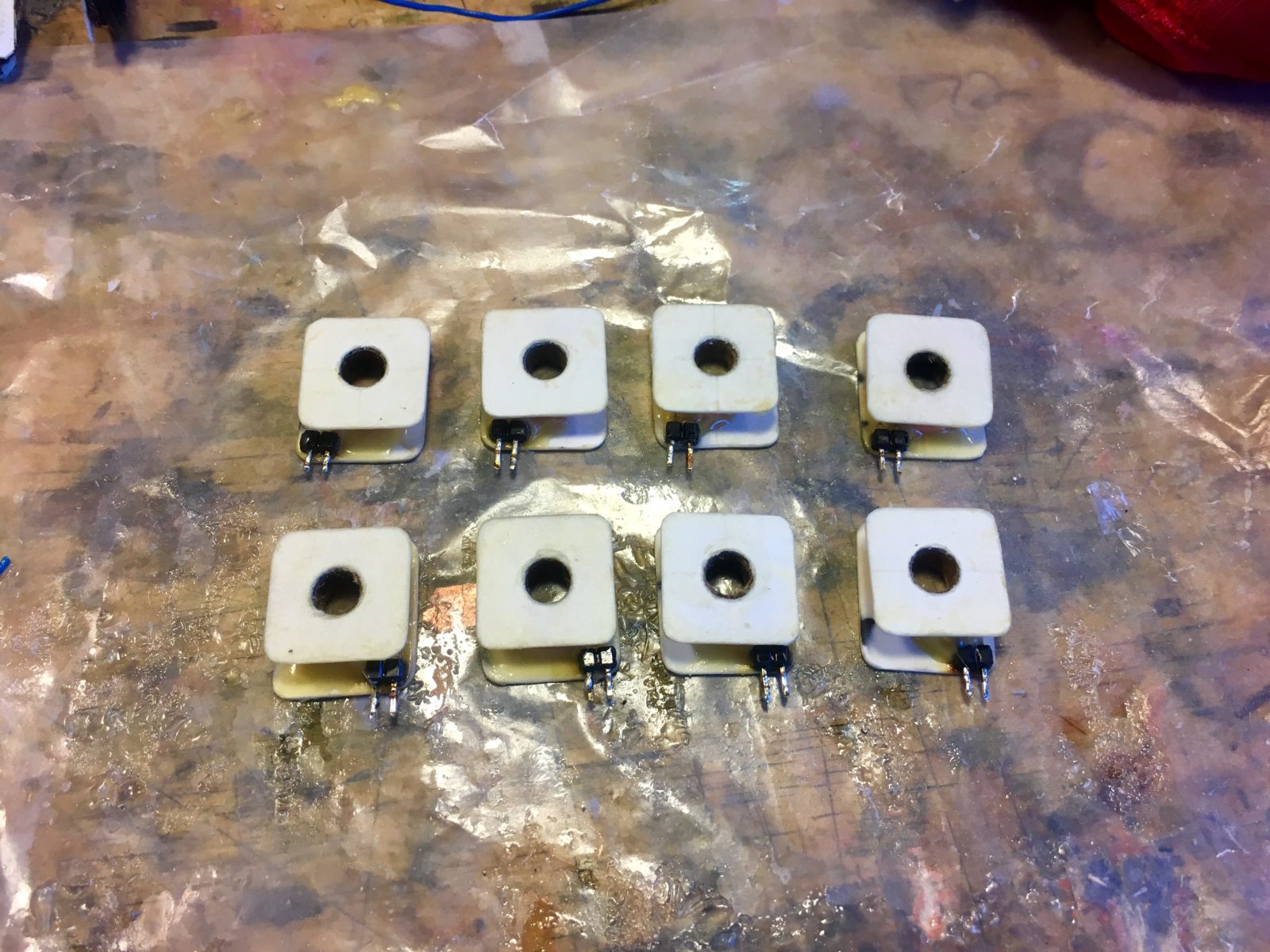
I also realized that if these micro-coils become a thing, I’m going to have to either build a specialized winder or modify one I have. The feed mechanism needs to be closer to the coil. With the regular hot dog shaped coils I usually make, the wire gets pulled over the length of the bobbin as it turns and lays the wire down pretty consistently. Not so with these single-slug coils! That stretching motion isn’t there. The distance from the wire breakpoint to the coil slows the lateral advance as it gets longer.
 
Last edited:
  • Like
Reactions: herndonbassist
I also realized that if these micro-coils become a thing, I’m going to have to either build a specialized winder or modify one I have. The feed mechanism needs to be closer to the coil. With the regular hot dog shaped coils I usually make, the wire gets pulled over the length of the bobbin as it turns and lays the wire down pretty consistently. Not so with these single-slug coils! That stretching motion isn’t there. The distance from the wire breakpoint to the coil slows the lateral advance as it gets longer.

Yes, you can make a better feed "nozzle" for your winder to reach in closer to a small round coil bobbin. That will help you wind more even and compact coils.

But, I suspect that as you get further into experimenting with this pickup design, you may end up with oval coils rather than round ones. The most efficient function of the coils, in picking up the movement of the magnetic field, may be in having the coils longer than the plates. So only the straight sides of the coils are between the plates, and the turn-arounds are hanging out beyond the plates.

Think about the shape of the magnetic field you've created with this plate/magnet configuration. It's unusual and very interesting. It has the potential of being very highly efficient at detecting the fine movement of the string, and transferring it to the coils. You may be able to get strong output levels with really good definition, using fewer turns in the coils.

I think you are really on to something here.
 
Yes, you can make a better feed "nozzle" for your winder to reach in closer to a small round coil bobbin. That will help you wind more even and compact coils.

But, I suspect that as you get further into experimenting with this pickup design, you may end up with oval coils rather than round ones. The most efficient function of the coils, in picking up the movement of the magnetic field, may be in having the coils longer than the plates. So only the straight sides of the coils are between the plates, and the turn-arounds are hanging out beyond the plates.

Think about the shape of the magnetic field you've created with this plate/magnet configuration. It's unusual and very interesting. It has the potential of being very highly efficient at detecting the fine movement of the string, and transferring it to the coils. You may be able to get strong output levels with really good definition, using fewer turns in the coils.

I think you are really on to something here.


Yeah, I was thinking of setting up a linear feed that slides on rails and uses an acme lead screw. I could then make an adjustable feed nozzle. We’ll see - I want to get a working prototype before I start thinking about doing major mods to my winder.

I’ve thought about making the core oval like you suggested, and I think it’s a good idea. Maybe I can use two 1/8” diameter cores instead of one 1/4” core. That would also give me a convenient spot to put some wire terminals. I want to try and keep the width 1” or below, so we’ll have to see about the curves of the bobbins extending beyond the edges of the plates.

BTW, the pole assemblies are configured N-S-N-S. It didn’t work N-N-N-N. Does that make a comb filter?

I think this configuration will be interesting. Sidewinders are naturally bright and clear-sounding with fairly neutral mids - turning them 90° and giving the pickups a wider aperture will increase the midrange response while theoretically retaining brightness. The larger neodymium magnets should increase the bass response as well. On top of that, these coils weigh in at about .75K - so all eight in series will run me about 6K - definitely a mid-impedance pickup.

My initial experiments indicate that your hypothesis is correct. Though I only had two strings working, the pickup had pretty strong output for its size. And as I have stated here, it had pretty strong bass and midrange response while retaining its clarity. The highs aren’t as extended as a “traditional” sidewinder, but there was more than ample high-end for a bass pickup.
 
Neither had I, which led to an hour diversion into Wikipedia, which included the periodic table and the "f-block" elements. Fascinating stuff.

Geez, I'm such a geek...

Yeah crazy stuff down there. Not a lot is taught about that section even in college Chemistry courses, well at least not deeply involved in undergrad. It's amazing the capabilities of many of those elements and how critical some are for electronics and modern technology.

Fun fact: ~4 elements (IIRC), more than a couple f block I think, are named after Ytterby, Sweden. There was a mine near by which was the source of the ore from which these elements were isolated from to prove their existence. It could be more or less, I can't remember exactly all these years later.
 
Yeah, I’m sweating about how I’m going to wire it. This assembly will help to keep the poles from crashing into each other and breaking the coils, and that’ll be a really big help. That was a big problem on my first two prototypes.

I also realized that if these micro-coils become a thing, I’m going to have to either build a specialized winder or modify one I have. The feed mechanism needs to be closer to the coil. With the regular hot dog shaped coils I usually make, the wire gets pulled over the length of the bobbin as it turns and lays the wire down pretty consistently. Not so with these single-slug coils! That stretching motion isn’t there. The distance from the wire breakpoint to the coil slows the lateral advance as it gets longer.

i don't know it this would apply to pick-ups but if your base plate is aluminum (it looks like al from the picture?) you may or may not see weird field issues. we had a case a couple of years ago when we were using aluminum coil retainers on a quadrupole we built and saw field symmetry variances on our hall probe. we made some G10 retainers and the problem went away. we thought that the issue may have been the close proximity of our original aluminum retainers to the pole faces. unfortunately we didn't pursue this further because we had to meet a ship date.

regarding epoxy, we've had good sucess using Loctite EA M-31CL. it has an open time of 30 mins and seems to stick to slippery nickel plating better then most. recently we've been curing assemblies in a vacuum over with no heat -just straight vacuum to extract out any bubbles.

what are you using for the steel poles? -1018?
 
Last edited:
  • Like
Reactions: Novarocker
i don't know it this would apply to pick-ups but if your base plate is aluminum (it looks like al from the picture?) you may or may not see weird field issues. we had a case a couple of years ago when we were using aluminum coil retainers on a quadrupole we built and saw field symmetry variances on our hall probe. we made some G10 retainers and the problem went away. we thought that the issue may have been the close proximity of our original aluminum retainers to the pole faces. unfortunately we didn't pursue this further because we had to meet a ship date.

Haha - in pickup design, I think they call that “mojo”!

That’s good to know. That holder is aluminum. For now, it’s a prototyping jig. I don’t know if it’s altering the field or if it matters if it is. I might be able to get it up and running tonight, so we’ll see how it sounds.

Bruce had mentioned the possibility of casting a plastic base, but we’ll have to see - I really had to use a lot of brute force to get those poles in there. I’d have to see if polyurethane resin is strong enough for the job. G10 would probably hold up.
 
i don't know it this would apply to pick-ups but if your base plate is aluminum (it looks like al from the picture?) you may or may not see weird field issues. we had a case a couple of years ago when we were using aluminum coil retainers on a quadrupole we built and saw field symmetry variances on our hall probe. we made some G10 retainers and the problem went away. we thought that the issue may have been the close proximity of our original aluminum retainers to the pole faces. unfortunately we didn't pursue this further because we had to meet a ship date.

regarding epoxy, we've had good sucess using Loctite EA M-31CL. it has an open time of 30 mins and seems to stick to slippery nickel plating better then most. recently we've been curing assemblies in a vacuum over with no heat -just straight vacuum to extract out any bubbles.

what are you using for the steel poles? -1018?

Thanks for the tips!

At this stage, I’ve been using cheap CA glue, mostly for its ability to seep into small places. I may upgrade to that Loctite epoxy you recommended later on. I’ll probably end up casting the whole thing in a big block of West Systems epoxy.

And yes, the poles are 1018.
 
  • Like
Reactions: Novarocker
Thanks for the tips!

At this stage, I’ve been using cheap CA glue, mostly for its ability to seep into small places. I may upgrade to that Loctite epoxy you recommended later on. I’ll probably end up casting the whole thing in a big block of West Systems epoxy.

And yes, the poles are 1018.


fwiw, if you can get a hold of it, 1006 is better for poles. the carbon content is .08% vs 1018 at .2%

pm me if you're interested and i'll send you a small piece.

for your epoxy encapsulation if you can pull a vacuum on it that would help quite a bit. you can use a hand vacuum pump and a bell jar or a modified pressure cooker.
 
Last edited:
  • Like
Reactions: Freekmagnet
I've been casting (encapsulating) my pickups in West Systems epoxy for a long time, and I've had very few problems with bubbles. As long as you stir the mix slowly and don't whip it onto a froth, West Systems is low-viscosity enough that any bubbles rise right up to the surface during the cure. Even pouring into thin spaces and complex shapes, I rarely see any voids or bubbles. West Systems (with the Slow 206 Hardener) works very well as a casting resin. I don't see any reason to go to the trouble of putting it in a vacuum. What's it going to gain you?
 
I've been casting (encapsulating) my pickups in West Systems epoxy for a long time, and I've had very few problems with bubbles. As long as you stir the mix slowly and don't whip it onto a froth, West Systems is low-viscosity enough that any bubbles rise right up to the surface during the cure. Even pouring into thin spaces and complex shapes, I rarely see any voids or bubbles. West Systems (with the Slow 206 Hardener) works very well as a casting resin. I don't see any reason to go to the trouble of putting it in a vacuum. What's it going to gain you?


it's certainly not for everyone but for those interested in pursuing a higher level of craft, it can help with the packing density of the coil build and absolutely making sure that there are no voids. it only requires around 3 to 5 psia of vac
 
Last edited:
it's certainly not for everyone but for those interested in pursuing a higher level of craft, it can help with the packing density of the coil build and absolutely making sure that there are no voids. it only requires around 3 to 5 psia of vac

Just to be clear, we're not using the West Systems for potting the coils. We use the super-thin CPES epoxy for that. The West Systems is just the external decorative/protective shell. A layer of black plastic on the outside.
 
  • Like
Reactions: Novarocker
Well guys, today I went for it.

img_6390.jpg


img_6392.jpg


I had trouble wiring it - there were a lot of phase issues. I was fairly diligent about getting the wire direction right and I did a lot of tests by isolating two pairs of coils. They all sounded fine. But for some reason, putting all eight pairs in series, the A and the D strings wouldn’t work.

What ended up working was this: the first four coils were joined Beginning > End > End > Beginning > Beginning > End > End > Beginning. The next four were joined End > Beginning > Beginning > End > End > Beginning > Beginning > End - basically the opposite. Then I wired those two sets in series. That got it running, at least. I hope that makes sense. In the process, I only damaged one coil. I had another from a previous attempt and it worked fine.

Anyway, the pickup sounded... interesting. The output was pretty good for a passive bridge-position pickup. It’s crazy bright - not in the ice pick sense, but rather, it hears EVERYTHING. All finger noise is right up front and center. There’s plenty of midrange and bass underneath the brightness - certainly more than my original sidewinders. The comb effect (if that’s what it is) gives it a really unique sound. I think if anything, that’s probably the best part about it.

I’m thinking that for this to work, I’m going to need more capacitance. I turned the treble all the way down and even cut some high-mids - and it still sounded bright! I can’t really add a significant amount of wire, so I might experiment a little with hardwiring a cap to ground to make a little LPF. We’ll see.