OK, on to the next part of this puzzle. First, allow me to put on my opinion hat. I use the word “opinion” because I have found that in the pickup-making universe, the ultimate truth is a relative thing. There’s some laws of physics that definitely apply, but at the end of the day there’s a lot of conjecture involved. Ultimately, one winder’s findings may be different from another’s. I’m just stating what I have discovered through my own admittedly un-scientific processes.
Let’s first go over magnetic materials. Most pickups these are made of various grades of Alnico or ceramic and every once in a while you’ll see neodymium. (There’s some weird pickups out there with rubberized magnets, but I just give a brief overview here)
Alnico has been around since the old days, and a lot of “traditional” pickups are made with Alnico - Fender, Gibson etc. Alnico is great because you can design a pickup that has a well-rounded tone - the highs are manageable and the mids are sweet. They’re also pretty versatile and forgiving - you can make a pretty good-sounding pickup by just wrapping some wire around it.
Ceramic magnets are stronger, so you can build a really bright pickup with them. However, they can also make a really stiff and harsh-sounding pickup. Ceramic pickups have a really fast bass response. A lot of more “modern” bass pickups are made with ceramic, but ceramic pickups don't necessarily have to sound "modern". A perennial fave here on TB is the classic T-40 pickup.
Neodymium is relatively new on the scene. I’ve been seeing a few more neo-driven pickups out there lately, but it’s still considered to be kind of “exotic”. Their main characteristic is their intense strength.
I’m writing this in an effort to dispel any myths about neodymium pickups. I’ve been playing with them for a while and they don’t magically make your pickup more amazing and they don’t give your pickup out-of-control output or anything. If anything, most of the pickups I’ve made with neodymium sounded really similar to Alnico-driven pickups. Because of their strength, you will have to alter your design significantly.
I’ve gotten strange requests from people to build things for them like a neodymium p-bass pickup, and my answer is usually, “why?” A p-bass pickup is basically p-bass pickup regardless of what magnet you put in it. Besides you can buy a neo P on eBay for $50. I’ve actually read statements from guys who claim that neos sound so different that the human ear is not ready for the way it sounds!
Anyway I’m calling BS. You can make a good-sounding neodymium pickup, but it won’t be the magnet making the miracle. It’s just a magnet like Alnico or ceramic.
What’s great about neodymium magnets? Well, it’s their intense strength. If you want to make a smaller pickup, then you can use a small neodymium magnet to drive it. Neodymium magnets are available in all shapes and sizes, they’re relatively cheap and it’s easy to experiment with all kinds of cool magnetic structures.
/******/
Next, let’s talk about sidewinders. I’ve been building sidewinders for a couple of years now. I used my sidewinder pickup in my Sirena Modelo Uno. They've been around for a while - most infamously in the Gibson EB-3, but they're pretty uncommon pickups. I believe that this largely because they are more difficult to manufacture, but I'm not sure. While the Gibson pickup isn't the best sounding pickup (they're affectionately known as the "mudbucker"), sidewinders are generally very bright-sounding pickups and have a neutral-sounding midrange. While they are humbuckers, some say that they have an almost single-coil sound. I've heard them described as being "natural" sounding, and I think that is a fair assessment. My theory is that this is largely due to the very narrow sensing area; basically, the central pole does 90% of the work.
I installed my sidewinder in the bridge position, and while it sounds very clear, the narrow sensing area presented a real challenge. The pickup just didn't put out a ton of low end. I ended up having to use a preamp to fill in some of the bottom, enhance some of the mids and cut some of the highs. The bass sounds great and I've been gigging with it, but I wanted to maybe have a pickup that didn't rely so heavily on a preamp.
Bruce and I had been talking about it, and he suggested making a wider pickup with a wider aperture. However, I'd already been down that road, and widening the space between the center and side poles didn't do all that much - again, the central pole does most of the work.
/******/
Next on the list are multi-coils. I haven't a built one myself, so I can't say much about them, but supposedly they are thick and bright sounding at the same time. Theoretically, this would be due to the skinny coils wired in series. The Wal bass and of course, the X-Strange AMB-2 are both loaded with multi-coils.
/******/
Which brings me to new pickup, code-named "Exotica"
I've decided I'm going to attempt to build a neodymium-driven multi-coil linear sidewinder. It doesn't get much more exotic than that
The idea is that I want a small pickup with a wide sensing area. Each string will have it's own sidewinder with it's pole running parallel to the string. This will give me the widest sensing area in the smallest space. The smaller neodymium magnets will allow me to make 8 tiny coils.
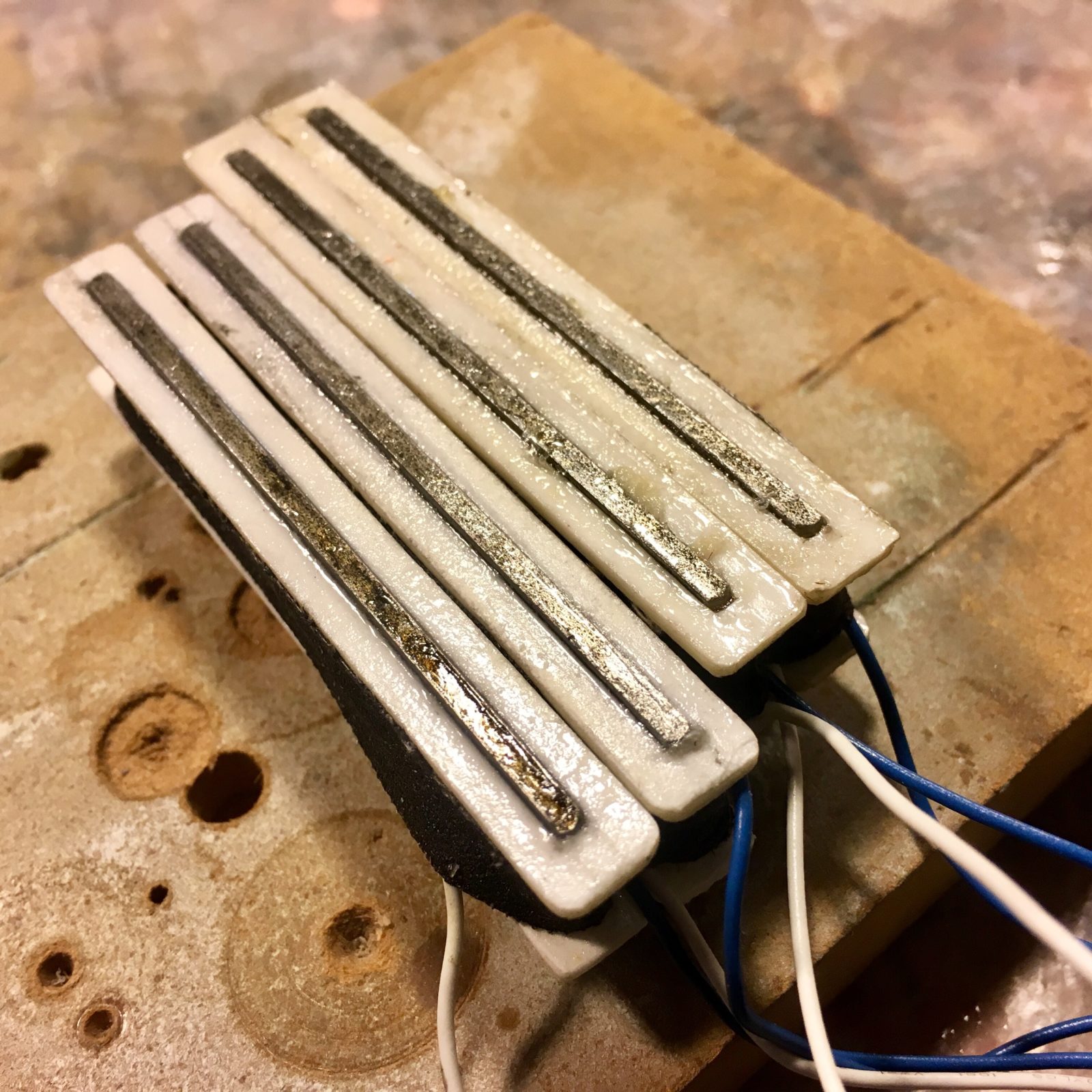
Here's a picture of my first attempt, which was an utter failure:
View attachment 3471798
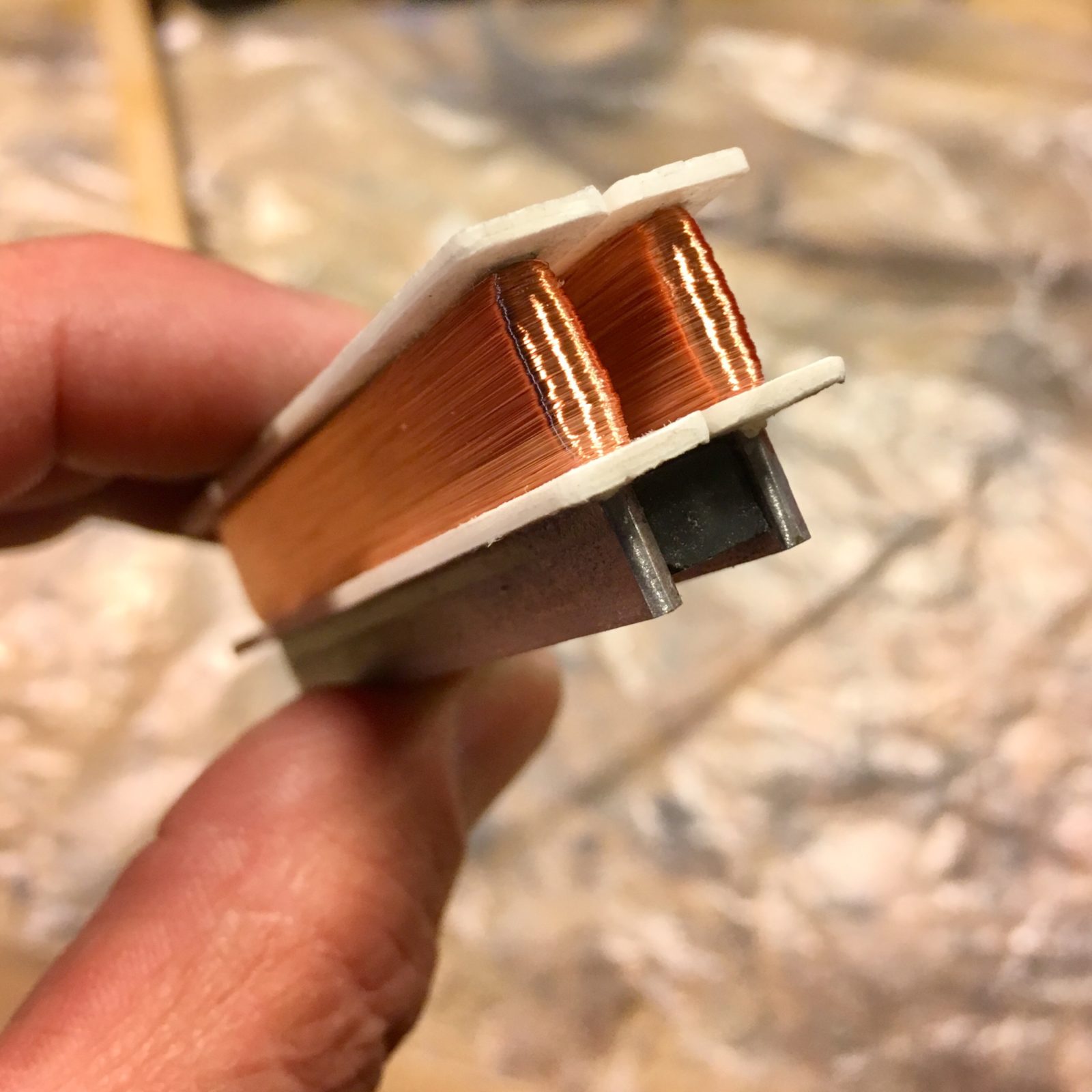
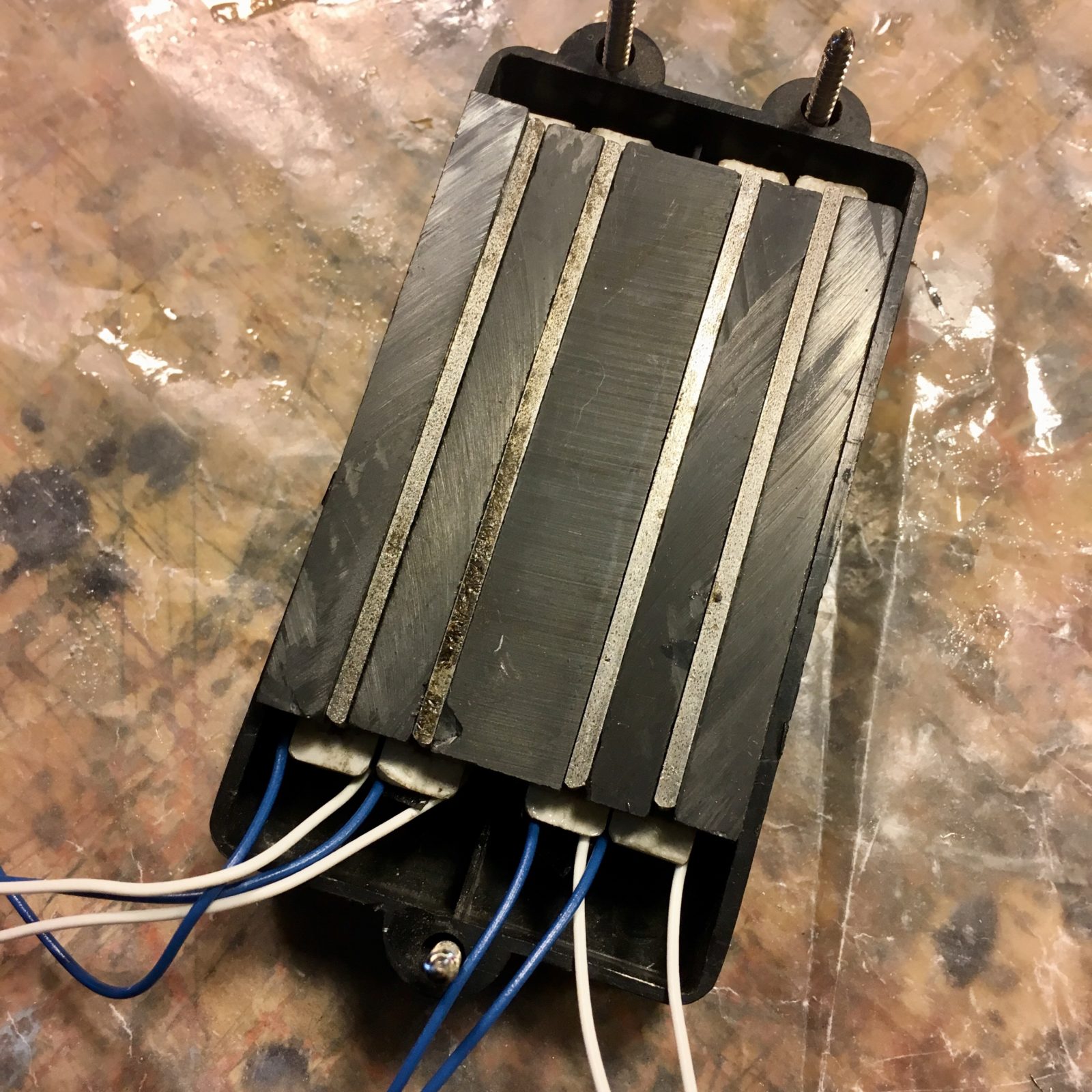
Why did they fail? Well the magnets are really strong and the bobbins and the wire are really fragile. Each set of coils would pull into one another and would either snap the wire or break the bobbin. On my second attempt, I tried putting the magnets underneath the bobbins, but I really had the same problem. I did manage to get 2 strings working and it sounded amazing. Really full sound.
View attachment 3471799
I used some polypropylene I had for the bobbins, but the plastic glue didn't hold. They were falling apart as I was putting them together. And again, the magnets would pull into one another and break the wires.
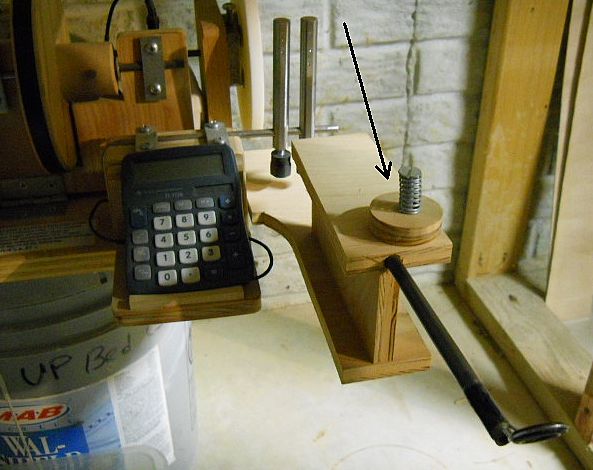
So, Bruce made this part for me:
This is basically a prototyping jig that will hold everything together while I assemble the coil/pole/magnet pieces. Because of space restrictions, the pickup will pretty much design itself. I can only add so much 44AWG wire. The biggest problem to solve will be the wiring. There's a lot of points of failure. I'm thinking that I might have to design some kind of circuit board to hold the coils in place.
I'm hoping to get started winding this week.