• TalkBass has been independent since 1998. Add your voice.
    Create a free account to reply to discussions, view embedded media, and browse with fewer display ads.
    Join freeLog in
    Want zero display ads or expanded classifieds tools? Compare plans.

Maple or rosewood on your Jazz?

I have a rosewood board on a Ric. All others are maple.
I do have an LP guitar with rosewood.

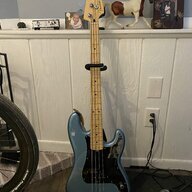
IMG_0366.JPG
IMG_0059.JPG
 
Sounds like a case of "golfers elbow" to me. This is actually quite a bit more serious than tennis elbow ( outside of arm). I've had chronic problems with this for 20 years which has recently been negatively affected by dealing with a big snowstorm a couple weeks ago. Rest and ice would be your best bet right now before it becomes a chronic problem. If you get pain free for a couple of weeks you can do some strengthening exercises.
Will do, thanks!
 
I have 1 maple and 5 rosewood boards on my basses. I bought the maple Lakland in 2003. It is a great sounding bass and plays beautifully but the board has marked up over time, which I really don't like. So every bass since has been rosewood, well 3 "ordinary" rosewood, 1 Brazilian rosewood and 1 Morado. The Morado is also pretty stained but only shows close up.

My experience is that maple and rosewood will lend a different sound to the bass (maybe useful in the studio) but with the powerful pickups and pre amps on these instruments I'm not sure you'd hear a difference on a gig.

Anyway, just like my tort pick guards, I buy my "dark wood" boards purely for aesthetic reasons.
 
Really? This contradicts everything I've ever heard about instrument necks. Guitar and bass that is.

Therein lies the problem. The maple = brigher notion is conjecture, with no real data to back it up. Maple looks brighter, and I reckon people hear with their eyes half the time. As such this notion is perpetuated ad infinitum on the Internet without any proper studies backing it up. I'm not saying wood doesn't make a difference, simply that changing fretboard material doesn't result in measurable, repeatedly reliable tonal changes in a predictable manner.

I actually agree with Scott Grove on Youtube (and that guy is crazy, his horrible taste in '80s guitars and equally antiquated opinions) when he says that even rosewood necks are basically maple necks. We aren't debating the neck material, simply the 7 mm or so of material that the frets are slotted into. Given that the pickup is only detecting the length of string between the fret and the saddle, where is the fretboard influencing tone? Is it sucking frequencies through the fret? The length of string behind the fret between the fret and the finger?

 
Therein lies the problem. The maple = brigher notion is conjecture, with no real data to back it up. Maple looks brighter, and I reckon people hear with their eyes half the time. As such this notion is perpetuated ad infinitum on the Internet without any proper studies backing it up. I'm not saying wood doesn't make a difference, simply that changing fretboard material doesn't result in measurable, repeatedly reliable tonal changes in a predictable manner.

I actually agree with Scott Grove on Youtube (and that guy is crazy, his horrible taste in '80s guitars and equally antiquated opinions) when he says that even rosewood necks are basically maple necks. We aren't debating the neck material, simply the 7 mm or so of material that the frets are slotted into. Given that the pickup is only detecting the length of string between the fret and the saddle, where is the fretboard influencing tone? Is it sucking frequencies through the fret? The length of string behind the fret between the fret and the finger?
Very good points.
 

Latest posts