
It's a fundamental law of nature! Any makeup artist will tell you that.Covering mistakes with fancy decorative work is a fundamental Luthier skill.


TalkBass has been independent since 1998. Add your voice.
Create a free account to reply to discussions, view embedded media, and browse with fewer display ads.
Join free Log in
Want zero display ads or expanded classifieds tools? Compare plans.
It's a fundamental law of nature! Any makeup artist will tell you that.Covering mistakes with fancy decorative work is a fundamental Luthier skill.


I'd paint the headstock black and avoid it for next time.
Yeah, what Lo-E is suggesting is the way to fix it right. It would be tricky to save the existing inlay, so I wouldn't bother. On the bench, make a whole new inlay, setting it into a thin piece of maple or some contrasting wood. Set it in black epoxy again, but remember to seal the wood grain first. Then cut out the wood into some decent looking medallion shape, big enough to cover the bleed out on the headstock. Rout away the old inlay, and inset the whole medallion in its place.
Covering mistakes with fancy decorative work is a fundamental Luthier skill.

Talking about covering mistakes, i came with this idea while playing in a gig haha, let me know what you think:
Using a waterslide decal paper, i'm going to print just the black outline to cover the ugly epoxy outline as shown below:

ç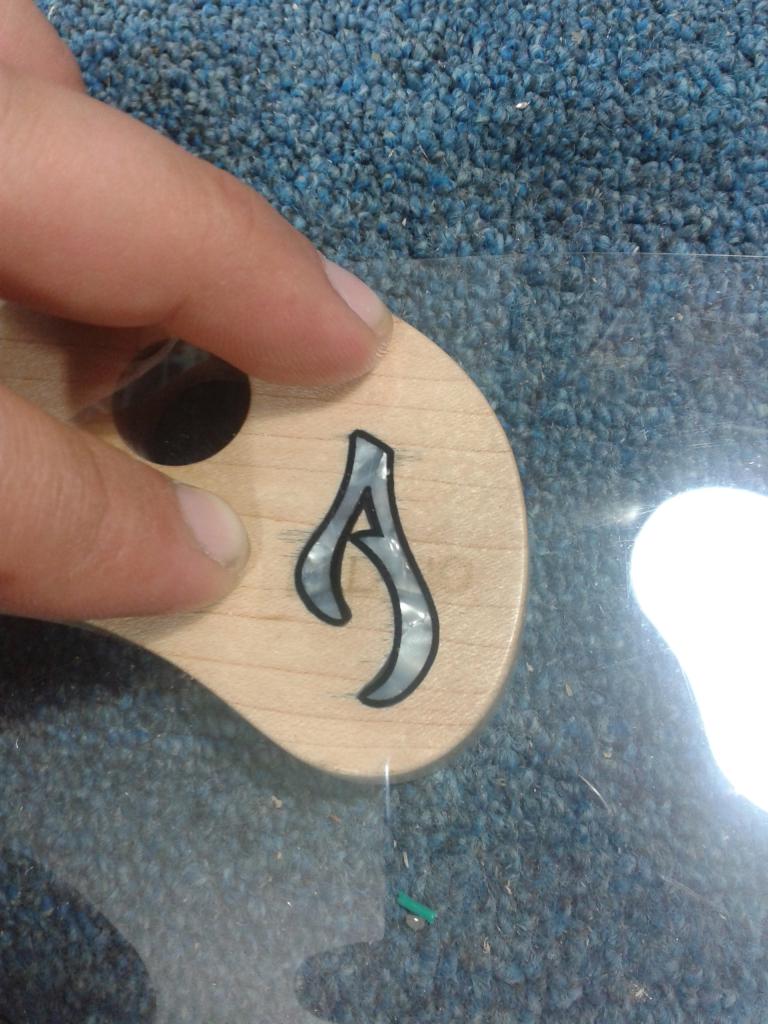
This is something "allowed" in lutherie? it's a crazy idea? what would be the implications? i made the test in the photos with acetate paper, obviously, this doesn't solve the bleeding epoxy problem, i think i'm going to talk with the customer and tell him if we can deal with it, and give him some free services at my shop or something, i don't really like the oval medallon idea, neither painting the headstock black (Thanks for the suggestions by the way) this is my 2nd build

Instead of painting black, maybe a dark wood dye could work, depending on what the rest of the bass looks like?
The decal outline is a fine idea, but that black staining is going to get worse when you put a finish on it. Personally, I would remove about 1/8" of wood from the top of the headstock and put a grain maple cap on top of the headstock and start over with your inlay. You could just glue it in with clear epoxy then use your decal outline idea to completely avoid the situation.


How about sand down a few mm around the inlay which hopefully will get you back to uncontaminated wood (of course you don't know how deep it seeped in) and give the inlay some relief and a bit of 3-dimensionality. Kind of like a downwards ramp towards the inlay then quickly ramping back up at the edge. Just an idea. Good luck with whatever solution you go for.



