• TalkBass has been independent since 1998. Add your voice.
    Create a free account to reply to discussions, view embedded media, and browse with fewer display ads.
    Join freeLog in
    Want zero display ads or expanded classifieds tools? Compare plans.

Maple vs. Rosewood fretboard

I have 2 2008 MIA P basses one with RW , one with Maple. They sound the same.

I have 2 90's Furys - one with the usual Maple and a rare one with Rosewood. They sound the same.

I prefer the feel of an oiled RW fingerboard and the way it looks with a Sunburst body.
I prefer the look of the Maple with the white fury and the ease of cleaning.

Period.
 
I'm pretty sure Leo only switched to rosewood from the early maple-only fingerboard days because it hid dirt better and theoretically thrived on the oils from grubby human hands. I don't think musical differences of fingerboard woods have ever been shown to matter. Aesthetics and "feel" are the only real factors.
 
The question I have been asking myself for years is why do I prefer maple? Is it because my favorite bass players growing up always seemed to play maple necked Fenders? Has that been subconsciously influencing my preference for maple? I try to tell myself that it's easier to see on a dark stage, or that it sounds brighter or whatever. But when you shovel away all the BS, it's because my early bass heroes played Fenders with maple necks. I don't know what else it could be.
 
IMG_3121.jpg
IMG_3122.jpg
IMG_3140.jpg
wood choices and finish are over rated in my view as factors in tone.... more important is pickups, strings, and preamp, as well as speakers.

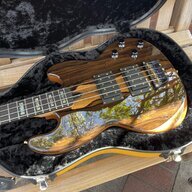
I go with what looks good for me. My latest Music Man Stingray has a 100% All Rosewood neck and fretboard... looks amazing and sounds just as good as the maple version.
 
  • Like
Reactions: MovingPitchers
Going by the look is as silly an idea to me as the idea of going by the wood seems to be to many of the people here. Play as many basses as you can and choose the one that sounds best. Each bass sounds a bit different. You can attribute that to whatever you'd like (wood, strings, pickups, preamp), but it doesn't really matter. Find a bass that feels and sounds right to you and you're set.
 
To try to add something constructive for the OP I will second that that difference is minor but there is a difference. For a "new" player this might actually matter (believe it or not). I think maple can be much more revealing when it comes to technique/string/finger noise. Rosewood seems to tame some of the transients that can be common to new players. Go ahead:-). Shoot me. Just trying to actually help
 
Despite having owned a few different basses, I can't tell the difference between maple and rosewood fingerboards. I would be interested to know if anyone out there has swapped between maple and rosewood fingerboard necks on the same bass body to test the theory. Anyone out there who has tried it?
 
  • Like
Reactions: SamJ
Despite having owned a few different basses, I can't tell the difference between maple and rosewood fingerboards. I would be interested to know if anyone out there has swapped between maple and rosewood fingerboard necks on the same bass body to test the theory. Anyone out there who has tried it?
My pj came with a rosewood board j neck. I switched to a maple board p neck. It lost brightness. Does that mean maple is less bright? Or p necks are less bright? Nope. It doesn't mean anything.
image.jpg
image.jpg
 
  • Like
Reactions: Jughead6
My pj came with a rosewood board j neck. I switched to a maple board p neck. It lost brightness. Does that mean maple is less bright? Or p necks are less bright? Nope. It doesn't mean anything.
View attachment 527615 View attachment 527616

Thanks. That's really interesting. It supports my belief that there are many factors that influence the sound of an instrument and it is very difficult or impossible to dumb it down to just one wood type or another.

One piece of maple is completely different to another, just as maple is completely different to rosewood.