• TalkBass has been independent since 1998. Add your voice.
    Create a free account to reply to discussions, view embedded media, and browse with fewer display ads.
    Join freeLog in
    Want zero display ads or expanded classifieds tools? Compare plans.

Math problem for calculus wizzes

I need to set up a calculus equation.

Pressure is a function of r (radius) and I'm trying to determine
the total force over an area. You can see that pressure is kind
of shaped like a doughnut. I'm looking for the equation to find
the answer -- not a numerical answer -- as the true equation
for the force has yet to be determined.
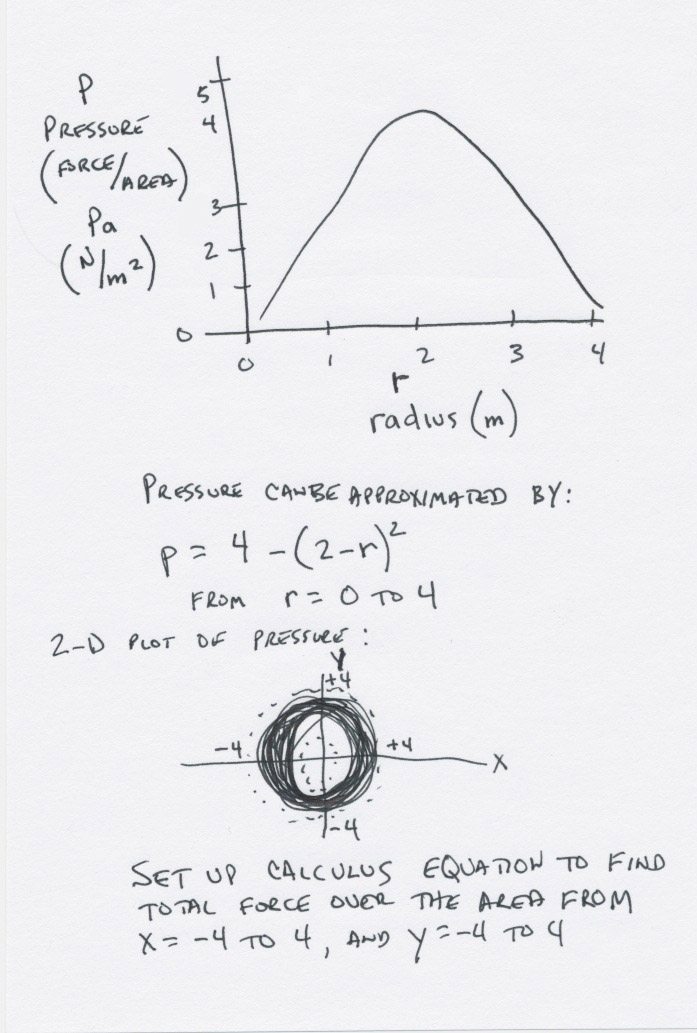
Force.jpg
 
First off, use polar coordinates. This will allow you to use two variables - radius (r) and degree of rotation around the origin (theta). It is possible to convert between polar coordinates and regular old Cartesian (x,y) coordinates - you can look this up in your calculus book.

Force = Pressure * Area.

Ostensibly, you know the expression for pressure, some function of radius only. **This is assuming Pressure is NOT a function of theta as well**

P = P(r)

Since Pressure varies with area, this is the first clue to set up an integral. It will have this general form:

The differential area element for polar coordinates is

dA = r dr d(theta)

So Total F = integral of P * dA

F(r) = integral (P(r) * r * dr * d(theta))

Since it is symmetrical, you can take out the theta component, so

F = 2*pi * integral (P(r) * r * dr)

Using the example expression you noted, P = 4-(2-r)2​

F = 2 * pi * integral (4r - r * (2-r)2​dr)

F = 2 * pi * integral (4r2​ - r3​) dr

Which, as a student of calculus you should be able to integrate with your eyes closed...

For a specific area integral, you have to perform a definite integral from r1​ to r2​. In the example you listed, r1​ = 0, r2​ = 4

Note - as described, This is NOT donut-shaped - this is a circle.
 
*weird symbol that looks like an f (4 on top, -4 on bottom)* 4-(2-r)^2 dx? Then antidifferentiate between 4 and -4? We're learning this in year 11 maths, what is this for?

Close - since this is a 2D problem, you need to have 2 dimensions, i.e., x & y. You would also need to convert the r variable into x & y coordinate system.

Area in x,y coordinate system = dxdy

In this case, it is a double integral. To perform a double integral, work from the inside-out. Integrate over the innermost variable and then progress to the outer ones.

Use of polar coordinates with the recognition of symmetry converts a double integral into a single integral. (To be definite, the second integral is performed, the answer is just 2 * pi ( the integration of d(theta) from 0 to 2pi = 2pi))
 
Thanks, Chebass. I agree with your solution. I arrived at what
is essentially the same solution after talking to my niece, a
current engineering student, and jogging the cobwebs in my
brain a little.

I figured I could multiply the pressure equation by 2Πr. That
will change the force per area to force per distance along r.
Then, integrate with respect to dr to get force over the total area.

Here is what I got:
Force2.jpg


The doughnut description was not 100% accurate but neither
is a circle. I was trying to convey that it is a ring of pressure
that peaks on a circle but drops off inside and outside of
that circle.
 
Okay, now for the extra credit problem: Set up and solve the integral in Cartesian coordinates.

That would be challenging. I would take advantage of
symmetry and solve for one quadrant (x>=0 and y>=0) and
multiply the result by 4.

And, because you are integrating over the area of a circle,
the y limit is a function of x (and maybe vice versa).
I think I did problems like this in college but I can't remember
how to set it up now.
 

Latest posts