• TalkBass has been independent since 1998. Add your voice.
    Create a free account to reply to discussions, view embedded media, and browse with fewer display ads.
    Join freeLog in
    Want zero display ads or expanded classifieds tools? Compare plans.

McVie on the Beano record, a little help?

Apr 14, 2020
6
29
Disclosures
I have a You tube channel where I publish videos of gear history including bass gear.
Hi,
This is Keith Williams from five watt world, a You Tube channel that makes videos about gear histories and gear minimalism. Well lately many more of the former and fewer of the latter it seems.

I'm working on a video on the making of the "Beano album", John Mayall and the Bluesbreakers with Eric Clapton. I could use some help from the good folks here as to what rig John McVie was using on that date, or even at that time in his career. I have my thinking on it, based on my research, but thought I'd come to the experts first.

Thanks in advance for any and all input.
 
Going by the sketchy photographic evidence, and most plausible scenario(and as the album was recorded in March, '66) I'd say either some sort of Vox rig(AC50 head into a Foundation 1x18", 2x15" or 15"/12" cab, similar to McCartney's earlier rig, perhaps)or maybe an early Marshall half stack, since Clapton had just switched to Marshall from his Yardbirds AC30, and Entwistle was pioneering the concept anyway. Just keep in mind, they were all 'local bands', playing the same clubs...
0B28D9E8-B149-4821-9471-CED784B58CE5.jpeg
88B65CD6-6A33-4777-8671-0E5EC59A6C98.jpeg
617CF200-0A3E-4285-AC41-4F0751791459.jpeg

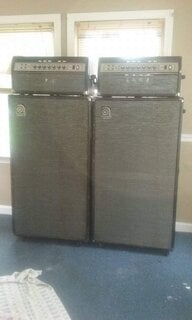
In this next pic, after Clapton, but with Peter Green(which places it late '66 to early '67)you can see what looks like the early Marshall rig...
03946F60-5838-49C1-BBF9-C5A6D536365E.jpeg

but as far as the album is concerned, I'd put money on some sort of Vox set up...
 

Attachments

  • 1199B712-B31E-45EE-8B46-D9BEA12801BE.jpeg
    1199B712-B31E-45EE-8B46-D9BEA12801BE.jpeg
    32.4 KB · Views: 50
I regularly saw John McVie with John Mayall in the Eric Clapton and Peter Green line ups, and I only ever saw him using Marshall. A 100 watt head and 412 cab.

Now that's what I was hoping for, a first hand account! It certainly is possible as the first 100 watt Marshalls were built in late 1965 at the request of Pete Townshend. I'm sure he would have been struggling to find his place in the wake of volume coming off Clapton's JTM-45 combo.

I wish we had a photo of him in front of a Marshall half stack. I will keep digging for that.
 
I'm not offering up any info, just a question. Was recording bass direct a thing back then? I'd imagine the consoles were tube pre, the processing and mastering gear as well at least mostly tube too. Could be just the tones of the bass, his hands, and the recording gear we hear on the records.
 
  • Like
Reactions: Bassdirty
I'm not offering up any info, just a question. Was recording bass direct a thing back then? I'd imagine the consoles were tube pre, the processing and mastering gear as well at least mostly tube too. Could be just the tones of the bass, his hands, and the recording gear we hear on the records.

There wasn't any direct to board back then. There is a good article from Sound on Sound about recording the Moody Blues "Days of Future Past" at Decca the next year. They even had to record an amp for the Mellotron (a Marshall, that must have been fun to "sweeten up".)
 
Now that's what I was hoping for, a first hand account! It certainly is possible as the first 100 watt Marshalls were built in late 1965 at the request of Pete Townshend. I'm sure he would have been struggling to find his place in the wake of volume coming off Clapton's JTM-45 combo.

I wish we had a photo of him in front of a Marshall half stack. I will keep digging for that.

Most of the pro working bassists playing blues, R&B and soul in the pubs and clubs had 100 watt amps and 412 cabs. It was standard issue and what most jobbing musicians could afford. The guys with full stacks were probably had "deals" with management and record companies. Blues bands were always the poor relations.

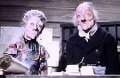
Clapton was loud but not deafening. I don't recall having to strain to hear the bass on any of those gig. Hughie Flint wasn't a hard hitting drummer and he was never drowned out. PA's were 100 watts (maybe 200 watts if you were rich) and the cabs were 4 12 columns. The Leslie might have been mic'd up but nothing else was. The photo above with the guys standing by the Burns Orbit combo is interesting. I don't know the story, but John Mayall used that combo as a PA system for a coupe of months. We couldn't hear the vocals or harp at all.

I think the bands back in the 60's generally weren't as loud as they are today. Or at least until Cream, The Jeff Beck Group and Hendrix arrived on the scene.
 
Hi,
This is Keith Williams from five watt world, a You Tube channel that makes videos about gear histories and gear minimalism. Well lately many more of the former and fewer of the latter it seems.

I'm working on a video on the making of the "Beano album", John Mayall and the Bluesbreakers with Eric Clapton. I could use some help from the good folks here as to what rig John McVie was using on that date, or even at that time in his career. I have my thinking on it, based on my research, but thought I'd come to the experts first.

Thanks in advance for any and all input.
Hey Keith! Love your research and resultant videos! Thank you!
 
I'm not offering up any info, just a question. Was recording bass direct a thing back then? I'd imagine the consoles were tube pre, the processing and mastering gear as well at least mostly tube too. Could be just the tones of the bass, his hands, and the recording gear we hear on the records.
It's been discussed that they recorded that album live as they played on stage.
 
  • Like
Reactions: basscooker
Now that's what I was hoping for, a first hand account! It certainly is possible as the first 100 watt Marshalls were built in late 1965 at the request of Pete Townshend. I'm sure he would have been struggling to find his place in the wake of volume coming off Clapton's JTM-45 combo.

I wish we had a photo of him in front of a Marshall half stack. I will keep digging for that.
I did in post #2.
 
I'm not offering up any info, just a question. Was recording bass direct a thing back then? I'd imagine the consoles were tube pre, the processing and mastering gear as well at least mostly tube too. Could be just the tones of the bass, his hands, and the recording gear we hear on the records.


Direct input
Direct input was first used by the Beatles on 1 February 1967 to record McCartney's bass on "Sgt. Pepper's Lonely Hearts Club Band". With direct input the guitar pick-up is connected to the recording console via an impedance matching DI box. Ken Townsend claimed this as the first use anywhere in the world,[31]although Joe Meek, an independent producer from London, is known to have done it earlier (early 1960s)[32]and in America, Motown's engineers had been using Direct Input since the early 1960s for guitars and bass guitars, primarily due to restrictions of space in their small 'Snakepit' recording studio.
 
Direct input
Direct input was first used by the Beatles on 1 February 1967 to record McCartney's bass on "Sgt. Pepper's Lonely Hearts Club Band". With direct input the guitar pick-up is connected to the recording console via an impedance matching DI box. Ken Townsend claimed this as the first use anywhere in the world,[31]although Joe Meek, an independent producer from London, is known to have done it earlier (early 1960s)[32]and in America, Motown's engineers had been using Direct Input since the early 1960s for guitars and bass guitars, primarily due to restrictions of space in their small 'Snakepit' recording studio.

Really helpful. Great info.
 
I'm not offering up any info, just a question. Was recording bass direct a thing back then? I'd imagine the consoles were tube pre, the processing and mastering gear as well at least mostly tube too. Could be just the tones of the bass, his hands, and the recording gear we hear on the records.


Most of Jamerson's stuff and actually all the Motown musician's stuff was recorded direct into a 5 channel tube mixer-preamp starting in 1961, very interesting threads about it down below:


The Real James Jamerson Amp

Bob Babbitt himself actually posted in this 2002 thread:

Soulful Detroit Forum


Maybe a little macabre but here is Bob Babbitt's forum that's still up.

[Invalid or Expired Link Removed]
 
Last edited:
I regularly saw John McVie with John Mayall in the Eric Clapton and Peter Green line ups, and I only ever saw him using Marshall. A 100 watt head and 412 cab.

Off topic, but I'm dying to know: Were the Clapton shows incredible like I want to imagine they were? The Blues Breakers 2006 Deluxe Edition has a disc of live cuts that include little of the Claptonian brilliance of the LP.
 
Eric Clapton was unique, stunning. He could make time stand still. We'd never seen anything like it, but I actually preferred Peter Green. EC was a loud and "in your face", a battering ram, PG was subtle and I thought, played with more feeling. I bought the Beano album and Hard Road. The records were good but the gigs were even better.
 
  • Like
Reactions: HaphAsSard