• TalkBass has been independent since 1998. Add your voice.
    Create a free account to reply to discussions, view embedded media, and browse with fewer display ads.
    Join freeLog in
    Want zero display ads or expanded classifieds tools? Compare plans.

Measured Amp and Cab voicings

Hi!

I am a sound engineer by profession and have lately been in the search of a new bass cab. I for one am interested in the voicing of a cab since its not that easy to get a hand on different cabs just find out right away that its definitely NOT the one for you.

This had me thinking along the following lines:

Why not sweep cabs (and amps) with a "reference" setup that would not change. At least the same mic and positioning, possibly the same preamp even. Then by comparing these results against each other, one has at least a glimpse of the cabs (or amps) voicing and can then go further investigating. I for one am interested and possibly might start doing this and publishing here, unless someone gives good reasons not to, has already done it OR has a better way.

Cheers

MArkus

 
I suspect for most people who are not in the industry and don't have the facilities it would come under the heading of too difficult. I did some amateur measurements just a few months ago, and was fairly convinced that what I was seeing included some significant room effects, so one can't really, for example, do the testing in the back bedroom. I've always found it remarkably hard in any field to find amateurs who will commit to do the hard yards in proper measurement and science. Much easier to blather on endlessly about what "everybody knows", especially everybody on the internet.
 
It's possible and certainly doable for personal amusement or research.

The problem is it gets exponentially difficult with every new cab you introduce.

Where do you Mic a 112?

Would you Mic a 215 the same way, and why; keep in mind there's 2 drivers.

What's the ideal space and way to Mic a ported cab vs a sealed cab so that using just the recorded audio you can hear the difference?

Do you volume match so a person wouldn't perceive the louder one as being better, or do you leave it be?

Do you pre-record loops and what would the signal chain be?

Someone recently posted that he/she was going to do a definitive shootout on cabs. When we questioned the methods and means of the definitive part, the story had shifted slightly and in fact wasn't going to be definitive. It became more of a personal investigation. I don't fault the member, I just don't think they understood the time, effort, and cost of the undertaking.

As I said, for personal interest and investigation lots of variables can be overlooked, especially when it's ultimately your own decisions. If the intent is to be displayed as accurate public information, there's MANY variables to consider or it'll be dismissed as just an entertaining, fun experiment.
 
  • Like
Reactions: Kro
Ok! :)

A few things generally that i thought of that will answer some questions above about the idea:

1. All measurements would be without room effect etc. Measured at a set distance at a set position off the cone. This could easily be reproduced.

2. All measurements are based on personal interest, why would i measure these things to sell them etc? Of course i could and would publish the results and write how they were measured and what the measurement tell and what they dont tell.

3. Defining the reference amp/cab is not a problem in this instance as it really does not matter what the original reference. It just serves as a basis of measured units. All the other cabs/amps are going fill the spectrum around the "reference", so one can as well for example compare two cabs of which neither is the reference cab either directly or by comparing both to the reference.

4. Even though i do these things for work, my standards would not be astronomical. I am thinking of it being used to give some idea of what the voicing might be. Basscabs are way too complicated to be perfectly captured with just one measurement etc. Issues such as porting, room, dynamic response etc i would completely try to ignore. Basically just giving a smoothed out EQ curve to approximate.
 
  • Like
Reactions: bobcruz
Here are my thoughts. First, the "reference" should just be dead flat, assuming "good enough for personal use" and not necessarily traceable to a national standards lab.

It's fairly straightforward to verify that the signal generator is flat across the frequency spectrum. Microphones that are flat enough are readily available these days.

A personal computer with audio in/out is good enough to use as an analyzer. Beware that high level signals can damage the audio hardware. Measuring the response curve of a preamp is not too hard, and it's safe to assume that most power amps are flat. Measuring a power amp without additional equipment to protect your audio hardware is difficult, and I don't think it's worth the effort.

Speaker measurement is just going to be difficult in a home setup. You can find out a lot about a speaker with a microphone placed very close to the cone -- this will tell you about the basic design, for instance box and port tuning. You can compute the low frequency response curve of a ported speaker from the response curve taken close to the cone. At low frequencies, dynamic response is a function of the frequency response curve.

Getting an absolute sensitivity measurement (actual dB SPL) will be hard. Getting decent curves above a couple hundred Hz will be hard indoors. Bill Fitzmaurice used to mention outdoor testing as a way to overcome this issue, but then you need tolerant neighbors. ;)

With all of these caveats, I've learned quite a lot from completely informal testing of my gear. Taking something that sounds good, and seeing what it looks like on paper, is an eye opening exercise.
 
When creating comparisons presented as fact, you owe it to each product you test to do so accurately and without making mistakes. Otherwise, imo, keep it private.

It's helpful that you REALLY understand how industry standards are specified, how standard measurements are made and why.
 
Taking something that sounds good, and seeing what it looks like on paper, is an eye opening exercise.

That sure is true.

A standard is a consistent way of doing things that a group accepts. When paper and sonic discrepancies occur, it leads me to be believe that the model is not complete and or too many assumptions have been made.
 
Last edited:
  • Like
Reactions: blubass
Hi!

I am a sound engineer by profession and have lately been in the search of a new bass cab. I for one am interested in the voicing of a cab since its not that easy to get a hand on different cabs just find out right away that its definitely NOT the one for you.

This had me thinking along the following lines:

Why not sweep cabs (and amps) with a "reference" setup that would not change. At least the same mic and positioning, possibly the same preamp even. Then by comparing these results against each other, one has at least a glimpse of the cabs (or amps) voicing and can then go further investigating. I for one am interested and possibly might start doing this and publishing here, unless someone gives good reasons not to, has already done it OR has a better way.

Cheers

MArkus

This is what we do at Bass Gear Magazine. Cabs are measured a 1w/1m, full frequency range, stepped/gated response, using an Audiomatica Clio system, with measurements taken on-axis, off by 15, off by 30 and off by 45 degrees. Amps are extensively bench tested using an Audio Precision apx525, including continuous and burst power testing.

Here is an Invalid Link Removed.

Here is an Invalid Link Removed.
 
This is what we do at Bass Gear Magazine. Cabs are measured a 1w/1m, full frequency range, stepped/gated response, using an Audiomatica Clio system, with measurements taken on-axis, off by 15, off by 30 and off by 45 degrees. Amps are extensively bench tested using an Audio Precision apx525, including continuous and burst power testing.

Here is an Invalid Link Removed.

Here is an Invalid Link Removed.

The off-axis measurements are a very important part of how a cab sounds/behaves.
A decay diagram can also tell you a thing or two and don't forget a (detailed) impedance diagram that can show "hidden" resonance spots of the cone/suspension.
Then we also have the harmonic distortion measurements, you really need some experience to interpret them.
So, when you find a "hick up" in the decay diagram, impedance plot and harmonic distortion diagram around a certain frequency range then you can conclude that there's something going on that will definitely "color" the sound. This may be a positive or negative thing depending on your taste :)

Still, nothing beats the ol' "compare cabs next to eachother" test. Oh, and also make sure that someone put's them behind a curtain or something to avoid bias ;)
 
A few yeas ago another bass player and I had an amp and cab shoot out, we had a collection of about 10 different bass cabs ranging from diabolical to state of the art. Like the OP we thought it would be an interesting exercise to do a frequency plot on each of them and compare that to what we had heard.

Being old we gathered together some old school test equipment (audio oscillator, db volt meter, reasonably flat mic, graph paper, pencil, erasure, and a few beers) and started plotting.

About 1/3 the way through the first plot we realised that we were probably getting more data back from the room than the cab, there were peaks and troughs everywhere. At this point we abandoned the test and went back to playing/comparing different basses, amps and cabs and drank the beer.

I've since learned that there are far better ways to do it than stick a mic in front of a cab and hope for the best but no longer have access to most of the cabs (or the enthusiasm).
 
Still, nothing beats the ol' "compare cabs next to each other" test. Oh, and also make sure that someone put's them behind a curtain or something to avoid bias ;)

We did this at a Talkbass GTG several years ago. It was a shootout for 15s, and except for one bogey DIY cab the clear winner was a 12.
Or_wink.gif
 
About 1/3 the way through the first plot we realised that we were probably getting more data back from the room than the cab,
That was my experience when I tried "back room" tests. Even with the mike close to the speaker, every plot had common artifacts that didn't seem to be accountable under speaker or enclosure factors, and which I assumed to be room effects. This wasn't a terminal problem for what we were doing, since we could mentally dial out the room effects and look at what was different about the things we were testing, but it would seem to be fatal for any hope of reproducible results in different locations. I think I observed to my mate at the time that we were rapidly learning exactly why professional quality audio testing involves such (compared to what we had) complex facilities...
 
A few yeas ago another bass player and I had an amp and cab shoot out, we had a collection of about 10 different bass cabs ranging from diabolical to state of the art. Like the OP we thought it would be an interesting exercise to do a frequency plot on each of them and compare that to what we had heard.

Being old we gathered together some old school test equipment (audio oscillator, db volt meter, reasonably flat mic, graph paper, pencil, erasure, and a few beers) and started plotting.

About 1/3 the way through the first plot we realised that we were probably getting more data back from the room than the cab, there were peaks and troughs everywhere. At this point we abandoned the test and went back to playing/comparing different basses, amps and cabs and drank the beer.

I've since learned that there are far better ways to do it than stick a mic in front of a cab and hope for the best but no longer have access to most of the cabs (or the enthusiasm).

An anechic chamber is nice to use. I suppose that going outside and pointing the speaker skyward to performs the tests doesn’t work too well if it is always raining. :laugh:
 
Hi!

I am a sound engineer by profession and have lately been in the search of a new bass cab. I for one am interested in the voicing of a cab since its not that easy to get a hand on different cabs just find out right away that its definitely NOT the one for you.

This had me thinking along the following lines:

Why not sweep cabs (and amps) with a "reference" setup that would not change. At least the same mic and positioning, possibly the same preamp even. Then by comparing these results against each other, one has at least a glimpse of the cabs (or amps) voicing and can then go further investigating. I for one am interested and possibly might start doing this and publishing here, unless someone gives good reasons not to, has already done it OR has a better way.

Cheers

MArkus
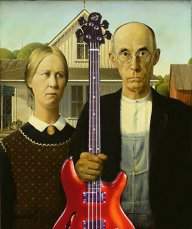
Imagine if they could do this for instrument cabs... well, they can, but won't

Invalid Link Removed