
Enjoy the benefits of a premium membership!
Upgrade Account
-
TalkBass has been independent since 1998. Add your voice.
Create a free account to reply to discussions, view embedded media, and browse with fewer display ads.
Join free Log in
Want zero display ads or expanded classifieds tools? Compare plans.
You are using an out of date browser. It may not display this or other websites correctly.
You should upgrade or use an alternative browser.
You should upgrade or use an alternative browser.
Medium Scale vs. Long Scale Basses
- Thread starter BassHappy
- Start date
More options
Who Replied?

i find that my personal musical 'history' (started on cello) has meant that 32 is simply more comfortable, yet allows me to transition easily to 34 (which i found more challenging when i was moving back & forth from 30 to 34) should i not have my own 32 at hand, for example.
i'll never give up my 34 jazz - but
i believe the fact that i think less about my left hand and am more comfortably and cleanly fretting on 32 is what improves my sound - not any sort of superiority or inferiority of the 32 vs. the 34 scale.
i'll never give up my 34 jazz - but
i believe the fact that i think less about my left hand and am more comfortably and cleanly fretting on 32 is what improves my sound - not any sort of superiority or inferiority of the 32 vs. the 34 scale.

My first bass was a Hag I, which is/was a 32" scale... Loved the pencil neck on that bass!
The next time I bought a bass, it was a Jazz (mid 70s)... Then a Carvin (33") and Hofner 500/1 (30") in the 80s ... Then my first Rick in the 90s (33")...
In the late 90s, I collected 12 Fender Mustangs and a Musicmaster (30" scale, but required 32" scale strings due to string-through-body set-up).
I learned with the Hofner and Mustangs that recording engineers (and, I'm sure others) listened with their eyes, and would immediately replace my bass with the house Fender (Jazz or Precision)...
Fender Mustang was like a smaller P bass, and, frankly, sounded just as good. I finally asked the engineers to record my choice of bass, AND theirs, and ask a 3rd party to pick which one. Ironically, the shorter scale basses were chosen more often than the long scale! Even I was surprised at that! My choice was mostly Hofner... But in studio, it was split between 'Stang and Hofner (when I got MY way).
When the Fenders, Hofners and Rickenbacker basses were designed, the intention was to replace that jungus dog-house! So, the closer the electric bass sounded to the stand-up bass the better...
Fender won the electric bass battle because it was well made (Mustang too!), and more widely available, and at a fair price.
And, FWIW, Fender hollow-body bass (I forget the model name now) was miserable!
The next time I bought a bass, it was a Jazz (mid 70s)... Then a Carvin (33") and Hofner 500/1 (30") in the 80s ... Then my first Rick in the 90s (33")...
In the late 90s, I collected 12 Fender Mustangs and a Musicmaster (30" scale, but required 32" scale strings due to string-through-body set-up).
I learned with the Hofner and Mustangs that recording engineers (and, I'm sure others) listened with their eyes, and would immediately replace my bass with the house Fender (Jazz or Precision)...
Fender Mustang was like a smaller P bass, and, frankly, sounded just as good. I finally asked the engineers to record my choice of bass, AND theirs, and ask a 3rd party to pick which one. Ironically, the shorter scale basses were chosen more often than the long scale! Even I was surprised at that! My choice was mostly Hofner... But in studio, it was split between 'Stang and Hofner (when I got MY way).
When the Fenders, Hofners and Rickenbacker basses were designed, the intention was to replace that jungus dog-house! So, the closer the electric bass sounded to the stand-up bass the better...
Fender won the electric bass battle because it was well made (Mustang too!), and more widely available, and at a fair price.
And, FWIW, Fender hollow-body bass (I forget the model name now) was miserable!
Oh, and IMO, the short and medium scale basses feel better to me too, and sound as good for what I do as any scale... I always sound like me (for better or worse).

Hey
Just wanted to re-iterate, I never got my hands on any of Stanley Clarke's Alembics, as mentioned in the initial post - he took the Alembic's with him so they were not laying around the studio during the day...
Could absolutely very well be that he was playing the short scale Alembics, but I thought his piccolo basses were short scale and his regular Alembic's were medium. I could be wrong, and boy do i wish i could have checked all of his Alembics out.
Nice catch on this....
My medium scale gallery is finally up and running here:
www.innertainment.net
Sorry, flash all over the place, so it won't work on mobile and ipads. Also displays a bit strange on some PC's. I recommend a good fairly new mac for proper viewing pleasure!
Best,
BassHappy
Just wanted to re-iterate, I never got my hands on any of Stanley Clarke's Alembics, as mentioned in the initial post - he took the Alembic's with him so they were not laying around the studio during the day...
Could absolutely very well be that he was playing the short scale Alembics, but I thought his piccolo basses were short scale and his regular Alembic's were medium. I could be wrong, and boy do i wish i could have checked all of his Alembics out.
Nice catch on this....
My medium scale gallery is finally up and running here:
www.innertainment.net
Sorry, flash all over the place, so it won't work on mobile and ipads. Also displays a bit strange on some PC's. I recommend a good fairly new mac for proper viewing pleasure!
Best,
BassHappy
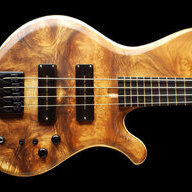


I own both a long scale bass (Squier Standard Jazz Bass) and a medium scale (Ibanez AEB5E Acoustic-Electric Bass) one and I like both of them. I plan on eventually getting a short scale bass (either a Squier Jaguar Bass Special SS or an Ibanez Mikro Bass).
As long as the bass sounds good, scale doesn't make a difference. It's a matter of preference.
As long as the bass sounds good, scale doesn't make a difference. It's a matter of preference.

I may not be able to hear a difference, but I sure as hell could feel a difference if I played them side by side.
For me the longer the scale the better. I like the most amount of tension I can get on each string because then I can play harder without excessive fret noise. The longer the scale, the thinner the strings you can get away with and still have the same tension. That's why I love the idea of the Novak fanned-fret system.
That said I have nothing against short or medium scale basses and have always been interested in owning one.
For me the longer the scale the better. I like the most amount of tension I can get on each string because then I can play harder without excessive fret noise. The longer the scale, the thinner the strings you can get away with and still have the same tension. That's why I love the idea of the Novak fanned-fret system.
That said I have nothing against short or medium scale basses and have always been interested in owning one.

I had a Fender Mustang. The neck is 30". However, it is strung through the body hence you need to put medium scale strings on it. Short scale string are too short.
Years ago I had a Mustang bass with 32" scale. It just never felt right and there were very few strings sets available. I sold it or traded it on a Jazz bass.
Hey
Nice to see the responses to what I consider to be a very interesting topic.
TapyTap, thanks so much for the kind words, glad you enjoyed the gallery. I have worked very hard over the years to amass a wide selection of world class medium scale instruments.
In answer to your question, I don't use "effects" as you call them - or EQ, except the occasional tone control tweak on the instrument. I only use the Roland V bass as my amplifier on most of the songs on "The Muse Awakens" by my band Happy the Man. The exceptions are "Adrift" where I use an upright sound and "The Muse Awakens" where i use a fretless sound. All the other cuts on "The Muse Awakens" I am only using the modeled amps on the V Bass and the Roscoes, which are identical. The best tracks to hear the natural sound of the piezos would be "Contemporary Insanity", "Lunch at the Psychedelicatessen" or "Barking Spiders". You can listen to "Contemporary Insanity" here if you are interested, just click on the track and make sure your speakers are up:
http://www.everythinghappytheman.com/music.html
I really have no way of knowing how many of the fine bassists on here are professional and how many are more in the hobby category - just saying - if you are playing music with a high degree of complexity requiring an inordinate amount of "chops" - whatever style you are playing - try it on a medium scale - if your hands are on the smaller side it may be a revelation for you, as it was for me.
Of course, if I were just playing straight ahead blues, covers, rock or country, it would be a pleasure and no sweat for me or anyone else - to play on a standard neck. It helps for me when I am playing the wickedly fast and complex passages to have the medium scale access.
I don't mean to single out King Razor as there are tons of players everywhere who talk in glittering generalities as you do - if the bass and the neck feels more comfortable for you - that is fine - but don't glorify the tension and refer to phantom fret noise that simply doesn't exist. These are folk tales - the ear doesn't hear the difference my friend.
The fact of the matter is that medium and short scale basses in many cases actually sound "fatter" than their long scale counterparts - and Fender (among others) confirms this at the link below:
(Invalid Link Removed)
Which in part says:
"In addition to the obvious size difference between long- and short-scale basses, is there a tonal difference?
Yes, definitely. For one thing, short-scale bass guitars sometimes use a slightly heavier string gauge than their long-scale brothers, which imparts a thicker and more bass-heavy tone than lighter-gauge strings with more brightness and snap. Further, shorter strings require lower string tension for proper intonation, which imparts not only a looser, more floppy feel to the strings, but also results in fatter-sounding low notes."
If you have ever wondered about this yourself, simply tune down any string on your long scale bass and hear how much "fatter" the sound becomes....
I had to smile as King Razor tells us about his long scale bass preference and acting like an authority implies that long scales are superior - then reveals he has never really OWNED a short or medium scale bass. Tsk tsk, how typical.
Maybe you should spend a few days woodshedding with one and honing your opinion before you expose your questionable credibility. I hate to single you out, there are hundreds like you, unfortunately....
Best to all and happy plucking....
BassHappy
Nice to see the responses to what I consider to be a very interesting topic.
TapyTap, thanks so much for the kind words, glad you enjoyed the gallery. I have worked very hard over the years to amass a wide selection of world class medium scale instruments.
In answer to your question, I don't use "effects" as you call them - or EQ, except the occasional tone control tweak on the instrument. I only use the Roland V bass as my amplifier on most of the songs on "The Muse Awakens" by my band Happy the Man. The exceptions are "Adrift" where I use an upright sound and "The Muse Awakens" where i use a fretless sound. All the other cuts on "The Muse Awakens" I am only using the modeled amps on the V Bass and the Roscoes, which are identical. The best tracks to hear the natural sound of the piezos would be "Contemporary Insanity", "Lunch at the Psychedelicatessen" or "Barking Spiders". You can listen to "Contemporary Insanity" here if you are interested, just click on the track and make sure your speakers are up:
http://www.everythinghappytheman.com/music.html
I really have no way of knowing how many of the fine bassists on here are professional and how many are more in the hobby category - just saying - if you are playing music with a high degree of complexity requiring an inordinate amount of "chops" - whatever style you are playing - try it on a medium scale - if your hands are on the smaller side it may be a revelation for you, as it was for me.
Of course, if I were just playing straight ahead blues, covers, rock or country, it would be a pleasure and no sweat for me or anyone else - to play on a standard neck. It helps for me when I am playing the wickedly fast and complex passages to have the medium scale access.
I don't mean to single out King Razor as there are tons of players everywhere who talk in glittering generalities as you do - if the bass and the neck feels more comfortable for you - that is fine - but don't glorify the tension and refer to phantom fret noise that simply doesn't exist. These are folk tales - the ear doesn't hear the difference my friend.
The fact of the matter is that medium and short scale basses in many cases actually sound "fatter" than their long scale counterparts - and Fender (among others) confirms this at the link below:
(Invalid Link Removed)
Which in part says:
"In addition to the obvious size difference between long- and short-scale basses, is there a tonal difference?
Yes, definitely. For one thing, short-scale bass guitars sometimes use a slightly heavier string gauge than their long-scale brothers, which imparts a thicker and more bass-heavy tone than lighter-gauge strings with more brightness and snap. Further, shorter strings require lower string tension for proper intonation, which imparts not only a looser, more floppy feel to the strings, but also results in fatter-sounding low notes."
If you have ever wondered about this yourself, simply tune down any string on your long scale bass and hear how much "fatter" the sound becomes....
I had to smile as King Razor tells us about his long scale bass preference and acting like an authority implies that long scales are superior - then reveals he has never really OWNED a short or medium scale bass. Tsk tsk, how typical.
Maybe you should spend a few days woodshedding with one and honing your opinion before you expose your questionable credibility. I hate to single you out, there are hundreds like you, unfortunately....
Best to all and happy plucking....
BassHappy
I've owned my first medium scale bass for about 3 months now. It just fits my hands so much better. I used to struggle at stretching from Bb to say, C# on the lower notes.
My conclusion is the medium scale has more tone overall. I also think one can play a little tighter to the beat with shorter strings to control..especially for funk slappin'. Usually the open strings of a standard 34 inch are richer in sustain, but I don't notice that with the medium scale Alembic.
Any less length of a neck tends to sound kinda bonkie to my ears, a little too much character, except in Paul McCartney's case.
My conclusion is the medium scale has more tone overall. I also think one can play a little tighter to the beat with shorter strings to control..especially for funk slappin'. Usually the open strings of a standard 34 inch are richer in sustain, but I don't notice that with the medium scale Alembic.
Any less length of a neck tends to sound kinda bonkie to my ears, a little too much character, except in Paul McCartney's case.
Hey
Nice to see the responses to what I consider to be a very interesting topic.
TapyTap, thanks so much for the kind words, glad you enjoyed the gallery. I have worked very hard over the years to amass a wide selection of world class medium scale instruments.
In answer to your question, I don't use "effects" as you call them - or EQ, except the occasional tone control tweak on the instrument. I only use the Roland V bass as my amplifier on most of the songs on "The Muse Awakens" by my band Happy the Man. The exceptions are "Adrift" where I use an upright sound and "The Muse Awakens" where i use a fretless sound. All the other cuts on "The Muse Awakens" I am only using the modeled amps on the V Bass and the Roscoes, which are identical. The best tracks to hear the natural sound of the piezos would be "Contemporary Insanity", "Lunch at the Psychedelicatessen" or "Barking Spiders". You can listen to "Contemporary Insanity" here if you are interested, just click on the track and make sure your speakers are up:
http://www.everythinghappytheman.com/music.html
I really have no way of knowing how many of the fine bassists on here are professional and how many are more in the hobby category - just saying - if you are playing music with a high degree of complexity requiring an inordinate amount of "chops" - whatever style you are playing - try it on a medium scale - if your hands are on the smaller side it may be a revelation for you, as it was for me.
Of course, if I were just playing straight ahead blues, covers, rock or country, it would be a pleasure and no sweat for me or anyone else - to play on a standard neck. It helps for me when I am playing the wickedly fast and complex passages to have the medium scale access.
I don't mean to single out King Razor as there are tons of players everywhere who talk in glittering generalities as you do - if the bass and the neck feels more comfortable for you - that is fine - but don't glorify the tension and refer to phantom fret noise that simply doesn't exist. These are folk tales - the ear doesn't hear the difference my friend.
The fact of the matter is that medium and short scale basses in many cases actually sound "fatter" than their long scale counterparts - and Fender (among others) confirms this at the link below:
(Invalid Link Removed)
Which in part says:
"In addition to the obvious size difference between long- and short-scale basses, is there a tonal difference?
Yes, definitely. For one thing, short-scale bass guitars sometimes use a slightly heavier string gauge than their long-scale brothers, which imparts a thicker and more bass-heavy tone than lighter-gauge strings with more brightness and snap. Further, shorter strings require lower string tension for proper intonation, which imparts not only a looser, more “floppy” feel to the strings, but also results in fatter-sounding low notes."
If you have ever wondered about this yourself, simply tune down any string on your long scale bass and hear how much "fatter" the sound becomes....
I had to smile as King Razor tells us about his long scale bass preference and acting like an authority implies that long scales are superior - then reveals he has never really OWNED a short or medium scale bass. Tsk tsk, how typical.
Maybe you should spend a few days woodshedding with one and honing your opinion before you expose your questionable credibility. I hate to single you out, there are hundreds like you, unfortunately....
Best to all and happy plucking....
BassHappy
Woah, woah, wait a second here.
"Phantom" fret noise? I don't know what the *#$% you're talking about but whenever I play a bass with thinner strings I get lots of fret noise because of the lower tension. That's why I use heavier strings than what is usually "standard".
Strings on a longer scale bass will have more tension than the same strings on a short scale bass. This is a fact, not just my opinion.
If you have a short scale bass and a long scale bass with the same strings set up the same way, there will be less tension on the short scale bass, and thus a higher probability of fret noise when playing hard (which I tend to do).
I'm not acting like any authority here...just posting an opinion based on a fact. Maybe short or medium scale basses magically have less fret noise than long scale basses for no reason. I don't know, but I highly doubt that.
You really shouldn't make assumptions about people, seriously.
Hey
TapyTap, thanks so much for the kind words, glad you enjoyed the gallery. I have worked very hard over the years to amass a wide selection of world class medium scale instruments.
In answer to your question, I don't use "effects" as you call them - or EQ, except the occasional tone control tweak on the instrument. I only use the Roland V bass as my amplifier on most of the songs on "The Muse Awakens" by my band Happy the Man. The exceptions are "Adrift" where I use an upright sound and "The Muse Awakens" where i use a fretless sound. All the other cuts on "The Muse Awakens" I am only using the modeled amps on the V Bass and the Roscoes, which are identical. The best tracks to hear the natural sound of the piezos would be "Contemporary Insanity", "Lunch at the Psychedelicatessen" or "Barking Spiders". You can listen to "Contemporary Insanity" here if you are interested, just click on the track and make sure your speakers are up:
http://www.everythinghappytheman.com/music.html
Thank you for the details. I'll have a listen through some decent headphones.
Hello King Razor
Not a personal attack at all. Sorry you seem so "offended". I am simply suggesting that if you are weighing in on this topic, you should take the time to be familiar with both medium and long scales....
How familiar can you possibly be with the actual nuances and characteristics of a medium scale bass if you have never owned one? Last I looked that WAS the topic of this thread.
Might I suggest to you is that "Fret Noise" is the result of improper set up. I have no "Fret Noise" on any of my medium scale basses - in fact I find it quite laughable. For the record, I never had any fret noise on my long scales either.
I would heartily suggest that you get your hands on a premium medium scale bass (Not short scale) and spend some serious time with it. Then, I would heartily endorse and welcome any comments you may have.
Best,
BassHappy
Not a personal attack at all. Sorry you seem so "offended". I am simply suggesting that if you are weighing in on this topic, you should take the time to be familiar with both medium and long scales....
How familiar can you possibly be with the actual nuances and characteristics of a medium scale bass if you have never owned one? Last I looked that WAS the topic of this thread.
Might I suggest to you is that "Fret Noise" is the result of improper set up. I have no "Fret Noise" on any of my medium scale basses - in fact I find it quite laughable. For the record, I never had any fret noise on my long scales either.
I would heartily suggest that you get your hands on a premium medium scale bass (Not short scale) and spend some serious time with it. Then, I would heartily endorse and welcome any comments you may have.
Best,
BassHappy

I own and play both long and medium scale basses. Check my profile.
I have found the Dingwall Super J to combine neatly many of the benefits of both. 34.25" on E up to 32" on the G. Very easy to play too and easy to set up.
In my experience, 'fret noise' generally comes from heavy technique or improper set-up, irrespective of scale length. Sounds good in the right context, lousy in others.
I have found the Dingwall Super J to combine neatly many of the benefits of both. 34.25" on E up to 32" on the G. Very easy to play too and easy to set up.
In my experience, 'fret noise' generally comes from heavy technique or improper set-up, irrespective of scale length. Sounds good in the right context, lousy in others.
The fact of the matter is that medium and short scale basses in many cases actually sound "fatter" than their long scale counterparts - and Fender (among others) confirms this at the link below:
(Invalid Link Removed)
Which in part says:
"In addition to the obvious size difference between long- and short-scale basses, is there a tonal difference?
Yes, definitely. For one thing, short-scale bass guitars sometimes use a slightly heavier string gauge than their long-scale brothers, which imparts a thicker and more bass-heavy tone than lighter-gauge strings with more brightness and snap. Further, shorter strings require lower string tension for proper intonation, which imparts not only a looser, more floppy feel to the strings, but also results in fatter-sounding low notes."
Yeah, I don't think quoting Fender (or any other company's) marketing speak "confirms" anything. My first bass was a short scale. I still have it and it sounds no "fatter" than my long scale basses. I don't find that it plays any different either but for those who do I am glad that they can get what they want. The Fender statement above is nonsense because it is self contradictory. It is impossible for there to be a definite tonal difference due to a feature that is sometimes seen on short scale basses. It is also wrong to imply that short scale basses have both thicker and looser strings because the reason short scale basses use thicker strings is to keep the tension close to "normal". To be sure there is a middle ground and they can have only somewhat thicker strings and therefore somewhat looser strings too but how much difference does "somewhat" make, really? And if looser strings give you a fatter sound all you have to do is to use light gauge strings on your long scale bass. And then there is the fact that if you do buy into this marketing ploy then you really should be playing short, not medium, scale basses to get that really fat sound.
I think that the fact that Fender makes and sells mostly long scale basses tells us more about what the average bass buyer finds optimum than any marketing copy about short scale basses can. And I think that the last part of that article, which you did not quote, is a more telling argument in support of your cause:
Further, short-scale bass playing has not been the exclusive province of kids and beginners. Plenty of bass greats have used short-scale basses, including Paul McCartney, Jack Bruce (Cream), Bill Wyman (Rolling Stones), Andy Fraser (Free), Glenn Cornick (Jethro Tull), Trevor Bolder (Spiders From Mars, Uriah Heep), Tina Weymouth (Talking Heads), Garry Tallent (E Street Band), Bruce Thomas (the Attractions), Gary Mounfield (Stone Roses, Primal Scream), Mike Watt (Minuteman, Firehose, Stooges) and many others.
I think this list of short scale players speaks to the crux of the matter. If you like a given scale length, no matter what it is, then you probably have some very good company and you should play what works for you, not what someone else tells you is "superior". If one scale length or another were truly superior then everyone would play that scale length. The fact that everyone does not puts the lie to the notion that one or another is superior. Except in one area: the variety of string options available for 34 inches is truly superior to that for any other scale length - it pays to be popular! All the attempts to demonstrate the superiority of a given scale length that you read here on TB are really driven by the very human need to validate the choices that we have made and you have entered that territory yourself. Far too few of us feel the strength of our own convictions enough to proudly walk our own path without affirmation in any area of life, choice of scale length is just a trivial example, if a popular one here on TB. If short scale was the way to go then we'd all be converting Strats to basses. If long scale was the way to go then we would all be playing 43 inch monstrosities. Actually I am surprised that we don't see a little of that here on TB, or have I just missed it? I do know that someone here mentioned they are having a 39 inch (I believe) custom bass made so we are getting close on the high end....
Play what you like, you don't have to justify it. You cannot take the comments made on TB too seriously. If you do then you will find that not only is your choice of scale length bad but also that you play the wrong brand of bass, your strings are flabby and lifeless, your pickups are a joke, your preamp sucks, only idiots use that strap, your bridge is hopeless, those tuners are garbage, your pick guard should be tort, and your mother is ugly!
Ken

Yeah BassHappy, I don't go with the bigger gauges for shorter scales, like you say, tune down and see. What you are essentially doing is putting a smaller gauge with a lower pitch there. The gauges on the TI set I put on my son's Icon are small by 34 standards, but the G string has more meat.
khutch -
i agree with much of your thinking - just wondering - what would be stopping anyone from using a long scale set of strings on a shorter scale?
i realize that a an E and certainly a low B string will be harder to fit into a tuner - but there are ways around that, no?
i agree with much of your thinking - just wondering - what would be stopping anyone from using a long scale set of strings on a shorter scale?
i realize that a an E and certainly a low B string will be harder to fit into a tuner - but there are ways around that, no?


