I’ve been on a quest to learn bass for over a year now, and I’ve drawn up a “you should have done this” memo to my myself. For the beginners reading this: I’m still relatively green, so consider the source. To more seasoned bassists: feel free to correct my conclusions as this is as much an asking exercise as it is an offering.
1. Stay away from pedals. I have one special pedal I’m very glad I lucked up on in my quest for a certain “tone,” but I reflect on how much time I’ve expended searching for them, twiddling with them when I have them, and then listing them when I’m done, and for the most part, it has been a wash. I really haven’t had that many, but they are a noodling-multiplier, and until some of the other things on this list are mastered, I really didn’t need to mess around with them.
2. Forget endlessly practicing scales, play actual songs, BUT while learning standard music notation. I have several scales automatically programmed in my fretting hand, and while it’s helpful, I would have been better off diving into song books learning things I like (and discovering songs that I wouldn’t have otherwise enjoyed until playing them), and developing a better sense of syncopation, building confidence, and most important, learning to read actual music. This is currently my most frustrating weakness: the inability to sit down and read so that I can play ANYTHING. Tabs are great to a learn a particular song, but they are not very useful in learning to play generally.
3. Don’t practice over an hour at a time (ok, maybe two once in a while). You would think long hours in the early mornings and late nights would equal advanced development, but nothing develops the way it ought to if you are worn out. Sleeplessness has a trickle-down effect on all aspects of life, including the ability to focus and learn music. Sometimes I need the extra time to nail a particular riff, but usually the extra hour or more is spent noodling. And when I wake up the next morning and I can barely flex my fingers, I’ve overdone it, and that negatively impacts the next time I pick up my bass.
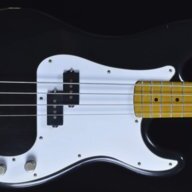
4. Buy the best bass for you within your budget. Not everyone can afford a $2000 instrument, but the enjoyment of playing doubled when I found a really nice P-Bass that sounds pleasing to my ears and feels great in my hands. Maybe I could find something just as nice at half the cost, but I know I have a winner in my possession. I don’t agree with a rigid “good for a beginner” mindset. If a $150 bass feels and sounds good to you, that’s great. My first was a Squier PJ, and while it in no way compares to what I have now, it gave me a point of reference. Six months in, I debated whether I should upgrade, and after I did I felt guilty for a bit (pig in a Lexus complex), but I’m now glad that I moved onto something nicer. It’s pure joy to play, and when the time to find something nicer comes along (and you can afford it), think of it as an investment in yourself. P.S. try it out before you buy it...when it comes to the instrument itself, reviews are only subjective guideposts. I’ve had two T-40’s: they sound AMAZING, but the neck (not the weight) forced me to trade them off. They’re not right for me.
5. Be eager to play with others, but choose wisely. I haven’t been burned on this one, but I can see how, if I wasn’t careful, this could be a major source of disappontment. I have one of the nicest, easygoing worship teams anyone could find that has invited me to come and play/learn in a relatively stress-free setting. The music is nice (albeit a little slow for my tastes), and I’m not a fan of worship music in general, but I couldn’t have found a better place to be initiated to the invaluable experience of playing with other very talented people. If I insisted on my first experience being what I really want to play (metal, punk, blues, etc), maybe I would have the same luck, but maybe not. It could be a really depressing thing to land as a first-timer with the wrong crowd. I know it’s inevitable if you play with enough people that you’ll encounter duds, but early on the quality of folks surrounding you means more than the genre.
And since this is long enough, I’ll cap it at 5. Again, I welcome the gentle rod of correction if I’m in error.
1. Stay away from pedals. I have one special pedal I’m very glad I lucked up on in my quest for a certain “tone,” but I reflect on how much time I’ve expended searching for them, twiddling with them when I have them, and then listing them when I’m done, and for the most part, it has been a wash. I really haven’t had that many, but they are a noodling-multiplier, and until some of the other things on this list are mastered, I really didn’t need to mess around with them.
2. Forget endlessly practicing scales, play actual songs, BUT while learning standard music notation. I have several scales automatically programmed in my fretting hand, and while it’s helpful, I would have been better off diving into song books learning things I like (and discovering songs that I wouldn’t have otherwise enjoyed until playing them), and developing a better sense of syncopation, building confidence, and most important, learning to read actual music. This is currently my most frustrating weakness: the inability to sit down and read so that I can play ANYTHING. Tabs are great to a learn a particular song, but they are not very useful in learning to play generally.
3. Don’t practice over an hour at a time (ok, maybe two once in a while). You would think long hours in the early mornings and late nights would equal advanced development, but nothing develops the way it ought to if you are worn out. Sleeplessness has a trickle-down effect on all aspects of life, including the ability to focus and learn music. Sometimes I need the extra time to nail a particular riff, but usually the extra hour or more is spent noodling. And when I wake up the next morning and I can barely flex my fingers, I’ve overdone it, and that negatively impacts the next time I pick up my bass.
4. Buy the best bass for you within your budget. Not everyone can afford a $2000 instrument, but the enjoyment of playing doubled when I found a really nice P-Bass that sounds pleasing to my ears and feels great in my hands. Maybe I could find something just as nice at half the cost, but I know I have a winner in my possession. I don’t agree with a rigid “good for a beginner” mindset. If a $150 bass feels and sounds good to you, that’s great. My first was a Squier PJ, and while it in no way compares to what I have now, it gave me a point of reference. Six months in, I debated whether I should upgrade, and after I did I felt guilty for a bit (pig in a Lexus complex), but I’m now glad that I moved onto something nicer. It’s pure joy to play, and when the time to find something nicer comes along (and you can afford it), think of it as an investment in yourself. P.S. try it out before you buy it...when it comes to the instrument itself, reviews are only subjective guideposts. I’ve had two T-40’s: they sound AMAZING, but the neck (not the weight) forced me to trade them off. They’re not right for me.
5. Be eager to play with others, but choose wisely. I haven’t been burned on this one, but I can see how, if I wasn’t careful, this could be a major source of disappontment. I have one of the nicest, easygoing worship teams anyone could find that has invited me to come and play/learn in a relatively stress-free setting. The music is nice (albeit a little slow for my tastes), and I’m not a fan of worship music in general, but I couldn’t have found a better place to be initiated to the invaluable experience of playing with other very talented people. If I insisted on my first experience being what I really want to play (metal, punk, blues, etc), maybe I would have the same luck, but maybe not. It could be a really depressing thing to land as a first-timer with the wrong crowd. I know it’s inevitable if you play with enough people that you’ll encounter duds, but early on the quality of folks surrounding you means more than the genre.
And since this is long enough, I’ll cap it at 5. Again, I welcome the gentle rod of correction if I’m in error.
Last edited: