• TalkBass has been independent since 1998. Add your voice.
    Create a free account to reply to discussions, view embedded media, and browse with fewer display ads.
    Join freeLog in
    Want zero display ads or expanded classifieds tools? Compare plans.

Ways to keep strings from jumping roller saddles on bass vi bridges?

Riff Ranger

bass/guitar/vocals in [Taking Suggestions]
Supporting Member
Mar 22, 2018
5,442
1
12,274
Bigfoot Country
thunderhorn.bandcamp.com
Other than lightening up our attack? 😆
81F22DCD-7C23-4079-B069-ECEBB8DBEDC1.webp


Obviously adjusting attack has no financial cost, but it doesn't take much force at all to knock that biggest string out of the roller saddle with a downstroke, and I would rather not lose the sound that comes with a reasonably heavy attack.

At first I thought it might just be me, as I've modified mine to take heavy strings for B0–B2 tuning, and maybe a .130 or even .120 B0 was just too much to ask of the hardware; but my friend here runs into the same issue, using the instrument as intended 😆 i.e. with La Bella bass vi flatwounds in E1–E3.

Other than drastically lightening up our attack, is there some way we can reliably keep our big strings on these roller saddles?
 
I got the "roller" terminology from the manufacturer here.
View attachment 7566879

Here's a different angle on mine:
View attachment 7566912

@96tbird would you still recommend taking a file to the saddle, whatever we call it?
Yep that's a roller. Didn't show that on the website I looked at today and stole the screenshot from.

You're gonna need a bigger roller! 😂

Somehow, you need to widen the string groove on that roller. How to do that on such a tiny piece IDK. The dang thing will roll away on you as soon as you hit it with a file/dremel/whatever. If you can devise a way to do it, that's the real remedy.

I do see your strings are all arcing up over the saddle and that's not helping the situation. Press down on the string on both sides of the saddle at the same time to bend it over the saddle in a clean break, as if the string had been on there a long time and has formed to the saddle; "setting witness points". You may need to adjust intonation again and form the string again,repeat.
 
I do see your strings are all arcing up over the saddle and that's not helping the situation. Press down on the string on both sides of the saddle at the same time to bend it over the saddle in a clean break, as if the string had been on there a long time and has formed to the saddle; "setting witness points". You may need to adjust intonation again and form the string again,repeat.
The witness points are cleaner than the image might suggest, but as @lowplaces surmised, I can't get the break angles especially steep. This might have been the issue on my friend's instrument with the flatwounds before I corrected his setup, though 🤞 I'll have to check with him when he's done building our practice space and has time to play again 😆 we're each handy in different but complementary ways.

You're gonna need a bigger roller! 😂

Machine shops can manufacture custom rollers. You got cute with your location so I cannot offer any references.
I suspected this was the case, but didn't realize it was a realistic possibility! I can't get a good photograph to show it, but I can see the tiniest of gaps between the .120 string and saddle. I wonder if this adversely affects the sound of that string as well; it doesn't ring out quite like the other strings, but not in the typical "thudding low B" way. The same string sounds great tuned to B on other instruments, including my Ibanez SRC6MS, which has immunity to my original issue … because it has no vibrato system.

@sissy kathy I live in Ashland, Oregon. I occasionally travel to Portland, Eugene, Bend, and San Francisco. If you have any recommendations in the region, please recommend away.

Thanks, everyone 🙌
 
In my unhelpful opinion - that's the wrong tool for the job. Big thick strings simply do not pair well with small saddles, as you've discovered. You can spend time and energy and money finding a way to make it work, but it's generally more efficacious to start with something more suitable.
 
The witness points are cleaner than the image might suggest, but as @lowplaces surmised, I can't get the break angles especially steep. This might have been the issue on my friend's instrument with the flatwounds before I corrected his setup, though 🤞 I'll have to check with him when he's done building our practice space and has time to play again 😆 we're each handy in different but complementary ways.



I suspected this was the case, but didn't realize it was a realistic possibility! I can't get a good photograph to show it, but I can see the tiniest of gaps between the .120 string and saddle. I wonder if this adversely affects the sound of that string as well; it doesn't ring out quite like the other strings, but not in the typical "thudding low B" way. The same string sounds great tuned to B on other instruments, including my Ibanez SRC6MS, which has immunity to my original issue … because it has no vibrato system.

@sissy kathy I live in Ashland, Oregon. I occasionally travel to Portland, Eugene, Bend, and San Francisco. If you have any recommendations in the region, please recommend away.

Thanks, everyone 🙌
Ima go way out on a limb and ask if you have a high school in your area with a machine shop. If you talk to the teacher, it may be a nice little project for a student to cut you a nice custom saddle from stainless. Same dimensions but a wider angle on the groove or higher shoulders.
 
  • Like
Reactions: Riff Ranger
Ima go way out on a limb and ask if you have a high school in your area with a machine shop. If you talk to the teacher, it may be a nice little project for a student to cut you a nice custom saddle from stainless. Same dimensions but a wider angle on the groove or higher shoulders.
Don't do higher shoulders unless you are prepared to have the saddle carrier replaced as well, the tolerances between the intonation screw and cutout are too close to raise the shoulders. Wider can be done because you can file the cutout on the carrier to accept wider.

While writing this I've realized a DIY solution if you are handy at all. Take your saddle apart and put it on the bolt you purchase from a hardware store, use the nut you bought at the same time, as a jam nut. Chuck them up in your handy dandy drill press (everybody has one, right?), and use a rattail or nut file to widen your present saddle. This can be done with a hand held drill, but is now a two person job.
 
Last edited:
Tuneomatic bridge on a 5 string bass. Bad idea to start with but with a separate trem I guess that is what one does, though I'm not sure roller bridges actually help with tuning stability with a trem.

You could change to a non-roller TOM and then file the slot on the B and E strings. There are folks who make solid bar bridges with slots (Tru-Arc, Compton) and they may be able to custom build a bridge for you with slots that function better.
 
Last edited:
I think you need to replace the bridge saddles on the first two strings with a non roller type. I know that will make using the trem bar much more difficult, if not impossible. Those strings are wider than the actual roller itself. I don't think there's a mod to the rollers themselves that will solve the problem, and it looks like there just isn't enough room for a wider roller without completely re-engineering the entire saddle.
 
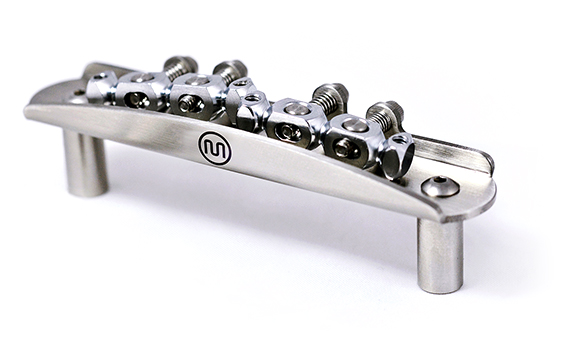
Not a cheap option but looks like you can get the Mastery bridge without their full wang bar apparatus. I'd contact them to confirm the fit but this could be a $200 fix. I run smaller strings than you do so I can't comment on how well this should work.

I also find the intonation adjustment a mind bender but you gotta pick your battles here.


IMG_5637.webp
 
Not a cheap option but looks like you can get the Mastery bridge without their full wang bar apparatus. I'd contact them to confirm the fit but this could be a $200 fix. I run smaller strings than you do so I can't comment on how well this should work.

I also find the intonation adjustment a mind bender but you gotta pick your battles here.


View attachment 7567683
The mastery is a replacement for the classic Fender Jazzmaster/Jaguar/Bass VII bridge, not for a TOM. You could instal one, but requires some surgery.
 
  • Like
Reactions: monsterthompson
Don't do higher shoulders unless you are prepared to have the saddle carrier replaced as well, the tolerances between the intonation screw and cutout are too close to raise the shoulders. Wider can be done because you can file the cutout on the carrier to accept wider.

While writing this I've realized a DIY solution if you are handy at all. Take your saddle apart and put it on the bolt you purchase from a hardware store, use the nut you bought at the same time, as a jam nut. Chuck them up in your handy dandy drill press (everybody has one, right?), and use a rattail or nut file to widen your present saddle. This can be done with a hand held drill, but is now a two person job.
Fair enough. But a wider groove = string deeper in the groove = higher shoulders. No?

The drill press plan is great. We DO all have a drill press. Except for me. So I would be jamming my corded drill into my bench vice. lol. The value of my Black and Decker is nothing to me when there's a bass to get playing right. But heck yeah, would reshape that groove right quick. It isn't going to take much to widen that out.
 
Fair enough. But a wider groove = string deeper in the groove = higher shoulders. No?

The drill press plan is great. We DO all have a drill press. Except for me. So I would be jamming my corded drill into my bench vice. lol. The value of my Black and Decker is nothing to me when there's a bass to get playing right. But heck yeah, would reshape that groove right quick. It isn't going to take much to widen that out.
How many times have you advised others, to widen the nut slot so the string sits properly in the slot, but to be careful not to file deeper, only file wider? Same deal, just the other end of the string.
 
Per AI fwiw

"
Yes, a standard Whizzo Buzz Stop will work on the Eastwood Sidejack Bass VI to address mechanical rattle and string slippage. Because the Sidejack Bass VI uses a traditional Fender-style floating vibrato tailpiece paired with a roller Tune-O-Matic bridge, it shares the exact same shallow string break-angle geometry that causes buzzing on Fender Jaguars and Jazzmasters. [1]
Installing a Buzz Stop pulls the strings down sharply behind the bridge, increasing downward pressure on your saddles. However, before you mount one, there are specific quirks regarding how it behaves on the Eastwood Sidejack Bass compared to a standard guitar. [1, 2]

How it Translates to the Eastwood Sidejack Bass VI
    • Bass String Clearances: The Sidejack Bass VI uses heavy, thick strings (typically .025 to .095). A standard Buzz Stop roller has enough clearance for these gauges. However, because the low E and A strings are significantly fatter, they will experience a very stark downward angle. This significantly stiffens the overall feel and response of your lowest strings. [1]
    • The Roller Bridge Component: Unlike standard vintage Jaguars that use threaded saddles, the Eastwood Sidejack comes factory-equipped with a roller Tune-O-Matic bridge. This means your strings are already resting on small rolling wheels. The added downward tension of a Buzz Stop will force the strings tightly into those rollers, preventing them from popping out during aggressive plucking or heavy tremolo use. [1]
    • Potential Friction Issues: Introducing a Buzz Stop creates a second point of friction right before the bridge. When you use the vibrato arm, the thick bass strings must glide under the Buzz Stop roller and over the bridge rollers simultaneously. This can sometimes cause tuning stability issues or slight mechanical binding if the roller components are not kept well-lubricated. [1] "