
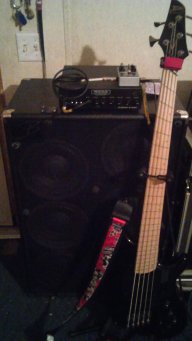
Hey what's up guys. I recently bought a mesa m6 and paired it with a RR410.
I'm just posting my experience and then some questions.
I use compression in my chain and I was very disappointed to discover that the fx loop is in series with the power amp, which basically rendered my compressor inoperable due to clipping even at lower volumes. After some contemplation on what to do, I decided to try the compressor between the bass and preamp. Problem solved. It sounded perfect. I also found that I didn't really like the post EQ di signal being manipulated by the power amp. BUT these, what I initially considered to be some pretty disappointing design features, brought me to a cascading benefit that beforehand, I would never have enjoyed doing in a situation with a sound guy or something...
-Go Pre EQ, di out.
I mean c'mon this equipment is thousands of dollars and a major inconvenience to haul around right? The Spector Legend Classic 4 with kalium strings (drop G# @ 30lbs/slight neck pup roll off.) into my bbe maxcom with about *typo edit->*2.5:1 compression, *some* limiting (keeping in mind the tube gain stage), and with the sonic maximizer engaged, is ideal to send to the board for me. This sends a well regulated full range (20hz-20kHz) "pure" bass signal, still retaining some dynamic ability ,to the house or studio guy where he can set you at an appropriate level, you know you will never clip, and the fundamentals will be persistent, even, and low.
I attribute owning the m6 to changing my stance on using pre EQ di signal although it actually has nothing to do with the amp itself.
After some toying around between output gain of the compressor and input gain of the m6 I've set the compressor output to have effectively no decibel change and the m6 input gain around 12:00-1:00 in order to maintain a decently clean sound during normal play and achieve tube drive during more aggressively played parts. The EQ knobs I'm not going too deep into, bass about 9-10:00 to compensate for higher tube gain, mid about 11:00, and treble about 10:30. After several different occasions of flipping it back and forth I have the voice selector set at 1(deepest mid scoop) by default. Do not let those graphics or descriptions fool you, no setting is lacking mid tone or punch but instead increasingly louder and present up till 5. The complete signal is then put into the mesa road ready 410. The cab complements the signal. At this point I can describe the sound by saying unchy mid tone, scooped mid feel.
Now, why I'm cool with hauling around hundreds of pounds and thousands of dollars of gear just to basically plug my bass straight to the pa...
I carry an sm57 in my rack drawer. Any sound guy with the technical capability and a shred of self respect will want to use both. So what that the 57 only goes to like 60hz or something because anything lower will be present in the pre di. Now it's just up to the sound or studio guy to blend them appropriately and everyone wins.
That was how I experienced the m6 and some of my thoughts. Thanks to anyone willing to read all of this, comment, and ask or answer questions.
Questions:
Does this design actually make more sense compared to an fx loop wired in parallel? My impression is that with some higher end amps you really need to understand what you're doing to get the most out of them, rather than just sticking your plugs in the hole that says "stick that here". I can see a lot of people possibly returning their amp because they think it's defected, or maybe even posting poor reviews about their gear in error due to lack of understanding.
Does anyone know how to identify road ready models? I was under an assumption that my cab could take 600watts, but I feel like it may only be 400. The speakers start to heavily distort with the volume knob getting around noon so I don't play it like that. The impedance is set properly and I'm using correct speaker cable, so can anyone see a problem with my settings or is it just too much for that little 410?
I'm just posting my experience and then some questions.
I use compression in my chain and I was very disappointed to discover that the fx loop is in series with the power amp, which basically rendered my compressor inoperable due to clipping even at lower volumes. After some contemplation on what to do, I decided to try the compressor between the bass and preamp. Problem solved. It sounded perfect. I also found that I didn't really like the post EQ di signal being manipulated by the power amp. BUT these, what I initially considered to be some pretty disappointing design features, brought me to a cascading benefit that beforehand, I would never have enjoyed doing in a situation with a sound guy or something...
-Go Pre EQ, di out.
I mean c'mon this equipment is thousands of dollars and a major inconvenience to haul around right? The Spector Legend Classic 4 with kalium strings (drop G# @ 30lbs/slight neck pup roll off.) into my bbe maxcom with about *typo edit->*2.5:1 compression, *some* limiting (keeping in mind the tube gain stage), and with the sonic maximizer engaged, is ideal to send to the board for me. This sends a well regulated full range (20hz-20kHz) "pure" bass signal, still retaining some dynamic ability ,to the house or studio guy where he can set you at an appropriate level, you know you will never clip, and the fundamentals will be persistent, even, and low.
I attribute owning the m6 to changing my stance on using pre EQ di signal although it actually has nothing to do with the amp itself.
After some toying around between output gain of the compressor and input gain of the m6 I've set the compressor output to have effectively no decibel change and the m6 input gain around 12:00-1:00 in order to maintain a decently clean sound during normal play and achieve tube drive during more aggressively played parts. The EQ knobs I'm not going too deep into, bass about 9-10:00 to compensate for higher tube gain, mid about 11:00, and treble about 10:30. After several different occasions of flipping it back and forth I have the voice selector set at 1(deepest mid scoop) by default. Do not let those graphics or descriptions fool you, no setting is lacking mid tone or punch but instead increasingly louder and present up till 5. The complete signal is then put into the mesa road ready 410. The cab complements the signal. At this point I can describe the sound by saying
unchy mid tone, scooped mid feel.Now, why I'm cool with hauling around hundreds of pounds and thousands of dollars of gear just to basically plug my bass straight to the pa...
I carry an sm57 in my rack drawer. Any sound guy with the technical capability and a shred of self respect will want to use both. So what that the 57 only goes to like 60hz or something because anything lower will be present in the pre di. Now it's just up to the sound or studio guy to blend them appropriately and everyone wins.
That was how I experienced the m6 and some of my thoughts. Thanks to anyone willing to read all of this, comment, and ask or answer questions.
Questions:
Does this design actually make more sense compared to an fx loop wired in parallel? My impression is that with some higher end amps you really need to understand what you're doing to get the most out of them, rather than just sticking your plugs in the hole that says "stick that here". I can see a lot of people possibly returning their amp because they think it's defected, or maybe even posting poor reviews about their gear in error due to lack of understanding.
Does anyone know how to identify road ready models? I was under an assumption that my cab could take 600watts, but I feel like it may only be 400. The speakers start to heavily distort with the volume knob getting around noon so I don't play it like that. The impedance is set properly and I'm using correct speaker cable, so can anyone see a problem with my settings or is it just too much for that little 410?
Last edited:





