• TalkBass has been independent since 1998. Add your voice.
    Create a free account to reply to discussions, view embedded media, and browse with fewer display ads.
    Join freeLog in
    Want zero display ads or expanded classifieds tools? Compare plans.

Mic'ing techniques for tracking double bass in studio

I've been systematically trying different mic configurations at different heights and distances from the bass. The large diaphragm condenser in omni mode is rounder, fuller, and bassier than cardioid. Someone said omni captures sound an octave lower; not sure if that's true or how it does so, but omni is a winner for double bass! The Blumlein Pair sounds very good, relatively tight sound and some room noise. The M/S with cardioid as M less so. The M/S with omni is the best stereo config of all three placed about 3 feet in front of the bass. I've also tried small diaphragm condensers about a foot above the top of the fingerboard / bridge area pointing down. Summed-to-Mono sound great and merged with a single LDC in omni, but a stereo X/Y config of the SDCs plus a single mono LDC in omni three feet in front of the bass is sounding really good. Normally the X/Y has a strong center image, and placing it close to the bass (esp. for fingerboard noise) enhances the combined signal with a touch of "3-D" moving up and away from the instrument. The photo roughly shows the layout. The X/Y and LDC placement is roughly 1:3 to help minimize phasing issues.
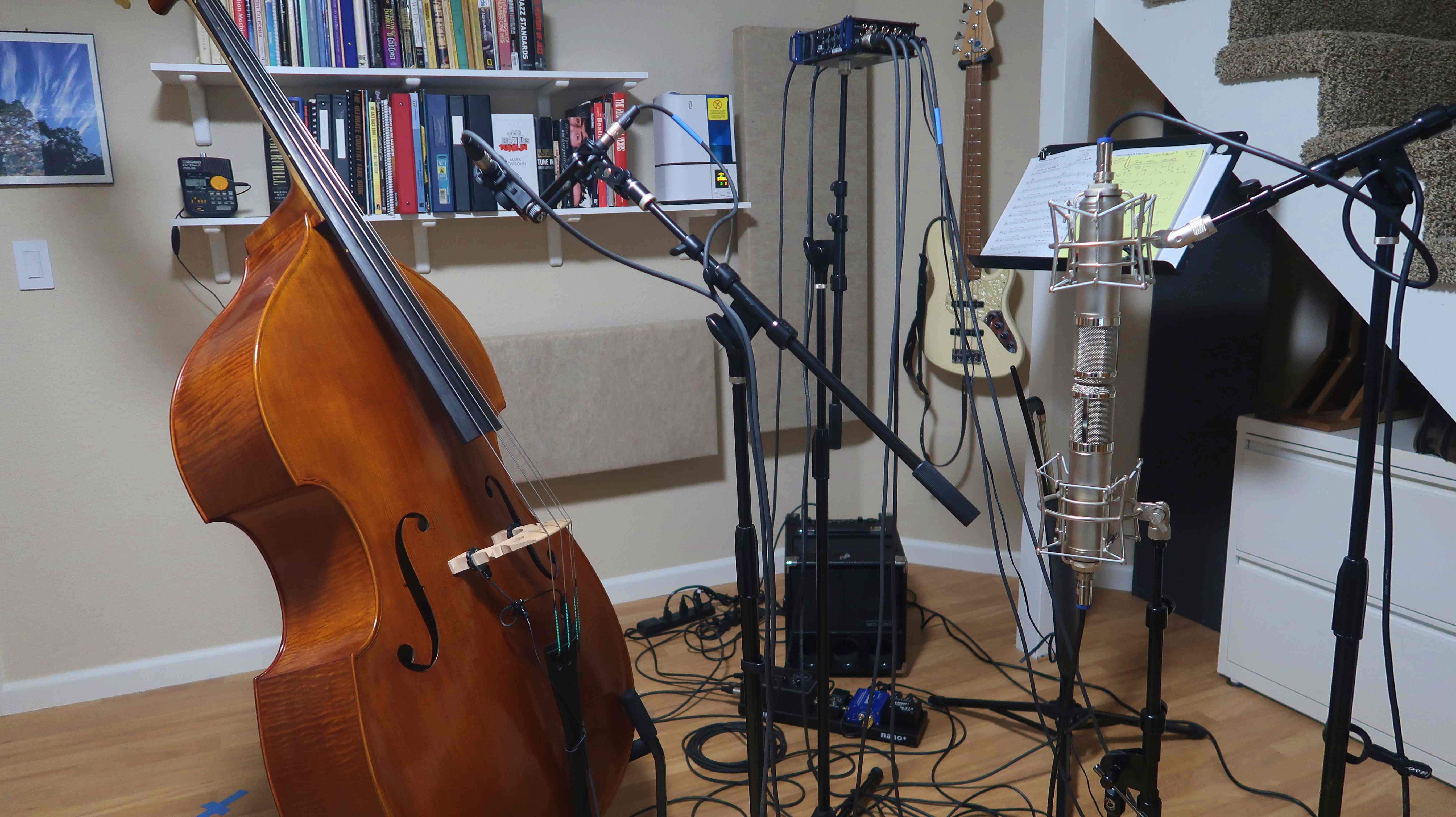
Stereo tests small.JPG
 
Last edited:
I've been systematically trying different mic configurations at different heights and distances from the bass. The large diaphragm condenser in omni mode is rounder, fuller, and bassier than cardioid. Someone said omni captures sound an octave lower; not sure if that's true or how it does so, but omni is a winner for double bass! The Blumlein Pair sounds very good, relatively tight sound and some room noise. The M/S with cardioid as M less so. The M/S with omni is the best stereo config of all three placed about 3 feet in front of the bass. I've also tried small diaphragm condensers about a foot above the top of the fingerboard / bridge area pointing down. Summed-to-Mono sound great and merged with a single LDC in omni, but a stereo X/Y config of the SDCs plus a single mono LDC in omni three feet in front of the bass is sounding really good. Normally the X/Y has a strong center image, and placing it close to the bass (esp. for fingerboard noise) enhances the combined signal with a touch of "3-D" moving up and away from the instrument. The photo roughly shows the layout. The X/Y and LDC placement is roughly 1:3 to help minimize phasing issues.

:thumbsup:

Yes omnis are generally considered better for capturing the extreme lows.

Don't quote me, but I believe the issue is directional mics lose the lower octave through the process that gives them their directional properties. The process also introduces variable phase errors in the low end. I don't believe these phase errors are such a big deal if you are recording a single instrument, but they can further degrade the low end if you are using multiple mics to record a large ensemble.
 
  • Like
Reactions: N. Kentucky Bass
Native omnidirectional mics are referred to as "pressure" mics, because only one side of the diaphragm is exposed to sound waves, so the diaphragm picks up the variations in pressure created by those sound waves.

As you can visualize, larger diaphragms will "hear" pressures which may differ from one point to another, resulting in coloring and/or distortion. Therefore, omnis with very small diaphragms are the most accurate of all mics and are generally used to record very-low-frequency sources.
 
  • Like
Reactions: Brennan and Wasnex
You also have to consider how much the player moves around. Depending upon the orientation of the mics, this could possibly cause an annoying shift in the stereo localization. The closer the mics are, the more this is likely to pose a problem.

If you have figure 8 patterns, you could try a mid-side array. This would give you a mono mic and the ability to blend in stereo as desired. The mid part of the array can be omni or directional.

You may find the thread interesting: Invalid Link Removed


On the point about moving around, I have been experimenting with an Explore Audio H-Clamp the past few months with an omni-directional Telefunken M61 small diaphragm condenser. I slightly prefer the same mic on a stand about three feet in front of the bridge. But it also works very well close-mic'd with the H-Clamp. With this device, it doesn't matter how much a player moves because the mic is always frozen in the same place. The recorded tone is excellent. Here are two angles on this idea:

H-clamp and Andy.jpg


M60 on H-Clamp.JPG
 
Also worth noting, if you're on a budget, you can get a pretty good recording with a decent lavaliere mic clipped onto the edge of an f-hole with the omni capsule suspended inside the bass. No proximity effect so sound is very good. No need for special clamps or mic stands, either. This is my Audio Technica AT803 shown two ways: one inside the double bass f-hole, the other clipped onto a pickup cable (since removed from my bass). The piece of cardboard prevents the teeth from scratching the top finish.

AT803 clipped inside bass - S.JPG


AT803 wide shot below afterstrings.JPG
 
  • Like
Reactions: Wasnex
YMMV, but I've had good results from wrapping a small diaphragm omni condenser in foam and sticking it in the bridge arch, pointing upwards toward the neck. If the room sound is OK you can get a surprisingly good tone with that setup.
It also allows the bass player to move around, which they are gonna do anyway!
 
I just completed a double bass / classical guitar duet project. For the double bass, best mic'ing configuration was the LDC about 2 feet in front of the bridge and a single SDC pointed at the fingerboard plucking area about 8-10 inches above. I got a bit "deep" into this one and tried recordings from nine different positions in my home studio. Believe it or not, some I tossed out immediately, three were excellent, and one in particular was the standout. I also discovered the floating wood floor was causing a subsonic resonance that did not sound good, so I played atop an Auralex pad and problem solved. It really pays to "learn your room" for recording double bass!

 
I just completed a double bass / classical guitar duet project.

Ukiah, very nice playing on both parts. The video is nice, but there are problems with the audio.

You obviously spent a lot of time thinking (see previous posts) about how to record your bass, so I assume through your testing you came up with the best mic selection and placement -- it's too late really to change any of that.

But how much effort did you put into the mixing phase: i.e. the blending of the two bass mics (phase checking, and band-passing each mic, or dropping one mic altogether), EQ of both guitar and bass tracks to create sonic spaces for each instrument, panning, and compression?

To my ears, on my studio cans, the bass doesn't sound all that great in the mix -- kinda muddy in fact, with little attack. The guitar sounds great, but hogs up most of the sonic spectrum -- which is typical.

Overall, the impression I got from listening several times was that it sounded like the project was recorded in two different studios and mixed in yet a third studio?
 
Ukiah, very nice playing on both parts. The video is nice, but there are problems with the audio.

You obviously spent a lot of time thinking (see previous posts) about how to record your bass, so I assume through your testing you came up with the best mic selection and placement -- it's too late really to change any of that.

But how much effort did you put into the mixing phase: i.e. the blending of the two bass mics (phase checking, and band-passing each mic, or dropping one mic altogether), EQ of both guitar and bass tracks to create sonic spaces for each instrument, panning, and compression?

To my ears, on my studio cans, the bass doesn't sound all that great in the mix -- kinda muddy in fact, with little attack. The guitar sounds great, but hogs up most of the sonic spectrum -- which is typical.

Overall, the impression I got from listening several times was that it sounded like the project was recorded in two different studios and mixed in yet a third studio?

Thanks! Yes, I'm aware of the audio shortfalls. I used just one mic for the DB. That studio was different from the guitarist's studio in Moscow. Videos were shot in the different studios as well, and I made it look like we were in the same room in post. I mixed audio in the same studio where I recorded. I actually re-tracked the DB at the end because a producer friend detected a faint buzz, which turned out to be the floating wood floor vibrating. Resolved that as best as possible by putting the bass on a Gramma Pad. The DB did not have the greatest natural sound as it was just a student bass, and it could have been recorded better, but I finally called it "done." And sold the bass! :) Let's just say I learned a lot!

Ironically, I am just wrapping up another project where the producer wanted a DB tone for a slow bossa nova original. So I stuck a thick microfiber sponge under the strings at the bridge of a P-bass w/TI Jazz flats, plucked near the end of the neck, and recorded with an omni SDC 24 inches in front of a PJB cab. A DB player could tell the difference, but most most listeners would not be able to tell I cheated by listening to the mix. Better faux DB tone than the real deal in the chess video! Maybe it was all in the fingers? :)
 
  • Like
Reactions: Wasnex
For what it’s worth, here’s my completely different “take” on this thread.

Reading through, it would appear the original poster is on a mission to capture and recreate the room sound he enjoys whilst performing with his bass, i.e., the bass in the room.

With the greatest possible respect, I would forget about all that completely and totally focus upon simply capturing the sound of the bass. Without the encumbrance of the room sound which in most recording situations would not be required, prove to be unwanted and might even become a problem.


I would use a large diaphragm condenser mic (for the colouring) 18” from the right-hand F hole (as one looks at the bass from the front).

If I wanted mechanical noises, I would add a small diaphragm condenser high up the fingerboard. But probably wouldn’t as I simply want the best most killer bass sound possible, and view such noises as a distraction from that mission critical aim.

If the bass player still didn’t hear the sound that they were seeking and were unhappy with the sonic impression of their instrument they were hearing. I would place a small diaphragm condenser mic on a boom behind the player, aligned with their left ear (as they look out from the instrument) sightly pointing down ward.

The salient point to consider is that singers and instrumentalists are used to hearing their voices and instrument, off axis to the instrument’s inherent projection of sound. Therefore, the tonality they hear differs slightly to that of the listeners in their audience, and of course to the instruments designed projection of sound the mic is precisely placed to capture.

This, at least to my mind, is a more precise way to capture what I imagine what the player really wants. Which is not actually the sound of his instrument in a particular room. But actually, the sound of his instrument, the way it normally sounds to his ears as he stands at the instrument plucking its strings.

In my experience, violin family instrument players, (and some concert pianists use to performing with concert grand pianos with the lid open or removed) are the most sensitively aware of the off-axis tonality of their instrument that they are accustomed to.

Although the players of many other instruments hear their sound off-axis to the projected sound, (acoustic guitar players for instance) it is usually, virtuoso violin family players that are clearly unsettled by hearing the simple capture of direct projected sound from their instrument.

Usually, a little of the instruments timbre as they experience it at their very own pinna’s, mixed in with the directly captured projection of sound is enough to completely satisfy them.

Put simply, they just want to hear their instrument exactly how they are used to experiencing it at their very own ears.
 

Latest posts