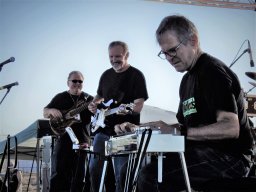
Here are the naked bass tracks, and I'll throw in a quick lesson on a cool studio trick.
Mike Lull M5V Demo (Bassline) (both pickups wide open, slight bass boost)
Mike Lull M5V Demo (Chords) (all bridge pickup, slight bass cut)
Mike Lull M5V Demo (Single Note Pattern) (all bridge pickup, slight bass cut, palm muted)
And now for the studio trickery. If you pan the chords to one side (say 40% Left) and the single note pattern to the other side (say 40% right), then you can get pretty good spatial and EQ separation. Here's what it sounds like:
Mike Lull M5V Demo (Without Trick)
That sounds OK, not too shabby. But if I want those two parts to really get wide and sort of out of the way of everything, there's a useful technique called the Haas trick. Google it, the back story and the theory behind it are really cool. But just to be practical, here's how I applied it to his mix:
1) I cloned each of these two tracks, so now I've got 4 tracks (2 copies of each part).
2) For each part, one copy gets panned hard right (100%R) and the other copy gets panned hard left (100%L).
3) For each part, I delayed one of the clones by 25 msec. This creates a poor-man's stereo effect. And I did it on opposite sides for each part, so the delay is on the left clone for the chords and on the right clone for the single note stuff.
Put it all together, and here's what the Haas trick does to widen and further separate the harmonic parts in this clip:
Mike Lull M5V Demo (Trick Results)
Pretty cool, eh?
Mike Lull M5V Demo (Bassline) (both pickups wide open, slight bass boost)
Mike Lull M5V Demo (Chords) (all bridge pickup, slight bass cut)
Mike Lull M5V Demo (Single Note Pattern) (all bridge pickup, slight bass cut, palm muted)
And now for the studio trickery. If you pan the chords to one side (say 40% Left) and the single note pattern to the other side (say 40% right), then you can get pretty good spatial and EQ separation. Here's what it sounds like:
Mike Lull M5V Demo (Without Trick)
That sounds OK, not too shabby. But if I want those two parts to really get wide and sort of out of the way of everything, there's a useful technique called the Haas trick. Google it, the back story and the theory behind it are really cool. But just to be practical, here's how I applied it to his mix:
1) I cloned each of these two tracks, so now I've got 4 tracks (2 copies of each part).
2) For each part, one copy gets panned hard right (100%R) and the other copy gets panned hard left (100%L).
3) For each part, I delayed one of the clones by 25 msec. This creates a poor-man's stereo effect. And I did it on opposite sides for each part, so the delay is on the left clone for the chords and on the right clone for the single note stuff.
Put it all together, and here's what the Haas trick does to widen and further separate the harmonic parts in this clip:
Mike Lull M5V Demo (Trick Results)
Pretty cool, eh?