• TalkBass has been independent since 1998. Add your voice.
    Create a free account to reply to discussions, view embedded media, and browse with fewer display ads.
    Join freeLog in
    Want zero display ads or expanded classifieds tools? Compare plans.

Mini basses - input needed :)

Grape Stake Tubscrod has a 22" scale. Rubber Aquila Thunderblacks. Piezo bridge.
It thumps nicely. Tuned EADG. Extra fat rubber E has some swing.
Took me a while to learn the very short fretless (naked) neck, but I've got it now.
No controls, plugs into board via balanced/mic cable, phantom powered preamp, no amp/cabinets to haul.

b-side-gl-450w.jpg


I'm making a couple of these now. Some in redwood, some in "other".
Here's a raw body in maple.

maple-tubscrod-450w.jpg


Rick
 
Wow thanks all so much for the replies and the warm welcome!

Welcome back! Are you Dr. Frederiek now? :D
Indeed :D I got the PhD three years back already, time flies!

Welcome back, Frederiek!

Several years ago, Keith Horne and I developed the Marvin Mini-Bass.
I love it. I'll read up on your posts about it! Looks like the perfect size for small hands and still very attractive for when they grow up (aka me taking care of them in the meantime :laugh:). Did you get custom strings for them?
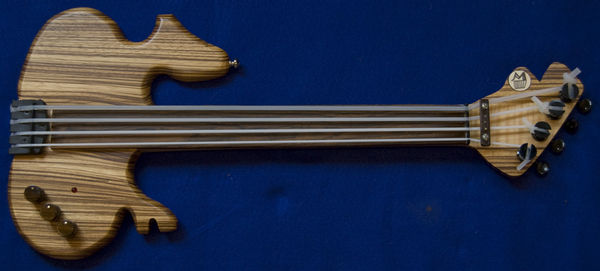
My thoughts are based on my personal preferences, and that would be 30" scale length standard tuning using LaBella Black tapewound short scale strings.

I owned an Ibanez Micro (28.6" scale length) which had no problem getting a solid E string, so going down to the 28" scale length range isn't necessarily a problem. I opted for 30" because the string selection was easier to deal with, as most manufacturer's "short scale" strings are made to accommodate the commonly available 30" scale length.

I presently own fretless and fretted 30" scale length bass guitars and love them dearly, and they are easy to transport in a standard Strat-sized gig bag.

I think there's a very good chance that I might love a 32" scale length even more, so there's a mid-scale bass build in the future for me.

Bruce's design is about as short as you can get for overall length, although you could take another inch off the end of the body if you really wanted to.
If you don't specifically need a short overall length then I think it's better to have a bit longer overall length as far as looks go.

Leo must have used 34" after experimenting a bit to find a scale length that was easy to produce a low E on. Manufacturers then pushed that number shorter until reaching a point of diminishing returns on clarity of that low E. Fender pretty much stopped at 30" and other manufacturers followed suit.

Going shorter than 34" doesn't make it more difficult to get a rumble out of the E, it makes it more difficult to get the nice upper harmonics out of the string due to the lower string tension. String gauge, of course, contributes to the total impact of scale length vs. tension, but there are practical limits to how far you can push the design parameters.

"Sub-short scale" implies to me the designs that go down to 25" and shorter. If you REALLY want to go that route then you might want to check out designs like the Kala U-bass and even shorter 17" scale Ashbory synthetic strung fretless basses of the past era.
Great ideas, thanks! What is the problem with the upper harmonics? I always thought short scale ended at 30" but I see I was wrong :)

Here’s one I made a few years back…the Minikin! It’s 21” scale like a kala except with ordinary strings and a magnetic pickup. The strings are custom, but if you get in touch with Newtone here in the UK they are surprisingly well priced. This one is bass octave not like the Mayones or Wing which are an octave up (without the octaver). The strings are heavy but not extremely so (I have the gauge written down somewhere!) it was similar to a heavy BEAD set except tuned EADG. I went through a couple of sets before settling on the one I did…I started off heavier.

If you wanted to avoid going for custom strings you could go headless…that way you could use any scale length strings of the right gauge, like a 5 string set for drop tunings.

This bass went to a number of shows before being sold and everyone who played it was impressed/surprised (in a good way!) by the sound and playability. It was super fun to play!
Newtone - noted. Good idea to use a BEAD gauge. So heavier strings are the way to go here? I thought of headless, would save some balance issues perhaps, but I like the more conventional looks. Your Minikin looks brilliant, only the background gives away the real size :)

Delighted to have @Frederiek back with us! Other than my relative who's loaned me the upright for the past 6 years having an Ashbory rubber string electric, and having seen and briefly played with someone else's Kala uBass with rubber strings, I have no useful input on the short-scale end of things.

At the risk of veering off electric, but towards instruments intended to introduce children to bass? Liutaio Mottola Lutherie Information Website The soundpost access is particularly charming.
Ah yes, with the cute little hatch, how lovely :)

I have a custom lefty 5 string fretless 23" scale uke bass which had a very fat sound when using Pahoehoe rubber uke bass strings and piezo pickup during the initial build. Several months after delivery I was able to find a string manufacturer that was able to make 23" scale tapewounds. I sent the bass back to the maker and he installed a magnetic pickup and the new tapewounds and the bass now sounds very much like a standard scale bass.
That is gorgeous, wow. What a beautiful design.

I went the Ashbory style, including some parts, and no lack of low end. I opted for 19" scale.
Ashbory piezo bridge and pre, and of course Ashbory tuners. Much better options these days thanks to Kala and others.

My band used to refer to it as Mini-me.

DSC_0059.jpg


To me tuning and scale length are always to be considered at the same time.
Awesome, that is tiny! I like how the fingerboard goes all the way to the bridge and the piezo is a great idea, particularly for a fretless.

I recently tried a Taylor mini bass and was very lmpressed with the sound. It is acoustic & 28.7 scale.
It is on my GASS list :D

Grape Stake Tubscrod has a 22" scale. Rubber Aquila Thunderblacks. Piezo bridge.
It thumps nicely. Tuned EADG. Extra fat rubber E has some swing.
Took me a while to learn the very short fretless (naked) neck, but I've got it now.
No controls, plugs into board via balanced/mic cable, phantom powered preamp, no amp/cabinets to haul.

View attachment 4718249

I'm making a couple of these now. Some in redwood, some in "other".
Here's a raw body in maple.

View attachment 4718347

Rick
This popped up in my search and I can only say I absolutely love it. It is so beautiful I want to hug it.
 
The topic of scale length for any stringed instrument is an interesting one! The main issue with shorter than typical scale lengths has to do with a property of the physics of vibrating strings, inharmonicity. An "ideal" vibrating string vibrates at a fundamental pitch, and also at integer multiples of that fundamental frequency. So an ideal A string would vibrate at 55Hz, and also at 110Hz, 165Hz, and on up, for example. Human perception of musical pitch is such that we perceive definite tonality when the partials are in these integer multiples of the fundamental frequency.

But real strings don't quite vibrate like this. When a real string vibrates, the partials skew sharp. How much they skew sharp (how much inharmonicity there is) depends on the bending stiffness of the string material, the tension the string is under, and the length of the (vibrating part of the) string. Stiffer string material, lower tension, or shorter vibrating length increase the sharping of the partials.

Human hearing perception is tolerant of a certain amount of inharmonicity. In fact, we generally prefer a little bit. Musical tones where there is no inharmonicity at all sound fake to us (think synthesizer). But if there is too much inharmonicity we perceive the tonality as vague (think chimes) and if this is not our expectation then we tend to find this unacceptable.

So, all things being equal, shortening the scale length increases inharmonicity. Although with a certain amount of shortening of scale length we would not hear anything amiss on the open strings, because inharmonicity increases with shorter string length we may very well find tonality sounds too vague for our taste as we play up the neck. And this is the general complaint against shorter than typical scale steel strung basses.

Note that steel strings have high bending stiffness because they are made of steel (for our purposes the material that the core of the string is made of is really most relevant). If the string (core) is made of a material with lower bending stiffness (like rubber or polyester) then lower inharmonicity is possible at shorter scale lengths. Thus the Ashbory and U-Bass.

I hope this helps!
 
Welcome back. :)

I made a couple of 25" basses a few years ago for my niece and nephew.

Build logs here if you are interested:
25" bass
25" short scale V2.0

In the second thread I describe the process of cutting down strings from a 5 string set. The four lowest strings from a 5 string set on a 25" scale is the same as fretting a normal bass at the fifth fret.