• TalkBass has been independent since 1998. Add your voice.
    Create a free account to reply to discussions, view embedded media, and browse with fewer display ads.
    Join freeLog in
    Want zero display ads or expanded classifieds tools? Compare plans.

MOJO!! Myth, or MAGIC?

To me, mojo = magic. But what is a magical instrument to me may not do a damned thing for you and vice versa. Mojo is the elusive combination that occurs when a player finds their ideal instrument(s).

+1 to that!

I majored in music performance (trumpet, not bass) for a number of years in college. Why I stopped is a long story not for this thread, but anyhoo...

There is...hopefully...a connection between a musician and his or her instrument. As I found last night, no other instrument feels quite as right to me, or sounds quite as good to me, as my own. In my case, it's my Jazz. In someone else's case, it might be their Stingray, or their P-Bass, or their Ric.

Same thing throughout my trumpet playing years. No other instrument ever felt as comfortable as mine. I played a lot of rental instruments and other horns through those years when the situation called for it...but my personal instrument always gave me the best results.

Over time, we come to know every nuance of our instruments. I know how my Jazz will respond on every fret on every string. I know the intonation by heart, and I can play it by feel with my eyes closed.

That's mojo to me.

-Mark
 
I think mojo is a combination of the player and the bass.

As an example, I recently bought a 1974 P bass that was played by a bassist with a famous band (in the '80s, not now) from new until he sold it to me last year. It was his number 1 bass for over 30 years and was played daily. That to me is cool. The fact that the my bass is in every concert shot, press photo and video this band did is even cooler to me.

More importantly, it plays, looks and sounds great.

On the other hand, I love my Fender MIA Jazz V, Bongo 5 and Lakland 55-02 basses too. These are all nearly new, but they make me play better. I play better with these instruments because the playability is great with all of them, the quality electronics make them sound great and knowing I am playing a high quality makes me feel good.

To each their own though.
 
I put this in the same bucket as the neck through/set/bolton debate, the woods debate, the cables debate, etc. If it makes a difference to you, then the difference is real to you. Whether it makes a difference to anyone else is irrelevant.
 
Although "Mojo" hs different definitions to people, there IS scientific proof that an older instrument will sound better than a new one, BUT only if it has been played on for many years.

I have read that, but I don't buy it. I don't claim to know one way or the other (although I admit to being skeptical of such things), but I don't buy that it has been proven. How does one measure "sounding better" empirically? Even if there is some evidence, evidence alone does not necessarily constitute proof. There is a world of difference between evidence and conclusive evidence.
 
To me, a tool is a tool. A bass is a tool. I take excellent care of my instruments, but to me they have no magic - just history. I appreciate that history and enjoy it, but to me "mojo" is something people write about in online forums, not something that we experience.

And when it comes to older instruments, "mojo" is often a synonym for "abused, beaten, and possibly attacked by a chainsaw."
 
Anyway, to sum up, I believe "MOJO" comes from the player, deep withing, and it's only 'unlocked' by the instrument.
I would agree with this. I'd add that I see it as a long-term relationship between man and bass. After years of building that relationship, something happens. When those two are paired together, it can be magical.
 
Now, I haven't really seen any scientific proof of this, but I find it reasonable to suppose that when a bass is played by one person with a certain touch in certain preferred positions over many years, it's bound to set up patterns of resonance that become more or less "ingrained" as the wood ages, and will be vibrational conduits peculiar to that bass. That's what mojo would mean to me, if anything - somebody's actual musical expression, or "soul", if you will, encoded in this way on the cellular level of the instrument. I speculate that a well-constructed new bass has the potential to accommodate any kind of playing and will "learn" how to respond over time.

Then again, how could this apply to carbon-fibre and other synthetic basses, unless we're prepared to go supernatural? Do old Steinbergers, for instance, have a mojo quality? If so, it might be the other kind, where the outer signs of prolonged use command a sort of respect by inference: this guy's obviously been around the block a few times.
 
Now, I haven't really seen any scientific proof of this, but I find it reasonable to suppose that when a bass is played by one person with a certain touch in certain preferred positions over many years, it's bound to set up patterns of resonance that become more or less "ingrained" as the wood ages, and will be vibrational conduits peculiar to that bass. That's what mojo would mean to me - somebody's actual musical expression, or "soul", if you will, encoded in this way on the cellular level of the instrument. I speculate that a well-constructed new bass has the potential to accommodate any kind of playing and will "learn" how to respond over time.

If you believe it, then it's real to you. Me? Like I said, I'm skeptical.
 
About 10 years ago, when I first started playing bass, I was hanging out in a music store, a mom&pop that is out of business now. I saw on the wall the most beat up looking Fender P my eyes had ever seen. It was a '71 and they werew asking $1500 for it. I almost laughed out loud and the proposterous thought of laying down that much for a used P-bass. It was quite a bit more than a brand new one and it was beat to death, makes no sense. For curiosity's sake, I took it down and plugged it in and started playing. It didn't take long for me to figure out why it was so expensive (though $1,500 doesn't seem like as much as it did 10 years ago). That bass had major MOJO!!! So I think it is in the bass, I have played dozens of P-basses since then and not one of them has ever come close.

Its not myth, but it isn't magic either. Its not like I turned in Jamerson or something while I was playing it(it was a 3-tone sunburst). But, there was something special about that bass. I wish I would've had the money for it back then.
 
I believe that there is something to the idea of "Mojo" but it gets exaggerated sometimes. I have a couple of instruments at home that i hang onto simply because I have had them along time and played many gigs with them. Besides nostalgia, I have no reason to keep them as they never get played.

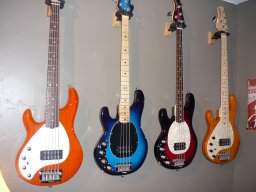
I tried for a few years to find an inexspensive bass that would give me that "mojo" feeling without spending a fortune. i found some decent basses over this time but always longed for a Stingray although they were out of my price range.

In early 2006 my financial situation had changed and I was able to buy the "bass of my dreams" after wanting one for many years.

I was like a kid at Christmas when the salesmans opened up the case of SR5 I had ordered in. I bought the bass and took it home without even playing it in the store! i was that confidant that this was "the one".

Well it turns out, it was! I have had this bass for awhile now and I have pretty much lost interest in my other "low end" basses. Maybe its because the Stingray is clearly a nicer instrument, but maybe its also that this bass represented a milestone for me in simply being able to realize a dream and be able to afford it.

This bass is by far the nicest instrument I have ever owned and it feels and sounds like it was made for me. I don't plan on allowing my bass to become too beat up just to have mojo as it already has more mojo then anything else I have ever played.

So to sum up, I think the mojo comes from within and is more about the relationship or connection the individual player has with a particular instrument, then the instrument itself.

My SR5 is just another SR5 to anyone else. It means more to me and thats why I love it so much.
 
Personally, I think the mojo is in the player, and a certain instrument will unlock it. But ONLY a certain instrument. and it's different for everybody.

so we search for THAT ONE that we internally know will be IT.

Hence our GAS.
 
So to sum up, I think the mojo comes from within and is more about the relationship or connection the individual player has with a particular instrument, then the instrument itself.

My SR5 is just another SR5 to anyone else. It means more to me and thats why I love it so much.

+10000 there Crabby. (And a good story too about your SR5.) Either I connect with the instrument in question or I don't - it's age & number of dings have nothing to do with it. (Setup *does* factor huge though. I can't get to that "connected" state if the setup is not to my tastes, regardless of the quality of the instrument.)

So, yeah, instruments right out of the box can do it, as far as I'm concerned, & I've also played 30+ yr old instruments that didn't.

Now, *why* I connect with a given instrument... that's another thread entirely. :D

GT
 
To continue the theorem, that's why bassists who can afford many basses seem to hang onto the ONE they have. (I guess a great example is G. Porter, Jr.)

Now, when you find that one, does it have mojo? NO. You must fill the bass with the mojo from inside you, by playing it, and caring for it, and imbuing it with all the positive vibes that gigs and practices and laughs and memories and all the other things that music provides.

That's my theory and I'm sticking to it.:D .