• TalkBass has been independent since 1998. Add your voice.
    Create a free account to reply to discussions, view embedded media, and browse with fewer display ads.
    Join freeLog in
    Want zero display ads or expanded classifieds tools? Compare plans.

Moving to a power amp setup, need some guidance!

Long story short, my bass amp gave up the ghost last night, and since I would always bypass the preamp and just use the power section (driven by a VT Bass and more recently an Ampeg SGT-DI), I figured I would just get a rackmount power amp.

I'm currently looking at the QSC GX5.

I'm drawn to this amp particularly for the crossover feature; I typically play with a 410 and a 115 cabinet (8ohms each), and I dig the idea of sending the lows to the 115 and everything else to the 410.

My main question is about the I/O routing from my preamp (the SGT-DI) to the QSC, and to my cabinets.

The SGT-DI has three 1/4" outputs: The first carries just the preamp signal, the second carries the preamp signal + cabsim (which I don't use), and the third is an unaffected "thru" signal. (There's also a balanced XLR out, but I need to send that to the board for our PA)

Could I use the two affected 1/4" outs from the SGT to the two channels of the power amp? Or would it be better to use a Y-cable coming off of one of the SGT's outs? Would there be any signal loss with a Y-cable?

Any help is greatly appreciated!
 
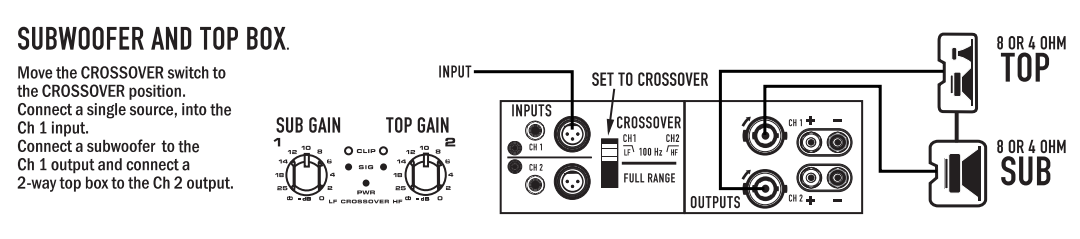
Or, would I simply set it up like this from the manual, basically as a Sub + Top Box?

M0bQXR1.png
 
If 100Hz is the only frequency choice for the crossover function, you'd probably be better off just running both cabs full range, IMO. Or there are fairly inexpensive 2-channel pro audio amps that have on-board DSP that allow you more flexibility in choosing crossover frequencies and can also employ digital LPFs, among other functions.

Bi-amping (which is what you'd be doing) is groovy and all, but you don't really have the sort of speaker complement to implement it in a way that would be advantageous... again, IMHO. :D
 
Could be a recipe for disaster.

Frequently a 410 and 115 are not a good combination partly because in most cases a 410 will be more efficient and handle more power than a 115. Check the specs.

Also, the 410 may have better LF extension than the 115. Meaning the 410 could be the best choice to do sub duty.

As an example:

Aguilar DB410
upload_2023-5-19_15-33-27.png


Aguilar DB115
upload_2023-5-19_15-33-2.png


The DB410 handles 300W more power and is 5dB more efficient.

In this case the 115 is rated to play 8hz lower.

IMHO a pair of DB115s would match better with a DB410, but the sensitivity will still be a bit low (99dB 1W/1m for two). So a quad of DB115 would be a better performance match (BIG RIG).

You can certainly try it, just be careful that you don't blow the 115.
 
I typically play with a 410 and a 115 cabinet (8ohms each), and I dig the idea of sending the lows to the 115 and everything else to the 410.
yeah, don't do that

the 4x10 probably handles more lows than the 1x15, not the other way around, and anyway crossing over would emasculate the cab with the lows taken out, basically leaving you with half the low end you have now with both cabs covering everything
 
Appreciate the responses!

So in running both cabs full-range, would the path basically be:

Input: Bass > preamp > power amp channel 1 input (Full range selected)
Output: Power amp channel 1 output > 410 cab (8ohms) > 115 cab (8ohms)

Or would the 115 need to be hooked up to the channel 2 output independently?
 
So in running both cabs full-range, would the path basically be:

Input: Bass > preamp > power amp channel 1 input (Full range selected)
Output: Power amp channel 1 output > 410 cab (8ohms) > 115 cab (8ohms)
yep

you could make a project of each cab on one side of the power amp so you can adjust their levels separately (mostly keeping the 1x15 backed off a little so it doesn't blow trying to keep up with the 4x10) but why bother?

the full stack run off one side should already be too loud before you get that far
 
Appreciate the responses!

So in running both cabs full-range, would the path basically be:

Input: Bass > preamp > power amp channel 1 input (Full range selected)
Output: Power amp channel 1 output > 410 cab (8ohms) > 115 cab (8ohms)

Or would the 115 need to be hooked up to the channel 2 output independently?


It depends on the cab's specs and what you are trying to accomplish.

The amp is rated 500W at 8 ohm/800W at 4 ohms.

If your speakers get way louder than you need, it may be beneficial to run each cab on a dedicated output. This will allow you to adjust the amp to match the SPL between speakers.

You need a TRS to TRS jumper if you want to run dual mono
upload_2023-5-19_16-5-20.png


If the power rating for one of your cabs is less than 500W, it may be beneficial to run both cabs on one side of the amp. A pair of 8 ohm cabs in parallel will pretty much share the power equally. 800/2 = 400W. The idea is to limit the amp to a safer power level, and each cab will see 400W at rated power.

For fun you could even try the biamp idea. Although it may not be optimal, it could be a valuable learning experience...just be mindful of your cab's limits and keep the power at a safe level.
 
Back in the rack days I ran a biamp rig: Power amp, rack preamp, 118 sub, 115 top.

Several problems over time and experience:

Virtually all bass guitar cabinets, then and now, are full range bins that are OK to stack full range, but a real half-ass solution for biamp. Look at PA: We see dedicated families of subs and high pass cabinets for 2, 3, even 4 way operation that are designed to work together. No bass guitar cabinets are like this.

It's also hard to hear the 100hz and below sound. Ideally, you'd want a 4 ohm sub getting twice the watts of an 8 ohm cabinet on top to approach a balance. Also, if you have fast ears, you may hear the highs with lows coming a tick behind. Again, serious FOH systems are time-aligned to eliminate this. Bass amps aren't.

Plus, you ain't gonna get any more Christmas cards from soundmen: You may very likely blowing lots of sub bass into every mic on stage.

We all tried this in the late 70's as bass amps had plateau'd around an iffy 200-300 watt level, and cabinets were pretty fragile or just not much good, folded 18's, 215's, etc.

With the advent of the 210's and 410's and new players like Trace, SWR, GK, leading right on up to today's far superior amps and cabinets, the component rigs went away.

I'd advise running full range, and QSC make great power amps, just be careful to match their power to your cabinets.
 
Long story short, my bass amp gave up the ghost last night, and since I would always bypass the preamp and just use the power section (driven by a VT Bass and more recently an Ampeg SGT-DI), I figured I would just get a rackmount power amp.

I'm currently looking at the QSC GX5.

I'm drawn to this amp particularly for the crossover feature; I typically play with a 410 and a 115 cabinet (8ohms each), and I dig the idea of sending the lows to the 115 and everything else to the 410.

My main question is about the I/O routing from my preamp (the SGT-DI) to the QSC, and to my cabinets.

The SGT-DI has three 1/4" outputs: The first carries just the preamp signal, the second carries the preamp signal + cabsim (which I don't use), and the third is an unaffected "thru" signal. (There's also a balanced XLR out, but I need to send that to the board for our PA)

Could I use the two affected 1/4" outs from the SGT to the two channels of the power amp? Or would it be better to use a Y-cable coming off of one of the SGT's outs? Would there be any signal loss with a Y-cable?

Any help is greatly appreciated!
Your 410 kicks out more lows, louder than your 15.
 
Long story short, my bass amp gave up the ghost last night, and since I would always bypass the preamp and just use the power section (driven by a VT Bass and more recently an Ampeg SGT-DI), I figured I would just get a rackmount power amp.

I'm currently looking at the QSC GX5.

I'm drawn to this amp particularly for the crossover feature; I typically play with a 410 and a 115 cabinet (8ohms each), and I dig the idea of sending the lows to the 115 and everything else to the 410.

My main question is about the I/O routing from my preamp (the SGT-DI) to the QSC, and to my cabinets.

The SGT-DI has three 1/4" outputs: The first carries just the preamp signal, the second carries the preamp signal + cabsim (which I don't use), and the third is an unaffected "thru" signal. (There's also a balanced XLR out, but I need to send that to the board for our PA)

Could I use the two affected 1/4" outs from the SGT to the two channels of the power amp? Or would it be better to use a Y-cable coming off of one of the SGT's outs? Would there be any signal loss with a Y-cable?

Any help is greatly appreciated!
1/4" output in one channel, xlr output in the other.

Although, you'll get far better results by simply running one unfiltered channel, and daisy chaining your cabinets.

Only thing that would change that is if you were using a sub woofer instead of a 15" bass guitar cabinet.

I'd just buy a Duncan power stage, and run the rig together.
 

Latest posts