• TalkBass has been independent since 1998. Add your voice.
    Create a free account to reply to discussions, view embedded media, and browse with fewer display ads.
    Join freeLog in
    Want zero display ads or expanded classifieds tools? Compare plans.

Multi faceted question about horn drivers and DI's

Hello TB. I introduced myself yesterday, and have a question to pose to assist me in an upcoming DIY cab building project. TLDR at the bottom if it's too ramble-y.

In my band I am actually the guitar player. The bass player is a great friend of mine, and wonderful musical collaborator. But, he is not a gearhead, at all. I am, however a huge gearhead, and have provided for him amp, cab, and pedals. Otherwise it would have been bass straight into a TC combo amp, which is functionally fine, but not too interesting.

I am going to build a new bass cab over the summer that he/we will use, but I need a little guidance.

One problem we are encountering is the drastic difference in high end response between a DI'ed signal and a mic'ed signal when using drive/distortion, especially in a live setting. It sounds just right from the speaker cab, (DIY 2x15 Eminence CA154's) or through the mic, but abrasively bright from a DI. I understand what is happening here. The speaker is passively filtering the high end with it's natural frequency response, and the DI is essentially flat response.

My question is.. Will adding a horn driver to my new cab build allow us to have a more consistent tone from DI and cabinet?
I realize we will have to tweak a lot of tone controls to make everything sound right through the new cab, maybe drastically, but the question stands.

TLDR:
Will a horn driver help minimize the difference between the cab sound and DI sound?

Thanks for any input.
 
Hello TB. I introduced myself yesterday, and have a question to pose to assist me in an upcoming DIY cab building project. TLDR at the bottom if it's too ramble-y.

In my band I am actually the guitar player. The bass player is a great friend of mine, and wonderful musical collaborator. But, he is not a gearhead, at all. I am, however a huge gearhead, and have provided for him amp, cab, and pedals. Otherwise it would have been bass straight into a TC combo amp, which is functionally fine, but not too interesting.

I am going to build a new bass cab over the summer that he/we will use, but I need a little guidance.

One problem we are encountering is the drastic difference in high end response between a DI'ed signal and a mic'ed signal when using drive/distortion, especially in a live setting. It sounds just right from the speaker cab, (DIY 2x15 Eminence CA154's) or through the mic, but abrasively bright from a DI. I understand what is happening here. The speaker is passively filtering the high end with it's natural frequency response, and the DI is essentially flat response.

My question is.. Will adding a horn driver to my new cab build allow us to have a more consistent tone from DI and cabinet?
I realize we will have to tweak a lot of tone controls to make everything sound right through the new cab, maybe drastically, but the question stands.

TLDR:
Will a horn driver help minimize the difference between the cab sound and DI sound?

Thanks for any input.

It certainly can. Quite a few of us prefer FRFR (full range flat response) cabs and using a cab modeler or some other way of getting where we need to be. And then others like myself just don't add distortion and love how a DI'ed signal sounds anyway. So as usual, it just depends...;)

Oh, and welcome to Talkbass.
 
The problem with adding a horn to enhance the sound of the mic'ed cab is now where do you put the mic? If you put it far enough away to hear a balanced signal from both drivers, you're too far away to have much isolation. That can be workable in a studio setting, but not so much on a live stage. Plus even the best HF compression drivers exhibit HF response roll off somewhat lower than the unvarnished, full-range DI signal.
 
Thanks for responding! Let me further explain what has pushed me towards this possible plan.

The problem with adding a horn to enhance the sound of the mic'ed cab is now where do you put the mic? If you put it far enough away to hear a balanced signal from both drivers, you're too far away to have much isolation. That can be workable in a studio setting, but not so much on a live stage. Plus even the best HF compression drivers exhibit HF response roll off somewhat lower than the unvarnished, full-range DI signal.

This problem isn't really a recording, or rehearsal problem. Only really live sound. It seems that 99% of the time the sound guys seem to insist on using a DI for the bass signal, which creates the aforementioned problem. I would never try to mic a multi-way cab in a live environment. That would be a nightmare, we would just run the bass DI to FOH 100% of the time.

The solution is simple, apply a filter that cuts the highs of the DI signal. Don’t feel that you need to add a tweeter to lower the the sonic quality of the cab. If you do add one, put an attenuator and/or an on/off switch on the tweeter.

Is there a piece of hardware you would suggest to filter the DI signal? Both the DI out from the amp head(GK RB 700) or preamp pedal(Aguilar Tone Hammer) are XLR FWIW.

Also, I for sure was planning on an attenuator for the HF driver if I install one.

Again, thanks for any advice.
 
  • Like
Reactions: beans-on-toast
Is there a piece of hardware you would suggest to filter the DI signal? Both the DI out from the amp head(GK RB 700) or preamp pedal(Aguilar Tone Hammer) are XLR FWIW. Also, I for sure was planning on an attenuator for the HF driver if I install one.

As mentioned, this can be handled in the mixing desk or rack preamp channel strip. You need a low pass filter to remove the high frequencies. Because the DI is an XLR is a balanced signal, the LPF would have to accept this differential signal.
 
  • Like
Reactions: byacey
This problem isn't really a recording, or rehearsal problem. Only really live sound. It seems that 99% of the time the sound guys seem to insist on using a DI for the bass signal, which creates the aforementioned problem.

In my experience a well designed cab with extented high frequency output can definitely mitigate this problem, but it is unlikely to completely fix it.

My philosophy is the sound should be processed seperately for different locations and purposes. One of the primary locations and purposes is on stage to satisfy the bassist's monitoring needs. Another primary location and purpose is out in the house for the audience's listening pleasure. Discrete processing is necessary because the acoustic environment varies from one location to the next, and because your needs on stage are often a bit different than what is needed in the main mix.

If the effects are dialed in through bass cab that is closer to full-range, flat response, the DI signal should generally be a lot closer to what FOH needs. I think you are likely to have better results if the DI is taken Post effects, but Pre EQ. Then the bassist is free to use as much EQ as necessary to get the desired tone on stage, without jacking up the DI signal. Dial the effects in first through a relatively flat rig. Then enage and adjust the EQ to taste. Remember and accept that the audio tech will most likely need to use a bit different tone shaping. Also there may need to be some reasonable compromise between the audio tech's and the bassist's tone goals.
 
The problem with adding a horn to enhance the sound of the mic'ed cab is now where do you put the mic?

One of the dirty little secrets of miking bass cabs is this is already an issue - the output of the cab comes mostly from the woofer, but a very important part comes from the port, and there isn’t one place close to the cabinet that works. So, you already need 2 mics if you want to do it right. With a horn in the mix, you need 3. Add in a DI…. Yeah, the bass isn’t going to get 4 channels on the board, unless your name is Flea or Victor.
 
Since you’ve stated that the sound from the cab is just right, simply fix the di sound by putting a low pass filter before it or a more elaborate cabsim.

AFAIK the ideal solution would be a impulse response (IP) of the OP's actual cab.

Two Notes has an App called Torpedo BlendIR: Older versions of Torpedo Remote and BlendIR (two-notes.com)

Supposedly BlendIR can be used to create your own IPs that can be loaded into a Torpedo C.A.B. M+ - Two notes (two-notes.com)

C.A.B M+ OM: torpedo_cab_mplus:torpedo_c.a.b._mplus_user_s_manual [User's manuals] (two-notes.com)
 
Well, I'm one of those who believe that the cabinet is part of the rig's tone. With all the problems this can cause on stage if not used properly, I still think it's up to the FOH to fit this sound into the P.A..

D.I., IEM, miked amp (horn or not), there will always be multiple ways to generate the bass tone. The tone should come from the bass rig to the FOH and not the other way around. Jamerson recorded a lot of stuff directly on the board, that is, it's not a matter of era but of method. You practice with cab, rehearse with cab, play small clubs with cab, cabinets are part of your tone, this shouldn't be missed just because it's more work for the band and FOH.

With the right equipment and volume any rig can work best if it starts with the musician's design. FOH should just adapt this sound to your system/environment. Is it an old thought? No way. Many bassists and modern bands still use amplifiers on stage because they are part of their tone, just as guitarists have always done. The fact that it is "easier" to treat the bass signal does not mean that it's not the same thing with different intensity. Or forget about the amps and the cabs and always use a D.I., no problem, but always do the same thing and find your tone this way.
 
  • Like
Reactions: Baelzebeard
Hello TB. I introduced myself yesterday, and have a question to pose to assist me in an upcoming DIY cab building project. TLDR at the bottom if it's too ramble-y.

In my band I am actually the guitar player. The bass player is a great friend of mine, and wonderful musical collaborator. But, he is not a gearhead, at all. I am, however a huge gearhead, and have provided for him amp, cab, and pedals. Otherwise it would have been bass straight into a TC combo amp, which is functionally fine, but not too interesting.

I am going to build a new bass cab over the summer that he/we will use, but I need a little guidance.

One problem we are encountering is the drastic difference in high end response between a DI'ed signal and a mic'ed signal when using drive/distortion, especially in a live setting. It sounds just right from the speaker cab, (DIY 2x15 Eminence CA154's) or through the mic, but abrasively bright from a DI. I understand what is happening here. The speaker is passively filtering the high end with it's natural frequency response, and the DI is essentially flat response.

My question is.. Will adding a horn driver to my new cab build allow us to have a more consistent tone from DI and cabinet?
I realize we will have to tweak a lot of tone controls to make everything sound right through the new cab, maybe drastically, but the question stands.

TLDR:
Will a horn driver help minimize the difference between the cab sound and DI sound?

Thanks for any input.

If you use distortion, yes, adding a horn will make the sound more similar to the DI... in all the wrong ways: now you'll also get fizzy distortion from your speaker cab.

When using distortion I find I have to put it through some kind of cab simulation before it gets sent to the desk. If I don't use distortion I'm happy without.

You can often tame the 'fizz' enough simply using a LPF or even EQing out the top end. You can cut anything above 6 or 7 KHz and you'll still have plenty of top end but won't get too fizzy at all.
 
The solution is simple, apply a filter that cuts the highs of the DI signal. Don’t feel that you need to add a tweeter to lower the the sonic quality of the cab. If you do add one, put an attenuator and/or an on/off switch on the tweeter.
Maybe this says more about my ears than anything else but I use a 90s SWR 400s wit two Goliath Jr 2x10 cabs that have tweeters with adjustable volume.Point is I can't really hear a difference however I set them .
 
  • Like
Reactions: beans-on-toast
Maybe this says more about my ears than anything else but I use a 90s SWR 400s wit two Goliath Jr 2x10 cabs that have tweeters with adjustable volume.Point is I can't really hear a difference however I set them .

It may not be your ears, but how you are using it. I suppose that it depends on the cab, if it’s working properly, the frequencies sent to it, even the room.

My EV cabs have a horn and 115. There’s a continuously variable attenuator and an off position. Even slight adjustments are evident. Usually the horn is off with a bass. When I play recorded songs through it in a stereo setup with a PA amp, the tweeter becomes more important because the material is full frequency.
 
  • Like
Reactions: kevmac
If you use distortion, yes, adding a horn will make the sound more similar to the DI... in all the wrong ways: now you'll also get fizzy distortion from your speaker cab.

When using distortion I find I have to put it through some kind of cab simulation before it gets sent to the desk. If I don't use distortion I'm happy without.

You can often tame the 'fizz' enough simply using a LPF or even EQing out the top end. You can cut anything above 6 or 7 KHz and you'll still have plenty of top end but won't get too fizzy at all.


Rather than using an LPF, I would rather adjust my effects to sound good in the first place. I don't have any trouble dialing in the drive pedals I own to sound good through a PA cab. That's not to say that I could dial in your pedals. Maybe I could, and maybe not.

Ideally you should send the audio tech a signal that is relatively close to your tone goals, rather than something that requires aggro processing to smash it into usable shape. The more voiced your cab is, the more it varies from the signal coming out of the DI.

The OP's idea is to reduce the variance between the bass cab and DI signals, so he has more control over his sound. IMHO, this is a good strategy, but it will require the bass player to change how he/she twiddles the knobs on his/her gear.

Whether the bass player will see it as an improvement depends on their taste. Obviously you will think it sucks, because you prefer more trational cabs without a tweeter. I would see it as an improvement because I prefer cabs with extended high frequency response.

As far as just slamming an LPF on the signal and calling it a day. Sure, that is a helpful approach, but IMHO it's not necessarily going to closely resemble the sound you are getting on stage.

Here is the on-axis frequency response of the drivers in the OP's cab (red trace):
Legend_CA154_1024x1024@2x.png


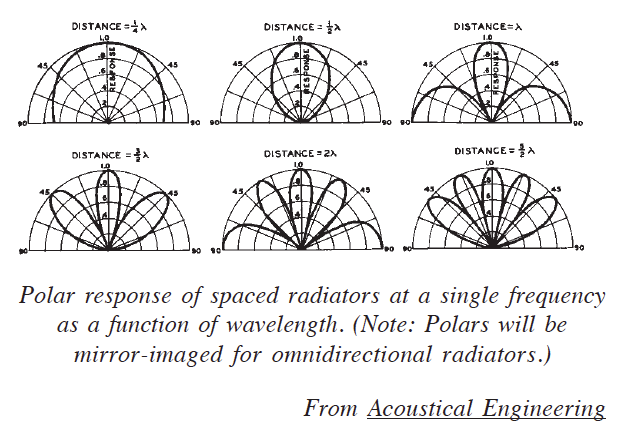
This is not necessarily what the bass player standing in front of the cab will hear. The off-axis high-frequency response will be more rolled-off. Also since there are two drivers in the cab, there will be comb filtering that will cause the off-axis response to be uneven due to the formation of secondary lobes.

Low_Directivity-polars1.png

Ref: Low-Frequency Directivity and Arrays (prosoundtraining.com)

FYI:
wavelength_formula_wavelength_formula_var_1.svg
= wavelength. These images are comparing the distance between the drivers to the wavelength, which varies indirectly by frequency.

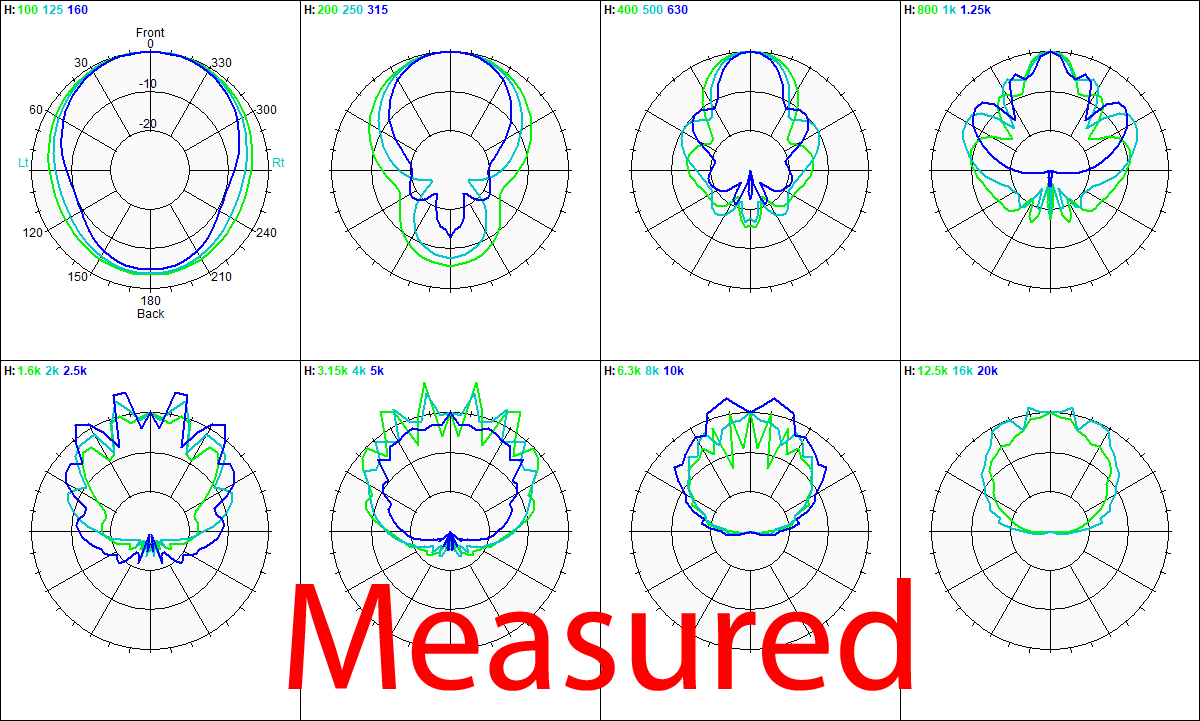
Here another images that shows the lobing between PA cabs:
3x_array_measured.png

A bass cab with more than one driver will produce similar lobing within it's passband.

Ref: Array Simulations - Pro Sound Testing
Ref:
 
  • Like
Reactions: Baelzebeard