• TalkBass has been independent since 1998. Add your voice.
    Create a free account to reply to discussions, view embedded media, and browse with fewer display ads.
    Join freeLog in
    Want zero display ads or expanded classifieds tools? Compare plans.

my 1st Bass -- what is it?

Aug 27, 2016
18
15
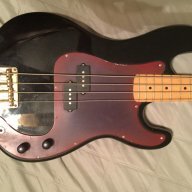
My new Cort Electric Bass, my very first bass guitar. The guy I purchased from said it's a 1985. He also said it was USA-made, which can't be true, so he could be wrong about the date too. (Pretty certain it was built in Korea.) The pick guard appears to be homemade. I'm not sure if the body is original either: the neck mount seems to be missing a part. Anybody know why this is?
I've played it through headphones and I find the sound very pleasing, though I have no other bass to compare it to. It will probably need some setting up, quite a bit of vibration going on.
Anyone who can tell me more about this bass I'd appreciate it. Got it for 100.
Note: the "vibration" I speak of is not fret buzz but sounds instead like it is coming from the body. This characteristic is alien to me.
UPDATE: I found a serial number sticker: 8513083, on the body, above the heel plate. It's see-through with fairly dark lettering so I barely noticed it there.
With most bass/guitars this would indicate, at the very least, the year it was made... but reading around on forums I've found this is likely not the case with Cort. Any input would again be appreciated, and I'm always looking for sources to read regarding the origins of this guitar. (Not likely to be many sources out there, if any, but who knows)
UPDATE #2: Broke the truss rod while adjusting. The piece of the rod that came off with the nut is pretty darn rusty, might even be some white corrosion in there but I can't quite tell. I'm not sure how much of this break was my fault---I could have been more gentle but that rod looks at though it was in pretty dire shape to begin with.
In any case, I won't let this incident ruin a playable bass. I adjusted the neck tilt to make up for the forward bow of the neck, successfully lowering the action, and I'm happy enough with the result.
IMG_0260_zpsiqoyridn.jpg
IMG_0265_zpsgr4iuuju.jpg
IMG_0267_zps42i1zzfx.jpg
 
Last edited:
Corts are a decent bass. I believe they are made in Korea but the have a history with Steinberger for some of the first headless basses.

I think Jeff Berlin is associated with Cort.

The hole in the neck plate appears to be for a hex screw that can adjust the tilt of the neck. It is a nice feature to have for setting up an action. Not available on a lot of basses.

IT should be a good bass with good sound and hardware. Enjoy it and set it up the way you like it!
 
Last edited:
The hole in the neck plate appears to be for a hex screw that can adjust the tilt of the neck. It is a nice feature to have for setting up an action. Not available on a lot of basses.
Any resources you can point me toward to learn to use this hex screw to adjust the "tilt of the neck?" Since truss rod adjusts curvature I'm assuming "tilt" refers to something else... I'm still just beginning to learn about these things.
I enjoyed the sound 'soon as I brought it home (I bought it without testing because I had a good feeling about it). Now I just need to learn some basic technique. Not the easiest thing to do with internet-only lessons but I'll manage. I find I like to do things my own way anyhow. Any tips on how to set it up for percussion-style play? I'm assuming a high action will go a long way to help produce that sort of sound but, like I said, I'm really just starting to learn about these things.
 
  • Like
Reactions: LowNloud1
It's called a micro-tilt on Fenders:

Fender's Micro Tilt Neck Adjustment | Adjusting Neck Angle On Guitars

neck-angle.jpg


Here is Fender's setup guide, everything should be applicable, but it won't mention the micro-tilt:

Invalid Link Removed


That's a good price if everything is in working order.

I paid $100 for a similar P/J bass, and an additional $25 for shipping.
Awesome, thanks. From what I understand this is basically a Fender P Bass copy so there should be plenty of similarities.
 
  • Like
Reactions: Killed_by_Death
Any resources you can point me toward to learn to use this hex screw to adjust the "tilt of the neck?" Since truss rod adjusts curvature I'm assuming "tilt" refers to something else... I'm still just beginning to learn about these things.
I enjoyed the sound 'soon as I brought it home (I bought it without testing because I had a good feeling about it). Now I just need to learn some basic technique. Not the easiest thing to do with internet-only lessons but I'll manage. I find I like to do things my own way anyhow. Any tips on how to set it up for percussion-style play? I'm assuming a high action will go a long way to help produce that sort of sound but, like I said, I'm really just starting to learn about these things.

Take a look here on page 2: Peavey T-40 Owner's Manual (Page 2 of 4)

It is for a Peavey T40 bass but the purpose is the same on your Cort. It will give you another dynamic to use in adjusting the action.

I am not an expert on neck adjustments but I have made a few. I would follow the Peavey manual as a reference for what order to do things.

Sight down the neck and check the current neck curvature. If the neck is flat, that's a good start. If not, adjust the truss rod tension.

Look at your bridge saddle height. The bottom of each string should be roughly the same height above the 12th fret.

The tilt adjustment will raise or lower the action around the 12th fret so that your have the correct height for the style you play. Check all the frets and make sure you have no buzz along each string.

Also check your frets and see if there are any with excessive wear. This could also cause buzz. There are kits you can buy to "dress" the frets if they need to be recrowned.

It may take a few attempts but once you have the action set, intonate the bass by adjusting the bridge saddles towards the top or bottom by turning the screw on the bridge with the spring on it so you get that when you play a string on the 12th fret, it is in tune when you play the same string open.
 
Take a look here on page 2: Peavey T-40 Owner's Manual (Page 2 of 4)

It is for a Peavey T40 bass but the purpose is the same on your Cort. It will give you another dynamic to use in adjusting the action.

I am not an expert on neck adjustments but I have made a few. I would follow the Peavey manual as a reference for what order to do things.

Sight down the neck and check the current neck curvature. If the neck is flat, that's a good start. If not, adjust the truss rod tension.

Look at your bridge saddle height. The bottom of each string should be roughly the same height above the 12th fret.

The tilt adjustment will raise or lower the action around the 12th fret so that your have the correct height for the style you play. Check all the frets and make sure you have no buzz along each string.

Also check your frets and see if there are any with excessive wear. This could also cause buzz. There are kits you can buy to "dress" the frets if they need to be recrowned.

It may take a few attempts but once you have the action set, intonate the bass by adjusting the bridge saddles towards the top or bottom by turning the screw on the bridge with the spring on it so you get that when you play a string on the 12th fret, it is in tune when you play the same string open.
Take a look here on page 2: Peavey T-40 Owner's Manual (Page 2 of 4)

It is for a Peavey T40 bass but the purpose is the same on your Cort. It will give you another dynamic to use in adjusting the action.

I am not an expert on neck adjustments but I have made a few. I would follow the Peavey manual as a reference for what order to do things.

Sight down the neck and check the current neck curvature. If the neck is flat, that's a good start. If not, adjust the truss rod tension.

Look at your bridge saddle height. The bottom of each string should be roughly the same height above the 12th fret.

The tilt adjustment will raise or lower the action around the 12th fret so that your have the correct height for the style you play. Check all the frets and make sure you have no buzz along each string.

Also check your frets and see if there are any with excessive wear. This could also cause buzz. There are kits you can buy to "dress" the frets if they need to be recrowned.

It may take a few attempts but once you have the action set, intonate the bass by adjusting the bridge saddles towards the top or bottom by turning the screw on the bridge with the spring on it so you get that when you play a string on the 12th fret, it is in tune when you play the same string open.
Yeah, my first mission is to adjust that truss rod---definitely got some forward bow going on there. I like to take 24-48 hours to do that... gradual adjustments... I'm not sure if that sort of time investment is necessary--- it's just a precaution I prefer to take. I figure it's best to be as gentle as possible when it comes to bending wood, especially pieces of wood that are over thirty years old! I don't wanna crack the neck on my first bass guitar.
As for the tilt adjustment/action @12th fret, I figure I'll leave that be for the time being, once I've got the neck straight. Right now it's quite high. I plan on pulling the strings rather than strumming them but I'll be playing with small adjustments here and there.
I'll have to take some time this next week to study the whole process you and Killed_by_Death have lain out for me but I believe I understand the fundamentals. And there's no way I'm paying a shop to do these things for me.
Thank you very much for your thorough reply!
 
With your admitted skill level, you need to be very careful with anything that you attempt to do to your bass. Lots of mistakes can be easily made with some bad results. Read the set up guides here and other places. Couple of procedure hints. If it's not already, make sure that the neck tilt adjustment is adjusted with no contact (angle) to begin with . It should be used later if needed. On the truss rod - back it off a bit to check the freeness of movement. You'll then know if it needs bit of lube to function properly. Just a couple of hints to throw in the mix. Have fun, but be careful.
 
With your admitted skill level, you need to be very careful with anything that you attempt to do to your bass. Lots of mistakes can be easily made with some bad results. Read the set up guides here and other places. Couple of procedure hints. If it's not already, make sure that the neck tilt adjustment is adjusted with no contact (angle) to begin with . It should be used later if needed. On the truss rod - back it off a bit to check the freeness of movement. You'll then know if it needs bit of lube to function properly. Just a couple of hints to throw in the mix. Have fun, but be careful.
Thank you, that is a very useful reminder. I will take my time with this.
 
Last edited:
Feel no shame for owning a Cort - they make well built stuff.

In fact, they make plenty of basses under contract for fancy shmancy brands that people here get quite uppity about.

BTW, the pickguard looks too well cut to be homemade. I'm guessing someone just spray painted the factory guard.
Yeah, I read the other day that 50 percent of the world's guitars are built in Korea. Cort probably has built a large fraction of that 50 percent through their various contracts, over the decades. My strat was built by Cort, in Indonesia.
In another forum I read, somebody had a "Japanese Fender built by Cort, in Korea." That statement is kind of funny, when you break it down. It's like a twice-removed cousin of a Fender, in a way.
Anyhow, my assumption about the pick-guard was due to its salvaged look, pictured in better detail below:
IMG_0272_zpsn29urinv.jpg

Whether it's original: others have suggested the same so I guess I'll take your word for it. But those markings around the pickups make me wonder if it came off another guitar. I'm not concerned about this, say in terms of quality, but I am curious how many guitars this piece is potentially built from.
 
Last edited: