• TalkBass has been independent since 1998. Add your voice.
    Create a free account to reply to discussions, view embedded media, and browse with fewer display ads.
    Join freeLog in
    Want zero display ads or expanded classifieds tools? Compare plans.

My band's failed attempt at going ampless

First, I don't think you understood what I was saying, so RELAX, professor.


I am totally chill.


My last response to you was mostly to address this:

And even on some stages, there's very noticeable sonically empty spots because there aren't any center-fill speakers

Yes there can be a hole in the middle with a poorly implemented PA. However, if the concern is spotty coverage of the audience, amps are generally worse. The solution is better PA implementation.

So...what I was saying is that when you're walking around a room with PA going and amps, there is depth to the sound when it comes from various places such as PA and amps, and I never said it was equal or uniform. If fact *BECAUSE* it's not equal or uniform, and even with (or also BECAUSE) all of it's sonic imperfections, that is one of the things that gives the live sound from multiple sound sources and different and sometimes changing vantage points, an interesting depth that is missing from going ampless.
This is a different issue. I agree there's a certain amount of "smearing" that goes on when a single speaker is used to reproduce multiple sounds at the same time. If you had a separate set of mains for each vocalist the resulting sound would have more depth. Not many people would argue for having a separate set of PA cabs for each vocalist. IMHO the more common solution is to use higher quality PA cabs that are capable of more depth and detail.

For the record I usually build a stereo mix with mild panning. The idea is not to create a stereo image for the audience; it's to open up the mix and create the perception of more depth.

There is also a certain loss of transparency when you ram a signal through a mic, mixer, and PA speakers. By this I mean the sound that comes out of the mains is not exactly the same as the original sound that comes from the amp. However, the sound from your amp typically gets darker and more diffuse as it travels over distance, so the audience is still unlikely to hear exactly what the player intended.

A well implemented IEM-based PA system can sound really good and provide a more consistent quality across the audience. A poorly implemented concert with stage amps can be an awful experience. The biggest factor is how well each approach is implemented. Assuming good implementation of both approaches: Ask two people which sounds best and there's a good chance you will get two answers. It's also likely each person will change their answer if they are asked at different points in the room.

Regarding which approach is best. I would say there is no clear winner, and each approach has a variety of different pros and cons that can vary somewhat with the situation. Using an IEM-based system can address some of the problems posed by amps. Likewise there are some things amps can do better in the hands of experienced and thoughtful pros. My perception is more and more people seem to be adopting IEMs, but I don't necessarily think everyone will ever go 100% ampless.
 
Last edited:
Are you so infirm that you can't carry equipment? Do you have dance routines where the amps might get in the way? What is the purpose?

The first amp I ever bought was a brand new MTI era Ampeg SVT and 810. I wanted the best and somehow, despite my research, wound up with a rig that could not produce the sound I wanted :bag: :blackeye:. I dove deeper into the rabbit hole and bought an Orban 672A and Fender Twin Reverb loaded with JBL E120s so I could run biamp. Man that rig sounded great, but it was also rather big and heavy.
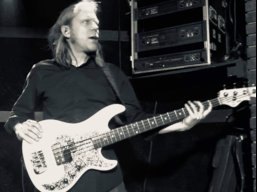
Before turning pro I sold the Ampeg and eventually gave the Twin back to my brother. My touring rigs as a pro were all much smaller. I typically used a 210 pushed by about 200-300W.

The big biamp rig was cool for occasional gigs, but totally impractical for a full-time pro musician without roadies. My last touring rig had a 210 and 410, but I rarely used the 410 because I didn't think it was worth the extra effort to transport or set it up. IMHO when you gig every day, setting more gear than you need quickly becomes tiresome, and your priorities are likely to change a bit...of course YMMV.

Around 1995 I built an ampless, IEM-based system that used electronic drums. For the most part audiences responded very favorably and we were requested specifically for our ability to play at a low volume. Reviews from band members was mixed, but we had to share a couple of IEM mixes, which sucked.

People were fascinated by the TrapKat we used to trigger the drum module.
1736455840589.png


With the previous system the weight of all gear was about 3500lbs and it typically took about 1 1/2 hours to unload, setup, and sound check. The IEM-based system weight between about 750-1200lbs...this included all instruments. One day we got stuck in traffic on the way to the gig, so we had to rush. The time to unload, set up, and sound check was approximately 20 minutes.
 
  • Like
Reactions: Windreaper
This is why, as a pro audio guy, with many years of pro experience mixing IEM monitors for bands, local, regional, and national, I just can't participate in these discussions about IEMs anymore.

When someone asks me about their band looking into using IEMs, there's usually one guy with an overview such as this of "How things should be". And he/she is right, everyone else is wrong, and anyone that disagrees is an idiot. And I've had enough of that crap for one lifetime.

I don't even care anymore. When I get that inquiry, I refer them to someone else in town. I haven't joined a new band in a few years, but I bring in my IEMs and I pretty much dodge questions about them unless I see a genuine desire to go IEM and willingness to put in the work and investment.

God Bless guys like @s0c9 and @Mike Caldwell among a few. others for pitching and offering help and dealing with the insipid arguments (How the hell did orchestras get into this discussion?? Yes, I've mixed symphony shows where the featured artist and rhythm section used IEMs and very successfully. I know what I'm doing. Had nothing to do with the initial discussion).

I'm so over it

Good luck to whomever does whatever with the matter.
I LOVE my IEM's! CTS custom molds, use them every gig. Enjoy creating my own monitor mix, crucial for clicks and background tracks.
just can't agree that ampless stages sound just as good or better to fans standing in front, or are more inspiring for musicians. And I don't think soundpeople are replaceable and the band can just DIY it.
I guess my point on the symphony was take out your ears, walk around stage every once in while and hear what your instrument and the ensemble really sounds like.

Enjoyed a great Kings X show last year at NAMM. Dug had 2 fridges on stage and Ty had a few half stacks. sounded just wicked, balanced and exciting in front (yes was wearing ear protection and the band was wearing IEMS). RCF was demo-ing their new FOH speakers so you could sit down in the back of the stadium and hear the full mix. That's the kind of performance I like!
 
  • Like
Reactions: BassGuyFL
In 2025 there is no excuse for any (pop, rock, classic. dance, original, ect) type band who considers their show is for the audience and wants to get and keep getting the choice gigs. not to use IEM's.
IEM's alone can cut the stage volume and mush considerably making it easier to get a good mix for the audience.
A big advantage for the band who is carrying a stand alone IEM split system is the monitor mix is more or less the same at each show.
After you get settled into the IEM's start thinning the amps from the stage.
 
As someone who's also a guitarist, I'll agree and disagree. IMO, once you're listening to the amp through an SM57 a lot of that "needs to be turned up" thing goes away, or is at least lessened significantly.
No offense intended, but you keep modifying your position. It helps to clarify up front no?
You NEVER mentioned listening to an amp thru a SM57 or them being mic'd to the PA at all - until the above post.
You said amps can be turned down and I said it depends.

As you're now talking amps on stage being mic'd for the PA, then 100% yes !! I agree.
Of course they can be turned down, but many bands DON'T have that option and will put vocals only thru their tiny speakers on sticks so you get "backline" going.

Maybe I'm just fortunate, but 99% of my gigs have house PA support and 5 of my bands (6 in 2024 with ~75 gigs) are fully IEM carrying their own IEM mixer, getting or giving splits to the House. Yes, guitar amps are used in most, but mic'd to keep stage volume manageable.
I have a pedalboard with a tube DI and don't use an amp on stage. I have IEM's.
That 6th band (I subbed for 3 gigs in Dec) turned out to have NO IEM capability. They had their own wedges (I don't own one), their own speakers on sticks (no subs) and did not plug into the House PA. Acoustic went to their PA. Tiny guitar amp SM57'd to their PA. Mic on kick only. I used their drummers Rumble 800 with no wedge. They were tough gigs to adjust to after the last 5+ yrs of being exclusively IEM.
Give me an IEM rig any day..
 
Last edited:
No offense intended, but you keep modifying your position. It helps to clarify up front no?
You NEVER mentioned listening to an amp thru a SM57 or them being mic'd to the PA at all - until the above post.
You said amps can be turned down and I said it depends.
Criticism accepted and no offense taken.

In fairness, it started an IEM thread, so I thought mic'd up and through IEMs was assumed.

That said, this thread has kind of gone weird, I'm not sure if it's an IEM thread anymore, and I think I stepped in the middle of something...
 
  • Like
Reactions: richntiff and s0c9
I haven’t read every comment on here, but I’m going to respond with a more philosophical take, than a gear/set up route. First here are some questions:
1.) Have you had discussions with these bandmates about what useful IEM mix looks like?
2.) Do you all have a band member or two who are responsible for the FOH mix?

IEM mixes arent necessarily meant to be studio recording quality. They’re supposed to give each individual member the tools they need to play their best. Focusing on that individualize and utilitarian side might be helpful.

Also, having a conversation about trusting the FOH mix, and not tampering with it seems like something y’all should address. IEMs are for you, FOH is for the audience. Seems simple enough, but I’ve run enough sound for bands who didn’t understand this that it’s kind of shocking lol.


Finally, a piece of technical advice, if you’re using IEMS it is absolutely essential that your gain structure is done properly. If not, you won’t have the volume flexibility to give everyone what they need. My band does gain structure before we even turn up the speakers. This forces us to get the gain correct before we even think about anything else.

Hope this is helpful! IEMs are worth it, be patient and put in the time, you won’t regret it!
 
Additionally, protective limiters with a fixed threshold will not work properly if levels are out of range. If the signal is too hot, the limiters engage constantly. If the signal is too low, the limiters allow huge volume spikes to pass.
Absolutely!

I’ll never forget the first time we focused on our gain structure. We turned the speakers all the way down. We balanced the amps at a comfortable level (at the time we didn’t all have Helix pedals). Then we mic’d everything and set gains on the board. When we turned the speakers up it was probably the best mix we had to date, and that was before we even EQ’d anything. People under estimate the importance of gain in getting proper EQ. If gain isn’t right you’re going to make the EQ work to hard and it won’t be good anyways.

For the OP, This translates directly to the IEM conversation because with IEM mixes it’s so easy to make it muddy. Especially if you aren’t using good multi-driver earbuds. Everyone wants to be heard and loud. But if you have good clear signals and EQ, you can hear everyone without just blasting their volume.
 
Ever stand in front of an amp-less band? sounds sooooo lame! way drum heavy and just wimpy. Saw a Metallica trib band with just one giant rack on stage. sounded really thin, and just didn't look right. zero headbanging from the crowd. As long as there is a drummer on stage hitting right (hard!) there should be a backline.
I skipped a couple of pages and maybe this is already old news...
The PA for a silent stage MUST have front fills carrying a full mix. At a certain stage size, the PA for a stage with backline MUST have front fills for vocals so they balance with stage wash. This is simply good practice for sound companies. Not doing that is malpractice...
 
Last edited:
I skipped a couple of pages and maybe this is already old news...
The PA for a silent stage MUST have front fills carrying a full mix. At a certain stage size, the PA for a stage with backline MUST have front fills for vocals so they balance with stage wash. This is simply good practice for sound companies. Not doing that is malpractice...
I gave up (or should have if I didn’t) when I read that it didn’t look right.

There’s no reasoning with that.
 
  • Like
  • Haha
Reactions: Passinwind and 4Mal
Update - I got a Behringer XR18 digital mixer that will allow us to run a personal monitor mix for each member of the band. We're going to get it set up and tested in rehearsal next weekend. Everyone in the band is excited about it. I'll let you all know how it goes.
Practice using the mixer as much as you do playing your bass.
 
Ampless? IEM's? We're not quite that advanced in the evolutionary process. My bigger problem is convincing folks that, via a conventional backline / monitor config, we can maintain a controlled, low-level stage volume while simultaneously providing a thick / rich mix via FOH. They just don't get it.

Riis
“Low stage volume” is a concept that is repellent to many people. Especially drummers lol.
 

Latest posts