• TalkBass has been independent since 1998. Add your voice.
    Create a free account to reply to discussions, view embedded media, and browse with fewer display ads.
    Join freeLog in
    Want zero display ads or expanded classifieds tools? Compare plans.

My Dirt Bender - Another Jounal

I kept switching forth and back between the middle and bridge position. The Middle position felt, of course, more rounded while the bridge position had a lot more bite.

I will have to take a look into the bass, at the wiring. If I turn down one of the pickups completely, the bass passes no signal with the switch in the middle position. I suppose that is wrong. That kind of forbids turning down one by a bit, too - I think.

However, I already found the (probably) perfect solution for my tonal problem. Of course one could look long and hard at all the involved frequency manipulation capable entities in the signal chain to determine how to go on about the stated problem. But I said already that I solved it in the rehearsal by turning up the lower mids on the Tonehammer amp head.
Luckily, there is this thing:

DB316_Angle.jpg


The DB 316 is, essentially, the sweeping mids control of the Tonehammer.
-The color works very well with my bass
-Thomann had one as B-Stock for a reduced price.
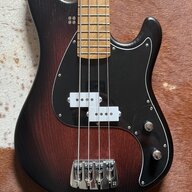
It is possible Aria wired it like a Gibson rather than a Jazz/Ric bass- just reversing the input and output lugs of the two volume controls. In that arrangement blending is still possible using small turns of each volume (as it is still putting resistance between the pickup input and the output), but turning either volume down all the way will completely ground the output. The Gibson version of wiring is actually arguably better from a loading perspective (there will be a tonal difference when turning down either control dependent on whether it is wired like a Gibson or Jazz), but not authentic to an actual Ric and with the trade-off you discovered
 
@el murdoque I just picked up a nanoPara from Sine-effect to do a similar role. I almost got the DB 316 until I saw that the frequency range only goes up to 1khz, and I was trying to boost frequencies in the 1.2k-1.5k range.
I'd grown particularly attached to having a nice little hi-mid bump near the beginning of the signal chain that came from the Tone/Color switch on the Empress Bass Comp, and especially having that bump ahead of the drives. I tried putting a similar boost at the end of the chain on my Empress Bass Para and in that range it brought out a lot of harshness in the drives instead of changing how they drive in that range.

With a standalone single band EQ pedal like that you're not forced to place it with whatever preamp pedal you're doing the rest of your primary EQ/tone shaping on. Try it both at the beginning and end of the signal chain and see how it affects the other pedals.

Now that I can retain that EQ bump at the beginning of the chain, I've been messing around with my compressor further down the chain (which is a direct result of spending time in this thread, trying out a DCX Bass and not loving it and not experiencing the beautiful touch-sensitivity of the drive, ripping apart the board and shifting the compressor further and further down the line.) On the plus side, I can more easily try out different compressors with a more honest comparison now that I'm not tied directly to the tone/color switch on the Empress.

I actually was on my way to the sine effects website because I've nearly bought the microPara a couple of times in the past, but I wanted to also check on the JHS Haunting Mids. On the Thomann website, I saw that the JHS is not a micro pedal (as I had somehow thought it would be) and that it's more expensive than the Sine, but the Thomann website knows me and showed the Aguilar pedal as an option.
 
  • Like
Reactions: tidbits
It is possible Aria wired it like a Gibson rather than a Jazz/Ric bass- just reversing the input and output lugs of the two volume controls. In that arrangement blending is still possible using small turns of each volume (as it is still putting resistance between the pickup input and the output), but turning either volume down all the way will completely ground the output. The Gibson version of wiring is actually arguably better from a loading perspective (there will be a tonal difference when turning down either control dependent on whether it is wired like a Gibson or Jazz), but not authentic to an actual Ric and with the trade-off you discovered
Okay, so there is a valid wiring that allows for the behavior my bass shows?
I mean, Matsumoku chugged out several versions of the bass from '75 to '78 and it seems they only stopped completely in '81, according to some web pages. But I failed to find this particular color or the checkered binding. There is a possibility that the previous owner had it painted, and of course there is the possibility that the wiring on the inside is not what it was when the bass left the factory.
 
Okay, so there is a valid wiring that allows for the behavior my bass shows?
I mean, Matsumoku chugged out several versions of the bass from '75 to '78 and it seems they only stopped completely in '81, according to some web pages. But I failed to find this particular color or the checkered binding. There is a possibility that the previous owner had it painted, and of course there is the possibility that the wiring on the inside is not what it was when the bass left the factory.
Yes the behavior you describe is consistent with the way a Les Paul works for example. I can’t speak to how the Aria was wired from the factory or whether there may be some other issue with the wiring. It will be easy to see if it’s wired like a Gibson when you open depending on where the input and output wires for each pickup are soldered on the volume controls. A Jazz Bass or Ric will have the input to the volume (either from the pickup or pickup switch) on the middle volume lug while a Gibson will have the Output (to the output jack or pickup switch- the switch comes after the volumes in a Les Paul, but before the volumes in a Ric) to the middle lug of the volumes and input will be on one side. I do seem to recall hearing of some Ric clones wired like Gibsons on TB FWIW.

Not sure about your Aria, but every stock 70s lawsuit-era instrument I’ve owned has had very low quality pots that may be worth upgrading. Your bass is maybe from the 80s though? And potentially better outfitted if so! I’ve never owned an 80s-era Japanese clone of anything.
 
Last edited:
  • Like
Reactions: el murdoque
I would second @sunbeast and say that if/when it's convenient, you should have that bass wired up like a proper Rick would be. For me, the magic of the electronics is the wide range of "in-between" tones you can get in the middle position, by backing off one of the two pickups. I rarely ever solo the bridge or neck, I get so much joy out of the mix/match combinations.

And, I'd say that, if/when you get in there for said wiring job, you should also see about adding the push/pull tone pot to the bridge pickup, in order to access both the "vintage" and "modern" tones. It makes the instrument incredibly versatile, IMHO.
 
  • Like
Reactions: sunbeast
Alright, well, since I rarely get to contribute to this Jounal for its intended purpose, not being on a dirt bender myself, I did recently manage to get my mitts on one of the new offerings from my "local" guy...

1319.jpg


This is supposedly a take on the original BJFE Blueberry, but having never previously played any variant of Blueberry, or the original Azure Drive, I was kind of walking into this pedal blind. All I knew from people I've talked to is that the original was supposed to be a great sounding overdrive, but just a bit too shy in the low end. So Broughton added a separate (full range) clean volume knob to this re-release, in order to mitigate the complaints.

So, having now played around with this, and being given the info from our resident jounalist, I was told the BJFE BB had a tone knob which controls how hard the lows are clipped. Initially, with my first 10min play through of the AD (when I truly didn't have time, but just *had* to give it a whirl), I thought the Sensitivity knob controlled the same function. But upon further inspection, I was wrong; it controls the overall character of the drive instead. Turned CCW, it makes the drive warmer and mellower, turned CW it makes the drive a bit more aggressive and bright. Whereas the Tone knob does what you think; an active boost/cut pot to control the high frequencies. Used in tandem, you get a lot of room to sculpt how the overdrive feels, from the gentle glow of a glass of brandy next to a cozy fireplace, all the way into ripping a chainsaw into one of those giant Northern California redwood trees. Well, *attempting* to saw that tree, and then watching the contraption catch fire as the motor gives way under the weight of that mighty forest sentinel.

The character of the overdrive is a little inherently warmer than I personally care for (I'm more into the drive sounds of Geddy Lee and KC-era John Wetton), but with the level of control over the character and bite, I was able to dial in a super pleasing sound. And that's with both of my basses sporting dead-ass rounds right now. I can only imagine how it'll sound when I try running some fresh strings in (my favourite sort of string. The fresher, the better! Unless I'm playing reggae, which is easily 80% of the time, if not more... So fresh strings are a bit of a "treat" for me). It's currently got the place of a Scorpion on my Nano/fly board, and even though I haven't tested it yet at a rehearsal or gig, I have a feeling it's going to keep the place. I like the Scorpion a lot, but prefer it as a second gain stage/flavour, rather than as the sole dirt pedal in my chain; it's voiced a little too modern/bright to be my daily driver. If I were playing more aggressive stuff, and wanted something more akin to the "DG" vibe, I will be grabbing the Scorpion. On the Nano, there's only space for the one drive, and it seems the Azure can dial up the kind of sounds I'm looking for, and will need in my bands, more easily.

Here it is, making nice with all its new roommates

1325.jpg
 
Alright, well, since I rarely get to contribute to this Jounal for its intended purpose, not being on a dirt bender myself, I did recently manage to get my mitts on one of the new offerings from my "local" guy...

View attachment 7276055

This is supposedly a take on the original BJFE Blueberry, but having never previously played any variant of Blueberry, or the original Azure Drive, I was kind of walking into this pedal blind. All I knew from people I've talked to is that the original was supposed to be a great sounding overdrive, but just a bit too shy in the low end. So Broughton added a separate (full range) clean volume knob to this re-release, in order to mitigate the complaints.

So, having now played around with this, and being given the info from our resident jounalist, I was told the BJFE BB had a tone knob which controls how hard the lows are clipped. Initially, with my first 10min play through of the AD (when I truly didn't have time, but just *had* to give it a whirl), I thought the Sensitivity knob controlled the same function. But upon further inspection, I was wrong; it controls the overall character of the drive instead. Turned CCW, it makes the drive warmer and mellower, turned CW it makes the drive a bit more aggressive and bright. Whereas the Tone knob does what you think; an active boost/cut pot to control the high frequencies. Used in tandem, you get a lot of room to sculpt how the overdrive feels, from the gentle glow of a glass of brandy next to a cozy fireplace, all the way into ripping a chainsaw into one of those giant Northern California redwood trees. Well, *attempting* to saw that tree, and then watching the contraption catch fire as the motor gives way under the weight of that mighty forest sentinel.

The character of the overdrive is a little inherently warmer than I personally care for (I'm more into the drive sounds of Geddy Lee and KC-era John Wetton), but with the level of control over the character and bite, I was able to dial in a super pleasing sound. And that's with both of my basses sporting dead-ass rounds right now. I can only imagine how it'll sound when I try running some fresh strings in (my favourite sort of string. The fresher, the better! Unless I'm playing reggae, which is easily 80% of the time, if not more... So fresh strings are a bit of a "treat" for me). It's currently got the place of a Scorpion on my Nano/fly board, and even though I haven't tested it yet at a rehearsal or gig, I have a feeling it's going to keep the place. I like the Scorpion a lot, but prefer it as a second gain stage/flavour, rather than as the sole dirt pedal in my chain; it's voiced a little too modern/bright to be my daily driver. If I were playing more aggressive stuff, and wanted something more akin to the "DG" vibe, I will be grabbing the Scorpion. On the Nano, there's only space for the one drive, and it seems the Azure can dial up the kind of sounds I'm looking for, and will need in my bands, more easily.

Here it is, making nice with all its new roommates

View attachment 7276060
A worthy and enjoyable jounal entry, complete with bizarre but nevertheless meaningful similies. Brava!
 
@sloppy_phil I saw your board with the AD added the other day when it first came in on the broughton thread. I really like the AD that I recently added to my board, but I'm hoping the clean blend will help me set my gain-staging a little nicer. The AD loses just a bit of low end as you move the gain up, but not a ton, and I like the rest of the sound so much that I'm sticking with it. I found that I can turn up the volume just a bit to make up for the lowend loss, but it's a silly little balancing act.

I also starting messing around with my omincomp finally (after getting the nanoPara I mentioned earlier) - you have some pretty interesting settings there - is that just set as a limiter basically? how often do you find yourself riding into it?
 
  • Like
Reactions: butterfingers1
A worthy and enjoyable jounal entry, complete with bizarre but nevertheless meaningful similies. Brava!
The local jounalist seconds this opinion!

My only contact with the Azure drive was a unit that sold in a German bass forum. It was ridiculously cheap for a Broughton pedal, but the Seller told me (I go by the same name on TB and in that place) that they read the jounal and I would not like it because it sucks lows. I never knew that there was a re-release with an added clean blend.
 
  • Like
Reactions: sloppy_phil
@sloppy_phil I saw your board with the AD added the other day when it first came in on the broughton thread. I really like the AD that I recently added to my board, but I'm hoping the clean blend will help me set my gain-staging a little nicer. The AD loses just a bit of low end as you move the gain up, but not a ton, and I like the rest of the sound so much that I'm sticking with it. I found that I can turn up the volume just a bit to make up for the lowend loss, but it's a silly little balancing act.

I also starting messing around with my omincomp finally (after getting the nanoPara I mentioned earlier) - you have some pretty interesting settings there - is that just set as a limiter basically? how often do you find yourself riding into it?
I know what you mean about the balancing act! It's not as simple as setting a drive/dirt pedal for unity gain, and leaving it alone. Very often, it requires a bump in your level in order to sit properly in a mix, and not feel like you're suddenly a little shy of low end. And what sounds good on stage/in rehearsal often doesn't sound great at bedroom or practice volume!

The comp may look like it has some funny settings, but I suspect that's because the Threshold knob works in reverse than you'd expect; keeping it down there around 9 o'clock is running the threshold super high! Turning it CW (how I initially went to set it without reading any manual) meant I kept hitting the brick wall, and I realized it's effectively backwards.

So it's peak limiting that I'm doing; super high ratio and threshold, moderate attack, and fast release. When I turn on the AD, I see the light flicker ever so dimly as I play with normal attack, and flicker a little more regularly and brightly when I play like a gorilla, which tells me just the comp is clamping down very gently only on my biggest transient spikes (the dimmer the light, the less intensely the comp is clamping). Most of the time, running clean bass, I barely see the metering light blink at all.
 
I also added some Audio to the Crowther Hotcake.

What do the readers of the jounal think - two or three audio snippets, me doing some sloppy playing of a lick that just came to mind, one clean pass followed by one pass with the pedal engaged ... would that be worth the effort?

I quickly understood that my idea from many moons back with the looper really does not work, because it completely ignores the important factor of how the pedal feels while playing and only shows how the pedal processes a pre recorded signal.

I'm not sure if people are here for thoughts and impressions (aka words) and for audio, they rather hit up youtube to listen to minutes long clips of people playing a pedal, swiping through the settings and such - or if a little audible backup would be of help.

I surely do know that "real" demo playing with the bass in and out of a mix is out of the question for me, I can't find the time to record all that, but hitting record on the laptop while noodling is within the achievable. .. .
 
I also added some Audio to the Crowther Hotcake.

What do the readers of the jounal think - two or three audio snippets, me doing some sloppy playing of a lick that just came to mind, one clean pass followed by one pass with the pedal engaged ... would that be worth the effort?

I quickly understood that my idea from many moons back with the looper really does not work, because it completely ignores the important factor of how the pedal feels while playing and only shows how the pedal processes a pre recorded signal.

I'm not sure if people are here for thoughts and impressions (aka words) and for audio, they rather hit up youtube to listen to minutes long clips of people playing a pedal, swiping through the settings and such - or if a little audible backup would be of help.

I surely do know that "real" demo playing with the bass in and out of a mix is out of the question for me, I can't find the time to record all that, but hitting record on the laptop while noodling is within the achievable. .. .
Unfortunately there is no perfect way to demo/compare pedals with recordings, because as you say they will always feel different and reward different playing approaches. If you aren't going to do the loop thing to make each demo consistent then I would suggest just finding a couple standout settings that show the useful range of the pedal and playing whatever types of lines that feel right for those settings. Personally for comparison purposes I do like the looper idea- the Youtube channel "Bass Stuff" seems to demo everything with the same pre-recorded loops using a P-Bass and Jazz Bass with both fingers and pick combined with live adjustments to see the sweep of controls and I've found that station one of the few consistently useful demo stations on Youtube for that reason (though with limited content!). In general I find limited use to demos apart from just basic timbre capabilities though unless someone really deep-dives and understands the pedal thoroughly before the demo as many demoers tend to not actually know what anything does going in and it just becomes a lot of noodling while dialing in impractical or totally useless settings.
 
  • Like
Reactions: sloppy_phil
I know what you mean about the balancing act! It's not as simple as setting a drive/dirt pedal for unity gain, and leaving it alone. Very often, it requires a bump in your level in order to sit properly in a mix, and not feel like you're suddenly a little shy of low end. And what sounds good on stage/in rehearsal often doesn't sound great at bedroom or practice volume!

The comp may look like it has some funny settings, but I suspect that's because the Threshold knob works in reverse than you'd expect; keeping it down there around 9 o'clock is running the threshold super high! Turning it CW (how I initially went to set it without reading any manual) meant I kept hitting the brick wall, and I realized it's effectively backwards.

So it's peak limiting that I'm doing; super high ratio and threshold, moderate attack, and fast release. When I turn on the AD, I see the light flicker ever so dimly as I play with normal attack, and flicker a little more regularly and brightly when I play like a gorilla, which tells me just the comp is clamping down very gently only on my biggest transient spikes (the dimmer the light, the less intensely the comp is clamping). Most of the time, running clean bass, I barely see the metering light blink at all.

I essentially do the same, but with the threshold much lower. In the reggae band, the comp is triggering on and off all the time since I hover on the threshold with my normal playing, with a light touch.
It is mostly a means of protection. I play with a light touch and the bass is turned up loud. A simple slip of the hand and ... ouch. Sorry subs.

In the metal band, I tried for something similar, only with the threshold much higher since I play much more energetic there, but I actually came to lower it some, so I essentially play with the limiter always engaged. I really dig the sound of the Cali76 when it's pumping.
 
Unfortunately there is no perfect way to demo/compare pedals with recordings, because as you say they will always feel different and reward different playing approaches. If you aren't going to do the loop thing to make each demo consistent then I would suggest just finding a couple standout settings that show the useful range of the pedal and playing whatever types of lines that feel right for those settings. Personally for comparison purposes I do like the looper idea- the Youtube channel "Bass Stuff" seems to demo everything with the same pre-recorded loops using a P-Bass and Jazz Bass with both fingers and pick combined with live adjustments to see the sweep of controls and I've found that station one of the few consistently useful demo stations on Youtube for that reason (though with limited content!). In general I find limited use to demos apart from just basic timbre capabilities though unless someone really deep-dives and understands the pedal thoroughly before the demo as many demoers tend to not actually know what anything does going in and it just becomes a lot of noodling while dialing in impractical or totally useless settings.


I see the same problem.
The thing with the loop and sweeping through the pedals range only really works with video, at least for me.
On top of that, I usually think that that any pedal, dropped into my personal environment, will sound very different to all the other personal environments.


@el murdoque I, for one, am a fan of you adding the little demo clips! Sure, it’s basically impossible to do a comprehensive rundown, but a wee snippet or two feels like a nice addition to the flowery prose :)

However, if it makes the resident Maple Juice Gourmand and the only known survivor of the Second Kiwi War in this thread happier, we can apply the principle of utility as formulated by the great wielder of words, Jeremy Bentham. The happiness of two readers/listeners greatly outweighs the slight inconvenience of the jounalist. I shall vow to record a few snippets for all the upcoming releases in the jounal and see where that goes.
 
I know it's only second level dirt related, but this thing arrived and I feel extremely happy about it.


View attachment 7277369
I’d love a fully-parametric single band mini EQ pedal! Does such a thing exist? The fully parametric midrange on my JohnK Centurion preamp is super powerful and something like that would be a great dirt-fixer IMO run either before or after a clipping circuit
 

Latest posts