• TalkBass has been independent since 1998. Add your voice.
    Create a free account to reply to discussions, view embedded media, and browse with fewer display ads.
    Join freeLog in
    Want zero display ads or expanded classifieds tools? Compare plans.

My Dirt Bender - Another Jounal

It's weird how my internal enabler works in some instances.
On some pedals, I feel like someone has to walk by my house and shout out the pedal's name, along with a ridiculously low price in order to make me buy one, else I keep thinking "No, the universe does not want me to play that pedal".

On others, a limited availability seems to egg me on. Take the Kasleder Jellyfish for example. I was just on the Thomann website, looking for new control knobs for the Aria Pro II, when I saw that they have the pedal back in stock - and since I only ordered items with a total value of €12, I needed something to cross the threshold for free shipping. . . .
 
WhatsApp Image 2025-07-12 at 13.48.20.jpeg
 
First impressions on the Jellyfish are to be taken with a grain of salt, because I did not really do proper testing.
I had to work, then went home and more or less directly to a garden party. Small talk, finger food and important people.
I love these. However, when I finally came home, I have had a few and not entirely sober. I did want to play the pedal, so I simply dropped it in my signal chain and played around a bit - and in that scenario, I was underwhelmed.

I have had that pedal on my low-key list for years, but two things made it jump from the rear places to the front of the shortlist.
The Wetter Bass on YT crowned it as the winner of a massive shootout. I did not watch the entire thing, but IMHO that guy has taste and knows his pedals, so that's something. The other incident is seemingly harmless, but I ran across a post somewhere, where someone claimed that their two favorite dirt pedals are the Audio Kitchen Fake Plastic Trees and the Kasleder Jellyfish. Someone who owns a FPT obviously is somewhat fearless about spending money on dirt pedals, and usually has had some sort of deep dive into the topic to end up with such a pedal. I surely love mine. And that person, a fellow owner of the FPT has put the Jellyfish on the same pedestal.

I did expect grand things, and I did not get them straight from the bat.

Let's start at the start.

Unboxing:
Fantastic.
-Pedal in a cotton bag with drawstring and Kasleder logo.
-Case Candy
-Manual
The pedal itself feels super high quality. The knobs certainly were not the cheapest you can order from allparts and the powdercoating (I assume that's what was done to the aluminum) is incredible. Really, pics don't do it justice. It looks and feels better in person.

The Knobs:
Volume does volume, and there is a lot of it on tap - Kasleder claims that it's strong enough to drive a power amp.
Bass and Treble are boost and cut, flat at noon - the exact frequency or amount of boost/cut is not specified, also the position of the EQ is not mentioned anywhere.
The gain knob is actually doing multiple things. First of all, it passes signal at zero. With gain at zero, EQ at noon and volume also at noon there basically is no difference in sound or volume when you switch the pedal on or off.
When you raise the gain you also manipulate a pre-determined wet/dry mix, so the higher you ride the gain, the more dry signal bleeds into the distorted signal.

The Experience:
The two other pedals I had in the signal chain were the Audio Kitchen FPT and the Effectrode Tube Drive.
I felt that this is somewhat of an illustrious company, but with the reputation that precedes the Jellyfish, I felt it could absolutely dine with the upper crust.
The first thing I noticed was that the forced dry blend sucks. I cannot help it, but it feels like I am trying to get in a little more edge and the pedal eludes the fulfillment of that wish no matter what I try. I raise the gain - the dry amount raises, too and overwhelms, blunting the edge. The honing stone in form of the treble knob somehow is no real help in that scenario, either. I feel like I'm constantly gunning for more edge and it's simply not coming.
Not a big help was that both FPT and Tube Drive were able to deliver that seemingly without effort.


I did vow to forget all the above and restart the whole thing again tonight.
 
I got a Jellyfish last week and I've also been trying to figure out how I feel about it lol.

Now I will say my dirt journey is potentially very different. At the moment I've been trying to find the most organic low gain drive/always on that I could find. The Jellyfish may very well be that. But if my intentions were to use it outside of that, I think that's where I'd be more uncertain haha. I also am still formulating final opinions on it and pitting it against the Trickfish OD Preamp.

I'll be interested in your final thoughts.
 
  • Like
Reactions: el murdoque
I got a Jellyfish last week and I've also been trying to figure out how I feel about it lol.

Now I will say my dirt journey is potentially very different. At the moment I've been trying to find the most organic low gain drive/always on that I could find. The Jellyfish may very well be that. But if my intentions were to use it outside of that, I think that's where I'd be more uncertain haha. I also am still formulating final opinions on it and pitting it against the Trickfish OD Preamp.

I'll be interested in your final thoughts.
Yeah, I will be doing some proper testing now that I got the first contact thing done, and I will properly insert it into a proper signal chain and play a proper bass through it.

I can't tell you exactly why, but I still have that Xotic BB Bass Preamp in the place where I want a low gain drive with a very organic sound. Probably because it's a really good low gain drive with an organic sound. The Fake Plastic Trees and the DCX Bass are great choices for the same position, but I somehow am so happy with the Xotic in that position that I won't change it. But I absolutely will probe for these capabilities on the Jellyfish next.
 
I got a Jellyfish last week and I've also been trying to figure out how I feel about it lol.

This is how I feel now. Somewhat perplexed, I'm trying to figure out how I feel about the pedal.
Instead of using the Aria Pro II, I went at it with the trusty ol' tools of P bass and my six string Le Fay, playing into the Cali76 and Noble, the way I'm used to and am very familiar with - something that works a lot better for judging the sound.

First of all, I closely listened to the EQ knobs. If you ask me, they are located after the clipping stage, the nature of the clipping does not change with turning them up or down. Of course the sizzle gets more pronounced when you turn up the treble, but it's not getting more, only more pronounced.

The position I ran it in is currently taken by the Xotic BB Bass Preamp. I also had the Tube Drive connected because that stupid thing is really growing on me.
The Xotic and the Effectrode are running with their tonal controls set to give off a fair bit of top end, on the Effectrode the tone knob is about 3/4 up and on the Xotic, the treble knob is also about 3/4 up. On both devices, this gives off more of an airy room for the sparkle, and the finger noise and plucking attack is emphasized. It certainly would be too much with fresh rounds, I'm sure, but I (have not said it in a couple of hours) am a flats player.
Both the Xotic and the Tube Drive kind of breathe in a bit of life and freshness into my sound. What I fail to understand is that in this context, the Jellyfish sounds muffled in an A/B/C comparison, even with the treble knob running at max.

Out of curiosity, I switched off my cabinet simulation (which is, essentially, a resonant low pass) and listened to the devices again. Both the BB and the Tube Drive gave off that ghastly sizzle that you all know and dread - what happens when you play an overdrive directly into a PA system.
The Jellyfish sounded a little different, too - but it was still fine.
My spontaneous assumption was that there is some kind of low pass working in the Jellyfish and that it is set a little bit lower than I personally like, hence the muffled feeling.
 
  • Like
Reactions: GrowlerBox
Crazy option: the Echo Fix EF-P5 FET Compressor has a gorgeous breakup when you disengage the compression engine and mess with the input, output, and blend controls. Transformer goodness. I hope Echo Fix looks into making a smaller pedal without the compressor part of the EF-P5 to use as a drive.

You should not have said that.
I'm a sucker for VU Meters.

I really hated that I did not like the gain of the DLA-2A and preferred the Effectrode LA-1A, because that meter was neat!
 
Crazy option: the Echo Fix EF-P5 FET Compressor has a gorgeous breakup when you disengage the compression engine and mess with the input, output, and blend controls. Transformer goodness. I hope Echo Fix looks into making a smaller pedal without the compressor part of the EF-P5 to use as a drive.
This is good to hear; I'm going to buy one next week. I love Echo Fix's stuff -- the spring reverb and chorus are beautiful. I'd love a tape echo deck, but a little beyond even my wildest attempts at justification right now.
 
  • Like
Reactions: Stubb
This is good to hear; I'm going to buy one next week. I love Echo Fix's stuff -- the spring reverb and chorus are beautiful. I'd love a tape echo deck, but a little beyond even my wildest attempts at justification right now.
I've posted a bit about it in the two weeks I've had it. It's just incredible. It's got that 1176 smack on tap that I liked with the Cali76CB, but more compression flexibility, transformer warmth on tap, and the coolest metering I've seen on a pedal. It's big and $500 is a lot for a compressor, but a new Cali76 is $400 already, and plenty buy those.
 
  • Love
Reactions: GrowlerBox
I've posted a bit about it in the two weeks I've had it. It's just incredible. It's got that 1176 smack on tap that I liked with the Cali76CB, but more compression flexibility, transformer warmth on tap, and the coolest metering I've seen on a pedal. It's big and $500 is a lot for a compressor, but a new Cali76 is $400 already, and plenty buy those.

This here thread is right in the middle of the gear snob quarter of TB.
$500 for a comp?

The last ones I really tried were the Doc Lloyd DLA-2A vs. the Effectrode LA-1A. Both units retail well beyond the $500 mark.
Even though I'm a fan of the old Cali76 and have those on all of my boards.
This is good to hear; I'm going to buy one next week.
I'd be VERY interested on hearing your verdict on how this can be abused as a dirt pedal.


My only problem with the Echo Fix is that the blue of the unit does not really match any of my stuff except for the Strymon BlueSky, but on that board, there's no real estate for such a big unit.
 
  • Haha
Reactions: GrowlerBox
This here thread is right in the middle of the gear snob quarter of TB.
$500 for a comp?

The last ones I really tried were the Doc Lloyd DLA-2A vs. the Effectrode LA-1A. Both units retail well beyond the $500 mark.
Even though I'm a fan of the old Cali76 and have those on all of my boards.

I'd be VERY interested on hearing your verdict on how this can be abused as a dirt pedal.


My only problem with the Echo Fix is that the blue of the unit does not really match any of my stuff except for the Strymon BlueSky, but on that board, there's no real estate for such a big unit.
I do like some clashing colours on a pedalboard. Mostly, though, I’m looking forwatd to having a third VU meter in my setup (the spring reverb and my little Ashdown tube amp providing the other two).

If I order it next week, it’ll take another week to get to me across the Tasman Sea from ‘Straya (customs, mostly), but I will report at the first opportunity I have to plug it in.
 
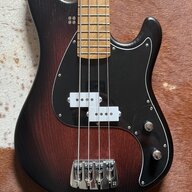
I finally had the first chance to take the Aria Pro II to a band rehearsal.
Two things became apparent:

1. I really like this bass and I will use it in my metal band as my #1 bass.

2. The current iteration of my pedalboard, or at least the way it is set, is not working 100% in my favor. I'm lacking those mids the P bass does on its own.

While playing with the band, I resorted to use the parametric EQ on my Tonehammer to boost the lower mids a bit and that brought me back into the mix.

I'd like some input on that topic. I do think the P bass emphasizes the frequency range between 250-500Hz to get 'that' sound, and those usually are the frequencies that will get you seated well in a mix.
The three machines on my current pedalboard that do tone shaping are the Audio Kitchen Fake Plastic Trees, the Verellen Meatsmoke and the Origin Bassrig SV. All of these are incapable of accessing this frequency range - the Origin only can do 220 or 800 Hz.

Of course my first try will be to simply put the entire pedal board into a neutral state and going for less of a bathtub EQ, maybe that will fix things already, but I'm also open to suggestions from people that made similar basses sit in mixes well.
 
I finally had the first chance to take the Aria Pro II to a band rehearsal.
Two things became apparent:

1. I really like this bass and I will use it in my metal band as my #1 bass.

2. The current iteration of my pedalboard, or at least the way it is set, is not working 100% in my favor. I'm lacking those mids the P bass does on its own.

While playing with the band, I resorted to use the parametric EQ on my Tonehammer to boost the lower mids a bit and that brought me back into the mix.

I'd like some input on that topic. I do think the P bass emphasizes the frequency range between 250-500Hz to get 'that' sound, and those usually are the frequencies that will get you seated well in a mix.
The three machines on my current pedalboard that do tone shaping are the Audio Kitchen Fake Plastic Trees, the Verellen Meatsmoke and the Origin Bassrig SV. All of these are incapable of accessing this frequency range - the Origin only can do 220 or 800 Hz.

Of course my first try will be to simply put the entire pedal board into a neutral state and going for less of a bathtub EQ, maybe that will fix things already, but I'm also open to suggestions from people that made similar basses sit in mixes well.
What pickup settings are you using? I've found on my Rics that one pickup up all the way then turning the other down just a bit adds noticeable punch in the mix vs having both all the way up (in fact I find that with most 2 pickup basses). For me it actually works this way regardless of which pickup is favored, though obviously there is a big difference in tone between those two settings. In my metal band in LA I used to favor the bridge pickup with the HPF capacitor engaged and roll the neck back, in my current band I am favoring the neck. My replacement pickups are pretty balanced output-wise, but if yours are like actual Ric pickups then the neck pickup is much lower output (unless that HPF cap is in the bridge pickup circuit). Even with that volume imbalance on a stock Ric I find that rule to still hold true that turning one pickups slightly down helps bring back punch.

In the LA band, my go-to tone pedal was the Darkglass Vintage with the Gain almost all the way down- with the low output of the Ric this allowed for almost clean tones. The real magic though was the tone of that circuit, which natively added a bit of low-mid punch and a bit of high-mid grind to my old flats. The first time I tried it with my Ric it pretty much became an always-on thing in that band because it just worked perfectly with those basses for me. In my current band I haven't dusted off the Darkglass, but am using the tilt EQ on an Onvilabs Smoothie comp to boost the low-mids a bit run into the Blackstone Mosfet then into the DCX Bass and so far digging the sound. My Ric tone is still a work in progress with this band though.
 
  • Like
Reactions: el murdoque
What pickup settings are you using? I've found on my Rics that one pickup up all the way then turning the other down just a bit adds noticeable punch in the mix vs having both all the way up (in fact I find that with most 2 pickup basses). For me it actually works this way regardless of which pickup is favored, though obviously there is a big difference in tone between those two settings. In my metal band in LA I used to favor the bridge pickup with the HPF capacitor engaged and roll the neck back, in my current band I am favoring the neck. My replacement pickups are pretty balanced output-wise, but if yours are like actual Ric pickups then the neck pickup is much lower output (unless that HPF cap is in the bridge pickup circuit). Even with that volume imbalance on a stock Ric I find that rule to still hold true that turning one pickups slightly down helps bring back punch.

In the LA band, my go-to tone pedal was the Darkglass Vintage with the Gain almost all the way down- with the low output of the Ric this allowed for almost clean tones. The real magic though was the tone of that circuit, which natively added a bit of low-mid punch and a bit of high-mid grind to my old flats. The first time I tried it with my Ric it pretty much became an always-on thing in that band because it just worked perfectly with those basses for me. In my current band I haven't dusted off the Darkglass, but am using the tilt EQ on an Onvilabs Smoothie comp to boost the low-mids a bit run into the Blackstone Mosfet then into the DCX Bass and so far digging the sound. My Ric tone is still a work in progress with this band though.
I kept switching forth and back between the middle and bridge position. The Middle position felt, of course, more rounded while the bridge position had a lot more bite.

I will have to take a look into the bass, at the wiring. If I turn down one of the pickups completely, the bass passes no signal with the switch in the middle position. I suppose that is wrong. That kind of forbids turning down one by a bit, too - I think.

However, I already found the (probably) perfect solution for my tonal problem. Of course one could look long and hard at all the involved frequency manipulation capable entities in the signal chain to determine how to go on about the stated problem. But I said already that I solved it in the rehearsal by turning up the lower mids on the Tonehammer amp head.
Luckily, there is this thing:

DB316_Angle.jpg


The DB 316 is, essentially, the sweeping mids control of the Tonehammer.
-The color works very well with my bass
-Thomann had one as B-Stock for a reduced price.
 
  • Like
Reactions: FenrirofOld
That's a cool pedal, so simple and straight to the point.

I was going to suggest taking a photo of your board, then zeroing it. The Aria P2 deserves that respect. However if the pickup volumes and wiring need a review, do that first. You know you love it already so it's worth the effort to get it to the best it can be.
 
@el murdoque I just picked up a nanoPara from Sine-effect to do a similar role. I almost got the DB 316 until I saw that the frequency range only goes up to 1khz, and I was trying to boost frequencies in the 1.2k-1.5k range.
I'd grown particularly attached to having a nice little hi-mid bump near the beginning of the signal chain that came from the Tone/Color switch on the Empress Bass Comp, and especially having that bump ahead of the drives. I tried putting a similar boost at the end of the chain on my Empress Bass Para and in that range it brought out a lot of harshness in the drives instead of changing how they drive in that range.

With a standalone single band EQ pedal like that you're not forced to place it with whatever preamp pedal you're doing the rest of your primary EQ/tone shaping on. Try it both at the beginning and end of the signal chain and see how it affects the other pedals.

Now that I can retain that EQ bump at the beginning of the chain, I've been messing around with my compressor further down the chain (which is a direct result of spending time in this thread, trying out a DCX Bass and not loving it and not experiencing the beautiful touch-sensitivity of the drive, ripping apart the board and shifting the compressor further and further down the line.) On the plus side, I can more easily try out different compressors with a more honest comparison now that I'm not tied directly to the tone/color switch on the Empress.
 
  • Like
Reactions: butterfingers1
That's a cool pedal, so simple and straight to the point.

I was going to suggest taking a photo of your board, then zeroing it. The Aria P2 deserves that respect. However if the pickup volumes and wiring need a review, do that first. You know you love it already so it's worth the effort to get it to the best it can be.

I'll do that review of the bass when I'm ready to correct any wiring mistakes. That means access to someone that wields a soldering iron with higher precision than I do. I don't want to unscrew the pickguard more often than absolutely necessary.