• TalkBass has been independent since 1998. Add your voice.
    Create a free account to reply to discussions, view embedded media, and browse with fewer display ads.
    Join freeLog in
    Want zero display ads or expanded classifieds tools? Compare plans.

My Dirt Bender - Another Jounal

On the nature of the boost:
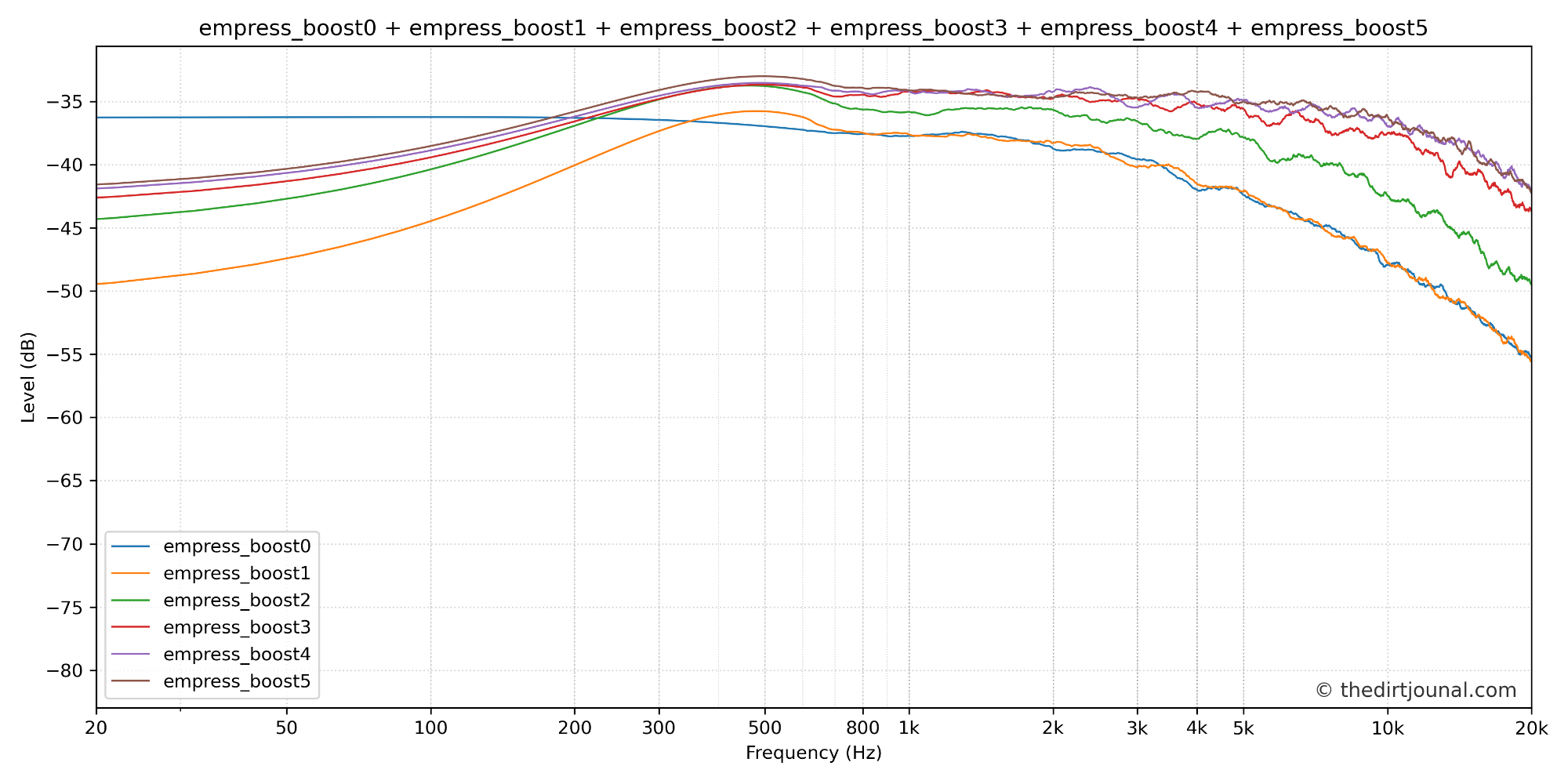
combined_empress_boost0_empress_boost1_empress_boost2_empress_boost3_empress_boost4_empress_bo...png


I plotted the spectrum of the boost knob. Mix 100% wet, everything else at noon.
Boost 0 is off
Boost 1 is on, but at minimum
Boost 2 is 9 o'clock
Boost 3 is noon
Boost 4 is 3 o'clock
Boost 5 is maximum.
 
Which begs the question - what do we want on the BASS VERSION? Maybe a switch to tune/disable the HPF on the pre-gain boost? A switch to add a lowpass to the clean mix (a la Doom 2)? Could even be internal dipswitches... Remove the Gate function in favor of running the boost independently?


The absolute minimum would be that the HPF is eliminated from the boost circuit.

Next up, I don't know about the gate. I have had no use for it up until now.
That might make room for a LPF setting for the clean blend.

Other than that, I'm already pretty happy with the pedal. Ah, a more sensitive VU meter. Something that does more than a tired shrug here and there.
 
The absolute minimum would be that the HPF is eliminated from the boost circuit.

Next up, I don't know about the gate. I have had no use for it up until now.
That might make room for a LPF setting for the clean blend.
I agree.

Add mild (one knob) compression on the clean (low-passed) channel and the pedal would be perfect.

Question remains: who’s gonna tell the Empress guys? ;-)
 
Last edited:
  • Like
Reactions: Sam_Empress
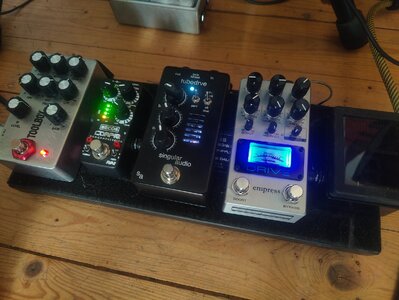
For visual reasons, I tried the Drive on my small board. I replaced the DCX, but then reversed the order with the Tubedrve, to try and make use of the boost this way.
IMG20260508133020.jpg
With the Drive, the Tubedrve and the CompIQ mini, I have three pedals in a row that give visual feedback when signal passes through.

Here's some audio of the result:
Tubedrve alone in the first pass, then Drive in normal mode, then Drive in Boost mode (set to post to hit the Tubedrve harder).

 
Hi I thought I'd jump in here to share the info I have regarding the Drive;

When The HPF filter circuit was tested in isolation without overdrive the max cutoff frequency was 100Hz.
The HPF filter is only applied if the boost is pre-Overdrive.
To retain clarity of the low end for bass you can mix some clean signal back in or use the boost post-Overdrive(in the advanced settings).
There are no plans to release a "Bass" version of the Drive (reading the feedback and wishlists is still appreciated though!).
 
Hi I thought I'd jump in here to share the info I have regarding the Drive;
Much appreciated, thank you!


When The HPF filter circuit was tested in isolation without overdrive the max cutoff frequency was 100Hz.
My measurements do not agree with that statement, but I am using stuff that's a far cry from a professional lab. I feed the pedal white noise from a looper and record the output into Audacity, from where I gather the data and use a python script to plot the graphs. However, my keen ears would agree with what the graphs show - a considerable low cut that is both felt and heard when playing bass into the pedal.


The HPF filter is only applied if the boost is pre-Overdrive.
To retain clarity of the low end for bass you can mix some clean signal back in or use the boost post-Overdrive(in the advanced settings).
There are no plans to release a "Bass" version of the Drive (reading the feedback and wishlists is still appreciated though!).
I've found multiple ways to make the boost work, but the problem remains when going for pre-drive boost and trying to make both a non-boost signal AND a boost signal work at the same time without altering knob settings, because the difference in low end response is clearly audible.

Having you here, I'd like to ask if at the point the ParaEQ Deluxe was released, were there plans to follow up with a bass version or did you come up with that at a later point? The Drive is a fine pedal as is, but it is quite clear from certain aspects that while it totally works for bass, it's intended and tailored for guitar.
Obvious choice from a business viewpoint as there are a lot more guitar players buying pedals and even then, it DOES work for bass - but I do think the difference in the ParaEQ Deluxe compared to the ParaEQ Bass is quite small, and the ParaEQ Deluxe works great on bass - I would envision that a bass specific version of the Drive would actually make more sense.

That said, I'll happily continue exploring sounds with that great new pedal!
 
Here's a note on the nature of the EQ:

combined_EmpressDrive_EQ_min_EmpressDrive_EQ_noon_EmpressDrive_EQ_max.png


While the Drive has a shelving treble control that is capable of boost and cut, there seems to be a baked-in tone curve that starts to drop off at around 2k.
The bass control's curve looks aesthetically pleasing with its flat response at noon and the symmetry created by the min and max.

I tried to go for a true flat response and got this:
combined_EmpressDriveEQ_flat.png

At this knob position:
IMG_20260509_155306.jpg

I am somewhat glad I measured it because in most of my testing I was worried because I rode the Treble knob very high (above 3 o'clock).

This would be another item for my list, should Empress ever decide to do a bass version - a bit more of the treble stuff, please!
 
With that measured, when I put the Empress Drive up against the Origin DCX Bass, I have the feeling that the DCX EQ is more or less a tool to polish your tone to a shine, where the empress feels more like a tool to shape the drive and it's nature. At a first glance, that's hands down a win for the DCX, because it sounds more sophisticated and noble. Five minutes in, however, I feel like the DCX aces the Drive in two distinct functions:

1. Used as a super low gain drive to polish up the bass sound. The better treble response is one factor, and the bass somehow feels weightier, also the DCX has better dynamics in regards to how touch sensitive it is. Used like this, it's more a second preamp or a magic tone sweetener pedal.

2. Used as a higher gain Overdrive, a mean one that sounds really angry. The DCX has that density that balls up the bass in a mix and lends it concentration, heft and sting.

The Empress lives and shines between those two settings and in that regard, it's so much better, it's not even close. The barely there overdrive on the DCX is a great bedroom tone and it's really subtle. So subtle that you can use it in almost any mix and no one would bat an eye.
The OD on the DCX packs a mean punch, with brass knuckles. The Empress has that tube-like quality. Something that reeks of tweed.
A drive you can use as a drive without sounding too offensive, but still have an audible position in a mix.
There is a lot of texture (to my ear) and it has a wooden, organic quality that I really like.

This makes it hard to compare the Empress with the DCX because these two can co-exist perfectly well without stepping on each other's turf.
 
I’m glad you put this one together. I was messing around with the Drive trying to dial in something similar to how I have my DCX set (treble maxed, edge of breakup) and I could not get the drive to hit the same brightness and articulation as the DCX.

I ended up pulling out my SineEffects nanoPara and dialed in a similar frequency/Q as the DCX treble control (very wide, centered @ 5.5kHz if I recall correctly) and placed that ahead of the Drive. It was close but still darker. I ended up dialing in a similar amount of treble as your ‘roughly flat’ settings and that was hitting the same type of sparkle.

In the end, they’re not the same, and for that I’m grateful. I didn’t expect them to be. The DCX is based off a studio console, and the Drive was based off the Germ Drive - itself having a lot of tweed-like DNA. Like you said, different tools, and my next experiment will be seeing how they play together.

The Drive is still likely to take the place of the DCX, but that’s more board logistics than favoring one over the other at this point.
 
I’m glad you put this one together. I was messing around with the Drive trying to dial in something similar to how I have my DCX set (treble maxed, edge of breakup) and I could not get the drive to hit the same brightness and articulation as the DCX.

I ended up pulling out my SineEffects nanoPara and dialed in a similar frequency/Q as the DCX treble control (very wide, centered @ 5.5kHz if I recall correctly) and placed that ahead of the Drive. It was close but still darker. I ended up dialing in a similar amount of treble as your ‘roughly flat’ settings and that was hitting the same type of sparkle.

In the end, they’re not the same, and for that I’m grateful. I didn’t expect them to be. The DCX is based off a studio console, and the Drive was based off the Germ Drive - itself having a lot of tweed-like DNA. Like you said, different tools, and my next experiment will be seeing how they play together.

The Drive is still likely to take the place of the DCX, but that’s more board logistics than favoring one over the other at this point.
combined_DCX_both_min_DCX_both_noon_DCX_both_max.png
 
m
Have you tried the nanoPara after the empress?
IIRC, both the DCX and the empress treble boost are located post drive.
Based on info mentioned earlier in this thread, I am pretty sure the Treble on the DCX mostly boosts before the clipping circuit and mostly cuts after, and the Bass does the opposite.
 
Have you tried the nanoPara after the empress?
IIRC, both the DCX and the empress treble boost are located post drive.

I tried it with the highs on the ParaEQ at the end of the chain, and I didn’t love the result. But this was both with and without the Blumes as my medium gain drive. It’s the same principle as the mids control on the Drive, you want those frequencies to help saturate the drive.

Based on info mentioned earlier in this thread, I am pretty sure the Treble on the DCX mostly boosts before the clipping circuit and mostly cuts after, and the Bass does the opposite.


I think that EQ behavior is one of the special things about the DCX. It’s something I’ve taken and applied as a general starting point to how I’ve been EQing my board. I haven’t gone as far as buying a second ParaEQ, but I’ve definitely thought about it.
 
My verdict on the DCX vs. Drive is that the sophisticated bassist of today should actually own both because they have little overlap - or at least that one can't replace the other because they do different things.
The bass EQ on the Drive adds bass. The LF EQ on the DXC adds weight.
The treble EQ on the Drive set to boost counters the devices baked in roll-off where the HF EQ on the DCX adds sparkle.
The nature of the drives is different, too - as I said, the Drive lives in the middle between the OD and EQ settings of the DCX.
I'll stop comparing the Drive to cheap devices like the Origin (in my market, the Drive is €299 while the DCX is only €279) and pit it against an expensive pedal next. A pedal that claims tube like saturation without running any tubes. The Fake Plastic Trees (€519).