• TalkBass has been independent since 1998. Add your voice.
    Create a free account to reply to discussions, view embedded media, and browse with fewer display ads.
    Join freeLog in
    Want zero display ads or expanded classifieds tools? Compare plans.

Double Bass My DIY audio adventure, and woes

fdeck

Supporting Member
Commercial User
Mar 20, 2004
18,686
21,447
Madison WI
sites.google.com
Disclosures
HPF Technology LLC
I've been working on my amplified sound lately. I've always been satisfied enough with it, but have only really listened when playing through an amp and speaker, in a room, with other musicians, etc.

Thanks to the lockdown, of course all gig work is cancelled, and my bands can't practice. We're being quite cautious. So one of my bands is trying to do some round-robin recording. It's vibes, bass, and drums. The vibes'ist has been finding some cool recorded tunes and transcribing them, something I'd love to learn how to do. I decided to start with laying down a bass track for one tune, which might not have been the brightest idea in the world, but there you go.

The other problem is of course electronics. We now have four musicians in the house, so all of my available "gear" has been spirited away to bedrooms and the like. And I've never owned a decent recording setup. So I decided in the spirit of the times that I should build my own audio interface using some parts that I have on hand, including:

PJRC Store

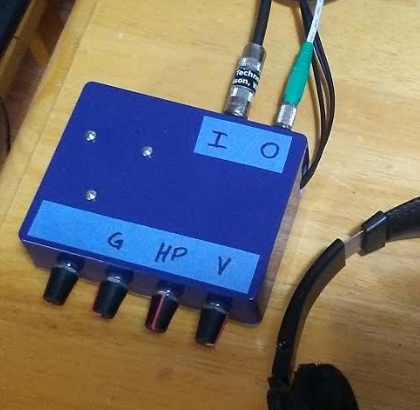
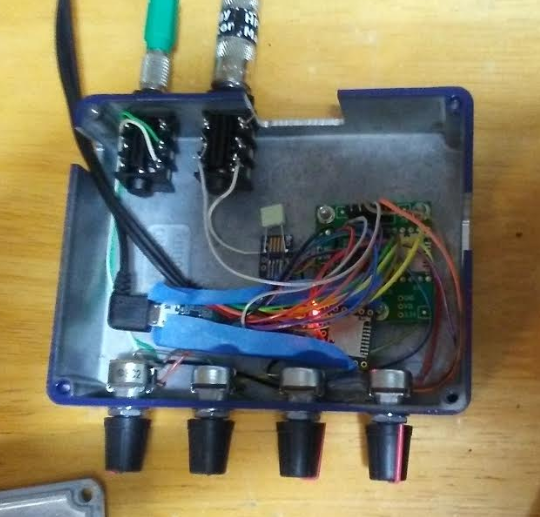
I had a couple of these because I'm trying to learn more about digital audio processing, probably not for a product, but I plan to share anything that I design if it's any good. Here's my first attempt. Some technical details: There's a microcontroller board and a Teensy Audio board, which contains the audio adc / dac functions. I added a little circuit that provides impedance buffering for a piezo pickup. I've programmed the microcontroller to implement a USB audio interface with some minor goodies such as gain and volume controls.

In terms of audio measurements, it's pretty good, just a few dB worse than a PreSonus box that I'm thinking of getting on recommendation from a relative. But that would spoil the fun of rolling my own, right? For now I'm not planning on trying to record with a mic because I'm in a rather noisy room and don't own a decent mic. So I'm going direct from my pickup to this recording interface, and then into Audacity.

Of course I'm delighted that I can record a track, and my colleagues and I have been having fun, though recording is a lot of work. But now for the woes. It should come as no shock that my pickup sounds OK, but not like a great bass in a great room played by someone better than me. So I have to now think about processing the sound, without really having any gear. For lack of a better term, the sound is just kind of plain and boring.

Anyway, I'll keep messing around with this, and will report anything that I learn. I'm always happy to hear anybody's advice about how to get the best use of a pickup and audio interface, understanding that it will always be a number of steps removed from the real thing.

Stay well, everybody!
upload_2020-5-13_23-43-48.png

upload_2020-5-13_23-44-15.png
 
I've been working on my amplified sound lately. I've always been satisfied enough with it, but have only really listened when playing through an amp and speaker, in a room, with other musicians, etc.

Thanks to the lockdown, of course all gig work is cancelled, and my bands can't practice. We're being quite cautious. So one of my bands is trying to do some round-robin recording. It's vibes, bass, and drums. The vibes'ist has been finding some cool recorded tunes and transcribing them, something I'd love to learn how to do. I decided to start with laying down a bass track for one tune, which might not have been the brightest idea in the world, but there you go.

The other problem is of course electronics. We now have four musicians in the house, so all of my available "gear" has been spirited away to bedrooms and the like. And I've never owned a decent recording setup. So I decided in the spirit of the times that I should build my own audio interface using some parts that I have on hand, including:

PJRC Store

I had a couple of these because I'm trying to learn more about digital audio processing, probably not for a product, but I plan to share anything that I design if it's any good. Here's my first attempt. Some technical details: There's a microcontroller board and a Teensy Audio board, which contains the audio adc / dac functions. I added a little circuit that provides impedance buffering for a piezo pickup. I've programmed the microcontroller to implement a USB audio interface with some minor goodies such as gain and volume controls.

In terms of audio measurements, it's pretty good, just a few dB worse than a PreSonus box that I'm thinking of getting on recommendation from a relative. But that would spoil the fun of rolling my own, right? For now I'm not planning on trying to record with a mic because I'm in a rather noisy room and don't own a decent mic. So I'm going direct from my pickup to this recording interface, and then into Audacity.

Of course I'm delighted that I can record a track, and my colleagues and I have been having fun, though recording is a lot of work. But now for the woes. It should come as no shock that my pickup sounds OK, but not like a great bass in a great room played by someone better than me. So I have to now think about processing the sound, without really having any gear. For lack of a better term, the sound is just kind of plain and boring.

Anyway, I'll keep messing around with this, and will report anything that I learn. I'm always happy to hear anybody's advice about how to get the best use of a pickup and audio interface, understanding that it will always be a number of steps removed from the real thing.

Stay well, everybody!
View attachment 3828280
View attachment 3828281

I would assume you're using one of your HPFs, so your running 10meg impedance. Therefore at least we know you are running high impedance. There have been quite a few conversations over the last year or so regarding what the optimum impedance is and how it varies by pickup. What pickup are you using and is the common wisdom that it is happy with 10meg? Or perhaps it has it's own buffer.

Here is one other crazy idea. Something I used to do with my amplified upright basses is tune them the same way I would tune a room for feedback, using either parametric EQ or a 31 band graphic. The combined response of the pickup and bass are by no means flat. By ringing the bass with a relatively flat response amp and tuning out the resonant frequencies, I think you smooth out the most dramatic peaks in the frequency response and make the sound more natural. The trick is learning to walk the line, because you can kill the bass's tone if you get to aggressive with the EQ. I believe this is sort of a crude allegory of what the Audio Sprockets Tonedexter does.

Aside from using a good pickup, an optimum buffer, and a bit of EQ, I cant' really make a lot of suggestions other than, if you are laying down tracks by yourself, you're probably going to be better off with a microphone. Mics don't work very well with upright when there are other players, but the sure do sound nice if you are playing solo.
 
  • Like
Reactions: fdeck
As far as I can remember (correct if I’m wrong) Francis uses a bridge wing pickup. So equill’s comment is right, the pickup signal is rather close to one from an EUB.

The Tone Dexter would be the best, since it could be trained with the acoustic sound of the instrument. Any other simulation of a box for its resonances (i.e. BodyRez) would be second. A room reverb (short and just a bit to make the sound a bit livelier) can simulate the body roughly to some degree, but without some more larger room or small hall reverb it still sounds dry.

Anyway if it doesn’t disturb you too much while playing, I would still go dry into the DAW if you go the reverb route, otherwise just the body simulation with the short room reverb. Try the room simulation later when mixing all tracks together.

Interesting thing what you put together. I only used an A/D at a control rate (about 1 KHz, but not exactly regular) decades ago.
Did you write a driver for it or does it use a standard audio (class compliant) protocol?

If you want to go the online route with jamming together, have a look at SoundJack.eu.
Specially have a look at the entry page video that uses SoundJack for synchronized playing and a DAW at every players end for undisturbed audio recording. Tracks were combined later (Video was recorded separately and combined later too).
You need forward UDP port 50000 to the IP-address of your computer running soundjack (LAN cable connection needed, 5 GHz WLAN might work too with some more latency, no 2,4 GHz WLAN!). The port will soon be changed to 50050, so better forward that port to the same IP-address too.
If I am at home I can assist you if you need.
 
  • Like
Reactions: Wasnex and fdeck
If you are (considering) using reverb, I higly recommend using both a short (small room) and a larger. The short reverb gives the illusion of the bass being "in a space" (close reflection) and the larger room ofcourse can add a bit of sonic elegance after taste.
If you use the same parametrics for all instruments, you can even get a sensation of having recorded together.
 
I would assume you're using one of your HPFs, so your running 10meg impedance. Therefore at least we know you are running high impedance. There have been quite a few conversations over the last year or so regarding what the optimum impedance is and how it varies by pickup. What pickup are you using and is the common wisdom that it is happy with 10meg? Or perhaps it has it's own buffer.
What I did for now was add a JFET buffer to the front end of the audio chip. There are still some JFETs available, though most are now in surface mount form. But this design let me do it all with minimal circuitry, and it has a 10 Meg input impedance.

I like the idea of ringing out the bass. I had played with that a bit, actually blasting the bass with sound from a speaker and measuring the output of the pickup to find unwanted resonances. Maybe I'll try that again. Don't ask why, but I have as many parametrics as I want. I could also add some filtering in the firmware of the microcontroller. ;)

@DoubleMIDI, the library for the microcontroller comes with support for creating a generic USB audio device, so I was able to avoid having to write a driver.
 
  • Like
Reactions: Wasnex
Well, I have to admit that I broke down and bought something: A PreSonus AudioBox stereo interface and a nice microphone, Audio-Technica AT2010, both on advice from a relative. The PreSonus was on sale, and possibly discontinued, but has a USB2 interface which means I don't have to upgrade my computer, or so I thought. The oldest, slowest computer in the house can't handle the data bandwidth, but a hand-me-down laptop from my spouse works just fine. Both came from Full Compass, who I tend to favor because they're local, and always nice.

So I tried an experiment, to record through the pickup and mic at the same time. No surprise, the difference is quite noticeable. I might have to figure out how to record without the appliances running in the basement, but first I have to think of something to record. Also, the measurements don't lie, the PreSonus is several dB quieter than my homemade thing.

I still had to use a preamp -- the PreSonus has a 2k Ohm input impedance. But I might wire up one of my "phantom powered piezo preamp" circuits for this purpose.
 
Using a microphone will probably solve most of your problems. Bit I still like to share an Audacity trick I’ve used to ‘acoustify’ a piezo recording. What I did is create two new stereo reverb-only tracks of the bass. As other have suggested: one with very small room characteristics, one as a bigger room. Both with different eq in the reverb. That way i could dial in a nice balance between direct sound, fake body reverb and room. Worked pretty well for me.
 
  • Like
Reactions: Wasnex
I've been recording in my music room for the past 10 years or so, even recorded a duo album in here. Since you are a DIY guy, I would recommend figuring out how to tame the room you are recording in. My 15'x16' room with 10' ceilings was a nightmare of reflective recording evil when we first moved in 20 years ago. I kept adding strategic rock wool panels, starting with the corners, until it started sounding better. I even ended up hanging an array from the ceiling and built some that fit exactly into the window frames to block street noise, but that are removable. It was a nice project and now the room is fun to record in, if still imperfect.

If you got your room together, you could probably ditch the pickup signal entirely. BTW, I've been using an old Presonus firewire interface for years. It sounds great, was inexpensive, and has been bug free the entire time. Good luck!
 
  • Like
Reactions: Ric Vice and Wasnex