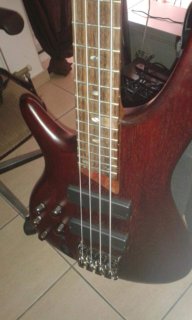
I am having an issue with the E string specifically. Every time i get a brand new set of strings, the set usually sounds nice and fresh for a few days, then the E string loses a lot of its sound while the other 3 strings still sound fine. (The A string also loses a bit of its sound but it doesn't sound as dead as the E string). What can i do to prevent this?

Enjoy the benefits of a premium membership!
Upgrade Account
-
TalkBass has been independent since 1998. Add your voice.
Create a free account to reply to discussions, view embedded media, and browse with fewer display ads.
Join free Log in
Want zero display ads or expanded classifieds tools? Compare plans.
You are using an out of date browser. It may not display this or other websites correctly.
You should upgrade or use an alternative browser.
You should upgrade or use an alternative browser.
My E strings always die quickly while my A, D, G strings are bright and fine
- Thread starter HazyMan
- Start date
More options
Who Replied?
I have the same issue with my low B string sometimes. Usually it's because I've twisted the string while installing it.


i think it's with different sets, but the strings i have now and my last set which definitely had this issue are daddarios. i might have had this with other brands too tho, just can't be 100% sure because i can't rememberAlways the same brand or does it happen with different sets?

I am having an issue with the E string specifically. Every time i get a brand new set of strings, the set usually sounds nice and fresh for a few days, then the E string loses a lot of its sound while the other 3 strings still sound fine. (The A string also loses a bit of its sound but it doesn't sound as dead as the E string). What can i do to prevent this?
Are you always making sure to set proper witness points when installing new strings, especially with bigger strings (E & A)?
set proper witness points? what is that?Are you always making sure to set proper witness points when installing new strings, especially with bigger strings (E & A)?
set proper witness points? what is that?
I kind of expected you to ask that...

Once the string is installed and tuned to pitch, gently (but firmly) press down on the string just in front of the saddle with your thumb to make sure it sits flat on the saddle with a definite break angle (ie "witness point") just behind it instead of having the string casually arched over the saddle.
oh, i've done that thing with the thumb but i've done it all across the string, not just infront of the bridge...I kind of expected you to ask that...
Once the string is installed and tuned to pitch, gently (but firmly) press down on the string just in front of the saddle with your thumb to make sure it sits flat on the saddle with a definite break angle (ie "witness point") just behind it instead of having the string casually arched over the saddle.

That's just typical of all roundwound strings. Some sets more than others. You can simply change strings every week. Some folks change everyday. You could switch to; coated strings, nylon tapewound, pressurewound, groundround (not hamburger), or flatwound. Take your pick.I am having an issue with the E string specifically. Every time i get a brand new set of strings, the set usually sounds nice and fresh for a few days, then the E string loses a lot of its sound while the other 3 strings still sound fine. (The A string also loses a bit of its sound but it doesn't sound as dead as the E string). What can i do to prevent this?

oh, i've done that thing with the thumb but i've done it all across the string, not just infront of the bridge...
That would be correct. The thicker strings are problematic as they're resistant to bending. I set mine at the tuner post wraps (!) and fretboard side of the nut & bridge saddle. As mentioned, it's also really easy to twist a string...be sure to allow the ball-end to spin freely during the install.
Riis

You just need to drool out of the other side of your mouth.
Seriously... I got nothing.
Seriously... I got nothing.


How does RW string gauge weigh into this concept? Would heavier strings (I use 105-50) add life to the E? Would stainless steel maybe?

Is it possible your playing the E and A a lot more then the other strings...you could be wearing those out faster than the rest
most likely is my guessIs it possible your playing the E and A a lot more then the other strings...you could be wearing those out faster than the rest

wmhill
Inactive
- Aug 20, 2012
- 4,054
- 17,209
- Disclosures
- MTD basses endorsed artist Bartolini pickups emerging artist TECAMP bass players gear endorsed
some basses are problematic like that. I had a fender zone that came out of the box new like that, the E string always sounded dull like an old string. I tried anything I could think of (including the "witness points") and returned it to the dealer. They came up with nothing as well. I tried several different brands and gauges of strings. The dealer even contacted fender, who really offered no help. I ended up trading it back in and got something that sounded good (Schecter). I know that doesn't help fix your problem, but maybe it's time to let it be someone else's problem. Put a set of flatwounds on it and put it on Craigslist

Several things I discovered over the years:
Hexcore strings in larger gauges last longer than round core strings
Proper installation is important. DR Strings has good information about that.
More aggressive playing wears out strings faster.
Hexcore strings in larger gauges last longer than round core strings
Proper installation is important. DR Strings has good information about that.
More aggressive playing wears out strings faster.

I am having an issue with the E string specifically. Every time i get a brand new set of strings, the set usually sounds nice and fresh for a few days, then the E string loses a lot of its sound while the other 3 strings still sound fine. (The A string also loses a bit of its sound but it doesn't sound as dead as the E string). What can i do to prevent this?
This is perfectly normal. Thicker strings tend to give their life up sooner than lighter gauge.
On a 5th string this gets really obvious. Low B goes dull in a couple days while the G string might be sizzling nicely for weeks (Elixir for example).

This may have to do with the way the strings are installed. Someone mentioned ensuring that the ball end spins freely while installing. This is to avoid introducing twist in the string. However, if it's a string through body design, or if the bridge doesn't allow the string to spin freely, then the ball end can't turn while you're stringing up. The key thing here then is to NOT wrap the string around the post - this causes twist in the string which will either unwind or wind more tightly the outer windings of the string around the core, depending on which direction you're wrapping. That's what causes the string to go dead quickly. Instead, run the string through the bridge, establish the witness point over the bridge saddle, measure the desired length needed for winding onto the tuning post, then put a sharp right angle bend in the string at that point (this further prevents unwinding of the wraps). Then cut the string off about 1 1/2 to 2 inches beyond that point (this is the portion that gets shoved down in the hole in the tuning post). Put that portion into the hole in the tuning post, and then wind the string on the post by turning the tuning peg, NOT by wrapping the string around the post. A string winder (either the manual kind or the attachment that goes on an electric screwdriver or drill) will greatly help here, rather than having to manually wind the tuning peg with your fingers all that way.
I used to have that problem with the E and A strings going dead very quickly (or being dead from the start), but once I started changing strings this way the problem went away. Best of luck!
I used to have that problem with the E and A strings going dead very quickly (or being dead from the start), but once I started changing strings this way the problem went away. Best of luck!

I think the heavier strings E and B typically don't maintain the zing of the other strings. I think has to do with the physical factors of things. If they had a longer scale they would probably have more zing.


