
I didn’t even know how bad they were until I read about it on the interwebz.

Enjoy the benefits of a premium membership!
Upgrade Account
-
TalkBass has been independent since 1998. Add your voice.
Create a free account to reply to discussions, view embedded media, and browse with fewer display ads.
Join free Log in
Want zero display ads or expanded classifieds tools? Compare plans.
You are using an out of date browser. It may not display this or other websites correctly.
You should upgrade or use an alternative browser.
You should upgrade or use an alternative browser.
My experience with notorious Gibson 3-point bridge
- Thread starter 4andnomore
- Start date
More options
Who Replied?
Things get better, or at least they should. Ric owners have been putting up with a similar train wreck for years, they finally at least partly improved it. It’s a crap design, no way to polish that turd. When (if) you get tired of settling for crap, get a Hipshot replacement.
Well, it’s generally considered to be much preferable for the entire bridge to be in contact with the body for sonic reasons. You don’t see boutique builders and higher end production basses Using an elevated bridge.

When I was 16 I bought an EB4L with the 3 point bridge. I'd only been playing for 2 years at that point, but even I could not get past that design-flaw of a bridge. As soon as I saved up a little more $ I took it to a shop and had them put on a 1st generation Badass. I have never regretted that.
Last edited:

I've got the original 3 point bridge on my two Gibson basses and have never had any trouble at all adjusting them. I've had to trim back the silk on TIs a bit, but I would hardly consider that a design flaw. My Gibsons play fine and stay in tune with none of the problems that are often repeated here. Maybe I'm just lucky, but I'm not that lucky.
Well, it’s generally considered to be much preferable for the entire bridge to be in contact with the body for sonic reasons. You don’t see boutique builders and higher end production basses Using an elevated bridge.
Agreed. Maybe they made sense on the EB1 & EB2, but on a flat, solid surface why in the world would you NOT want positive contact?Well, it’s generally considered to be much preferable for the entire bridge to be in contact with the body for sonic reasons. You don’t see boutique builders and higher end production basses Using an elevated bridge.
This horse has been beat to death long ago.
Yeah, it looks like the mold for that casting wore out in the early 70's, I think it takes up way too much real estate, there's lot of Les Paul guys that curse those posts, and just like a Tuna-Matic bridge, the saddles fall right out. I had these on the Ripper and the RD, and I never saw them numbered 1-4, though that was so early on I could have very well missed 'em.
But . . . . it works. Whaddya gonna do? They pioneered the 3D Schaller for the Victory basses, used in lots of applications, and they don't get credit for it, one of the best bridges out there on the appropriate basses. And they're certainly not alone: It's still way better than that pot-metal museum piece that Ric has foisted on their users for years until last year.
Well there you go: Took a few more pot shots at dead horses . . . . . . .
Yeah, it looks like the mold for that casting wore out in the early 70's, I think it takes up way too much real estate, there's lot of Les Paul guys that curse those posts, and just like a Tuna-Matic bridge, the saddles fall right out. I had these on the Ripper and the RD, and I never saw them numbered 1-4, though that was so early on I could have very well missed 'em.
But . . . . it works. Whaddya gonna do? They pioneered the 3D Schaller for the Victory basses, used in lots of applications, and they don't get credit for it, one of the best bridges out there on the appropriate basses. And they're certainly not alone: It's still way better than that pot-metal museum piece that Ric has foisted on their users for years until last year.
Well there you go: Took a few more pot shots at dead horses . . . . . . .
Maybe I can make some glue outta those dead horses and use it to properly adhere those lame countersunk anchor post thingys.This horse has been beat to death long ago.
Yeah, it looks like the mold for that casting wore out in the early 70's, I think it takes up way too much real estate, there's lot of Les Paul guys that curse those posts, and just like a Tuna-Matic bridge, the saddles fall right out. I had these on the Ripper and the RD, and I never saw them numbered 1-4, though that was so early on I could have very well missed 'em.
But . . . . it works. Whaddya gonna do? They pioneered the 3D Schaller for the Victory basses, used in lots of applications, and they don't get credit for it, one of the best bridges out there on the appropriate basses. And they're certainly not alone: It's still way better than that pot-metal museum piece that Ric has foisted on their users for years until last year.
Well there you go: Took a few more pot shots at dead horses . . . . . . .
D
Well, it’s generally considered to be much preferable for the entire bridge to be in contact with the body for sonic reasons. You don’t see boutique builders and higher end production basses Using an elevated bridge.
I guess I better upgrade the 2-point bridge on my double bass with a Babicz then...
An upright bass is hollow. Apples & oranges. I think the original 3 point bridge may have been for Gibson's contour top basses. It was just probably cheaper for them not to change it for the EBO.I guess I better upgrade the 2-point bridge on my double bass with a Babicz then...
Last edited:


those were about as solid a contact as could be asked for, string on bar / base to body anchor.Agreed. Maybe they made sense on the EB1 & EB2, but on a flat, solid surface why in the world would you NOT want positive contact?
Maybe so, but you couldn't tell my 16 year old self NUTHIN!those were about as solid a contact as could be asked for, string on bar / base to body anchor.

While it is fundamentally true that Gibson wouldn't give the sweat off their nards to save a bassist dying of thirst, I wonder if the reason for lack of published instructions might be for a different reason.
Is it possible that they are indirectly pushing users to leave setup to professionals? Yes, anyone could learn how to adjust a mechanical bridge but taking it so a shop is good for business, for the shop, for the factory, and ultimately delivers more consistent satisfaction, all of which strengthens brand loyalty. So that might or might not be the reason but it seems logical.
Is it possible that they are indirectly pushing users to leave setup to professionals? Yes, anyone could learn how to adjust a mechanical bridge but taking it so a shop is good for business, for the shop, for the factory, and ultimately delivers more consistent satisfaction, all of which strengthens brand loyalty. So that might or might not be the reason but it seems logical.
lolMaybe so, but you couldn't tell my 16 year old self NUTHIN!
solid, and their simple / clean looks are why I wish they weren't so hard to source now.
The whole top of your double bass has to be free to vibrate. The bridge design has been honed over centuries. Bolting a large piece of metal in its place would have a profound negative impact on your tone and volume. Pretty much the opposite of solid bodies.I guess I better upgrade the 2-point bridge on my double bass with a Babicz then...

got a Casady Epiphone a few years back.
immediately, like within hours, replaced that antiquated, cludgy bridge with a Hipshot Epi replacement.
the adjustability, mass and solid locked-onboard aspect of this easy swap improved the tone, feel & fine-tuning 1000%. just my 2 cents
immediately, like within hours, replaced that antiquated, cludgy bridge with a Hipshot Epi replacement.
the adjustability, mass and solid locked-onboard aspect of this easy swap improved the tone, feel & fine-tuning 1000%. just my 2 cents
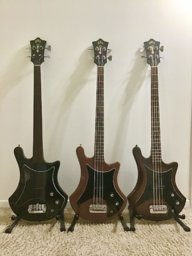
I’ve got a lot of Vintage Thunderbirds, and Vintage Guild‘s with 3 point bridges. I’ve never had a problem with them, and don’t understand why so many people don’t like them, and have had trouble with them. I don’t doubt their experience, but I’ve never had any bad experiences with them.
It looks like it was cast in a 7th grade shop class of cheap pot metal. There is not enough space between the saddles and the string anchor so the strings wraps at the bridge end ride over the saddles . There is nowhere near enough string break abgle over the saddles, the small tensioning anchor at the front is supposed to compensate for this but it's a poor substitute for correct string break angle. Gibson used this bridge on so many basses often with out considering if it it a good match for what they are developing. Many basses equipped with this bridge you can't get the action low enough. The saddles are notched making for a wide contact point with the sting, not optimal. The saddles fall out if you break at string. I could go on, I've dealt with it enough, nothing anyone can say will ever change my mind about the thing.
Saying that the three point bridge isn't such a bad bridge is like saying Charlie Brown had good taste in Christmas trees.
IMO its not a bad bridge and I happen tp like Charlie Brown's Christmas tree.Youare entitled to your opinion - no need to trash mine.


