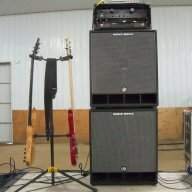
Russ I have no idea how good the soundman is. Our drummer says he's good but I don't know for sure.
Can you elaborate on the sound perception issues?
Sorry if this gets wordy but I'll try to explain as well as possible.
When you have full PA support, you've usually got a few things going on:
- You're on a big stage
- You're in a big room
- You're trying to keep your stage volume as low as possible
- You may or may not have good monitoring available
The key here is the "stage volume as low as possible". If you're really doing it right, the guitar and bass amps are low enough that you and the guitarist can't really hear each other if your amps are facing forward toward the crowd. The room should be big enough that you're not really hearing any reflections off the walls because the low volume sound is just going out and being absorbed by the people in the room. The same goes for what's coming out of the PA--you won't necessarily hear it because you're *behind* the front-of-house speakers, and those speakers are designed to *not* send their sound backward because that can cause lots of feedback.
So how do you solve this problem where nobody can hear each other? In an ideal world, you solve it with monitoring. Monitors are those wedge-shaped speakers you see sitting along the front of the stage, pointing back at the band. They send the signal from the mixing board back to the band so they can hear themselves play. In an ideal world, you've got a separate monitor mix and even a separate monitoring sound guy whose sole purpose in life is to make the monitor mix sound good to the band. In the real world, that almost never happens. You get whatever crappy mix the sound guy puts together, which is usually *very* heavy in vocals and not a whole lot else. The singer has to hear himself to sing in tune, so the vocals get cranked up.
So, how do you play well in a real-world situation? There are a few tricks:
- Learn to play your part while only hearing yourself, the drummer, and the singer. That's usually the best you can hope for. If you have no monitoring, or only vocal monitoring, set up your amp right next to the drummer so he can hear you and you can lock in together.
- Put your amp on a stand so the speakers angle toward your head. This lets you keep a lower stage volume and still hear yourself well.
- Set up your amps in a "crossfire" setup. What this means is that instead of you and the guitarist putting your amps behind you facing the crowd, you put them to the sides of the stage facing across the stage at each other. This helps everybody hear everybody while making the sound guy happy because the amps aren't facing the microphones at the front of the stage. Even better is to put them in the front corners of the stage and face them toward the drummer. This only works with smaller combo amps, don't put a full stack at the front of the stage. It'll just block your view of part of the crowd (and their view of you).
Edit: Oh yeah, and always trust the sound guy when you're on stage. If you can't hear yourself, don't assume nobody else can hear you. Turn up just enough to where you can hear yourself and leave it at that. And I don't mean "hear yourself with your chest pounding like you know your amp can do", I mean that your amp is audible to you on stage. In big rooms and on big stages, what the crowd hears is *very* different from what the band hears on the stage. Just play through your set, then ask somebody you trust in the crowd whether the band sounded good out in the audience or not. If it did, the sound guy is doing his job correctly regardless of what you heard from your spot on the stage.