
Enjoy the benefits of a premium membership!
Upgrade Account
-
TalkBass has been independent since 1998. Add your voice.
Create a free account to reply to discussions, view embedded media, and browse with fewer display ads.
Join free Log in
Want zero display ads or expanded classifieds tools? Compare plans.
You are using an out of date browser. It may not display this or other websites correctly.
You should upgrade or use an alternative browser.
You should upgrade or use an alternative browser.
My New Studio Build (perhaps overly detailed)
- Thread starter silky smoove
- Start date
More options
Who Replied?

For me, priority in a mix goes like this:I’m always fascinated by how some songs have this amazing (to me anyways) drum sound and others just sound so crappy. As a bass player, I tend to key I on the drum sound WAY more than I should.
- Vocals
- Kick
- Snare
- Bass
- Literally everything else

Did a session right before the pandemic lockdown to effect. The drummer brought a non-ported bass drum and didn't want to port it for the session. No biggie. It sounded nice and tight in the room, so I convinced myself that I didn't need to mic the beater side of the kit. I'm finally getting to mix the session after waiting for some missing parts that we couldn't record while locked down. Well, here I am REALLY wishing I'd thrown a 57 on the beater side of the kick as everything captured is pretty darn boomy. As a result I'm using a noise gate into Melodyne Assistant to convert the audio of the bass drum to MIDI and then sample augmenting the whole thing. Not the way I wanted it to go, but if the end result is a good sounding mix then I'll be happy with it. Lesson learned though. No port on the bass drum? Don't question it and just mic the beater side of the kit in addition to the normal BD mics.
is there a techinqe or method commonly used for mic'ing the beater? I have stopped using a LDC now that I have a sub kick to go with a shure 52a but this could be great for adding attack and "click" sound 5-8k???
thx
@silky smoove I'm curious how they go about getting this tone out of the drums....
You probably need to listen to it through a good set of headphones. It sounds like poo on my work laptop.
You probably need to listen to it through a good set of headphones. It sounds like poo on my work laptop.
My go-to is also a Beta 52a and a sub kick speaker mic, which in my case is a Solomon LoFreq. Great combination. If I need it mega-fat I'll push the Beta 52a further inside the drum and then apply Waves R Bass at about 50hz to the LoFreq in post.is there a techinqe or method commonly used for mic'ing the beater? I have stopped using a LDC now that I have a sub kick to go with a shure 52a but this could be great for adding attack and "click" sound 5-8k???
thx
As for mic'ing the beater; The same rules as anything else still apply. More on-axis will sound brighter. More off-axis will sound less bright. The closer to the sound source the louder it will be and the room sound will be reduced. The further away from the sound source the quieter it will be and the room sound will be increased. With that in mind, it's very hard to get fully on-axis since there's a drummer sitting there playing. If they never move their throne I suppose you could get creative and thread it through their legs, but that seems problematic at best. I typically thread a mic on the floor tom or hihats side aiming as close to the contact point of the beater as possible. Prioritize getting it in a spot where the drummer won't bump into it with their legs and do what you can to get the snare into the mic's cancellation zone for its polar pattern. You won't be very effective at this as the snare is just too loud not to spill into the beater mic in this location, but it's worth trying a few placements to see what works best. The other pitfall that most people don't consider is that some kick pedals are really squeaky and you're trying to get a mic as close to it as possible. Further, the squeaks are all in the range that you want to emphasize from this mic, not to mention it's the same range that's coming off the snare strainer as well. It all adds up to being a mic location that I only use if I absolutely have to. I would much rather mic inside the drum through a port in the reso head whenever possible. As for mic selection; All you should be concerned with on this mic is attack. Most of the time the bulk of a bass drum's attack lives at about 3khz. Sometimes higher and rarely lower. With that in mind, you don't need a condenser to reach up that high in terms of decent response, so I always reach for a dynamic and preferably one with a small body. My favorite is probably just a good ol' 57, but anything similar would do just fine. Steve Albini uses this tiny little Countryman mic on a mini-XLR that he dangles off the beater side bass drum hoop so that it's pointing right at the top of the beater. It's very slick with how it gets close to the beater without being in the way of the drummer. It's also $500 last time I checked, and I've got other things to spend money on before I get to that, especially when this is a mic technique I don't use very often.
@silky smoove I'm curious how they go about getting this tone out of the drums....
You probably need to listen to it through a good set of headphones. It sounds like poo on my work laptop.
That one's easy. It's the basic rock and modern country snare sound that's been around since the 80s. Get any decent sounding 14" snare with some depth to it (6.5" or more), put on a coated head, preferably one with two plies like an Emperor, tune it to medium pitch and have the drummer play it with their sticks hitting dead center. Close mic the top with a good dynamic mic since the top end extension of a condenser isn't needed and it will help to minimize hihat spill. A 57 or SM7B (if there's room) are good choices, but any decent condenser would do. There may be a bottom mic, but if there is it's mixed in VERY low relative to the top mic. Ideally you'd track through something like a 1073 or a 312c that you can push into saturation to exaggerate the transients a little, but if not you can do it in the box with something like Softube Harmonic Saturation, which is my go-to harmonic saturation plugin. You can hear that the top end has been rolled off a bit, but you don't need to get crazy. The bottom end is rolled off just enough to remove rumble but with the meat of the snare tone still in tact. On a rock or modern country snare it's important that the snare not be overly bright and still have enough body to provide sufficient weight on the backbeat. There's probably a slow attack, medium release compressor directly on the snare track doing some light gain reduction whlie trying not to obliterate the transients. Additionally I'm sure there's one or more forms of buss compression happening in parallel that really smash the drums and then get blended back in underneath the channel output to the 2buss to bring up the RMS value of the drums. The reverb applied sounds like a plate to me, and it specifically sounds like a plate applied to the top mic as it sounds like a lot of proximity in the reverb tail. They likely low passed the reverb as well to darken it a bit since I'm not hearing a ton of sheen.
It took longer for me to type that out then it would to set all of that up in a session

Last edited:
Quoting myself here.Steve Albini uses this tiny little Countryman mic on a mini-XLR that he dangles off the beater side bass drum hoop so that it's pointing right at the top of the beater. It's very slick with how it gets close to the beater without being in the way of the drummer. It's also $500 last time I checked, and I've got other things to spend money on before I get to that, especially when this is a mic technique I don't use very often.
I looked it up, and for anyone interested you can see the mic I was describing in the screenshot below dangling in front of the beater head. It’s a Countryman Isomax. The current version (Isomax 2) sells for less than I was thinking at $240 new. I’m not always the biggest fan of the sound of Steve’s records but he has enough of a pedigree to know what he’s doing and I’m sure this mic has a lot going for it in this application. The small profile and ability to get close to the beater without getting bumped by the drummer is unquestionably great. The cardioid pattern with the cancellation pointed up towards the snare strainer is also a really smart placement even if it will still get a ton of spill.
My go-to is also a Beta 52a and a sub kick speaker mic, which in my case is a Solomon LoFreq. Great combination. If I need it mega-fat I'll push the Beta 52a further inside the drum and then apply Waves R Bass at about 50hz to the LoFreq in post.
As for mic'ing the beater; The same rules as anything else still apply. More on-axis will sound brighter. More off-axis will sound less bright. The closer to the sound source the louder it will be and the room sound will be reduced. The further away from the sound source the quieter it will be and the room sound will be increased. With that in mind, it's very hard to get fully on-axis since there's a drummer sitting there playing. If they never move their throne I suppose you could get creative and thread it through their legs, but that seems problematic at best. I typically thread a mic on the floor tom or hihats side aiming as close to the contact point of the beater as possible. Prioritize getting it in a spot where the drummer won't bump into it with their legs and do what you can to get the snare into the mic's cancellation zone for its polar pattern. You won't be very effective at this as the snare is just too loud not to spill into the beater mic in this location, but it's worth trying a few placements to see what works best. The other pitfall that most people don't consider is that some kick pedals are really squeaky and you're trying to get a mic as close to it as possible. Further, the squeaks are all in the range that you want to emphasize from this mic, not to mention it's the same range that's coming off the snare strainer as well. It all adds up to being a mic location that I only use if I absolutely have to. I would much rather mic inside the drum through a port in the reso head whenever possible. As for mic selection; All you should be concerned with on this mic is attack. Most of the time the bulk of a bass drum's attack lives at about 3khz. Sometimes higher and rarely lower. With that in mind, you don't need a condenser to reach up that high in terms of decent response, so I always reach for a dynamic and preferably one with a small body. My favorite is probably just a good ol' 57, but anything similar would do just fine. Steve Albini uses this tiny little Countryman mic on a mini-XLR that he dangles off the beater side bass drum hoop so that it's pointing right at the top of the beater. It's very slick with how it gets close to the beater without being in the way of the drummer. It's also $500 last time I checked, and I've got other things to spend money on before I get to that, especially when this is a mic technique I don't use very often.
That one's easy. It's the basic rock and modern country snare sound that's been around since the 80s. Get any decent sounding 14" snare with some depth to it (6.5" or more), put on a coated head, preferably one with two plies like an Emperor, tune it to medium pitch and have the drummer play it with their sticks hitting dead center. Close mic the top with a good dynamic mic since the top end extension of a condenser isn't needed and it will help to minimize hihat spill. A 57 or SM7B (if there's room) are good choices, but any decent condenser would do. There may be a bottom mic, but if there is it's mixed in VERY low relative to the top mic. Ideally you'd track through something like a 1073 or a 312c that you can push into saturation to exaggerate the transients a little, but if not you can do it in the box with something like Softube Harmonic Saturation, which is my go-to harmonic saturation plugin. You can hear that the top end has been rolled off a bit, but you don't need to get crazy. The bottom end is rolled off just enough to remove rumble but with the meat of the snare tone still in tact. On a rock or modern country snare it's important that the snare not be overly bright and still have enough body to provide sufficient weight on the backbeat. There's probably a slow attack, medium release compressor directly on the snare track doing some light gain reduction whlie trying not to obliterate the transients. Additionally I'm sure there's one or more forms of buss compression happening in parallel that really smash the drums and then get blended back in underneath the channel output to the 2buss to bring up the RMS value of the drums. The reverb applied sounds like a plate to me, and it specifically sounds like a plate applied to the top mic as it sounds like a lot of proximity in the reverb tail. They likely low passed the reverb as well to darken it a bit since I'm not hearing a ton of sheen.
It took longer for me to type that out then it would to set all of that up in a session
Thx Silky, I have found the squeaky pedal can be brutal, (my current drummers has a bit of squeek to it (He took it home with his kit just before this last lock down we went into he was going to oil it, I have a direct dive pedal that is awesome no noise at all but some drummers don't like it)
The hole in his bass drum is much smaller than the one in our kit, so getting a 57 inside on the beater is a PITA, specifically when I like using the 52a juts outside the hole or like you said, I will put in in the hole for more bass response (the sound hole is just large enough for the 52a) I will have to experiment a bit with trying a mic on the beater to see what results I get
Clarification: This will yield LESS bass response, but I then couple it with my Solomon LoFreq which I then add Waves R Bass to for mega-fatness. The point of pushing it further in the drum is that in conjunction with the LoFreq + R Bass setup I want the non-sub mic to be a little thinner and more attack'y to offset the huge low end content provided by the aforementioned combination.I will put in in the hole for more bass response (the sound hole is just large enough for the 52a)
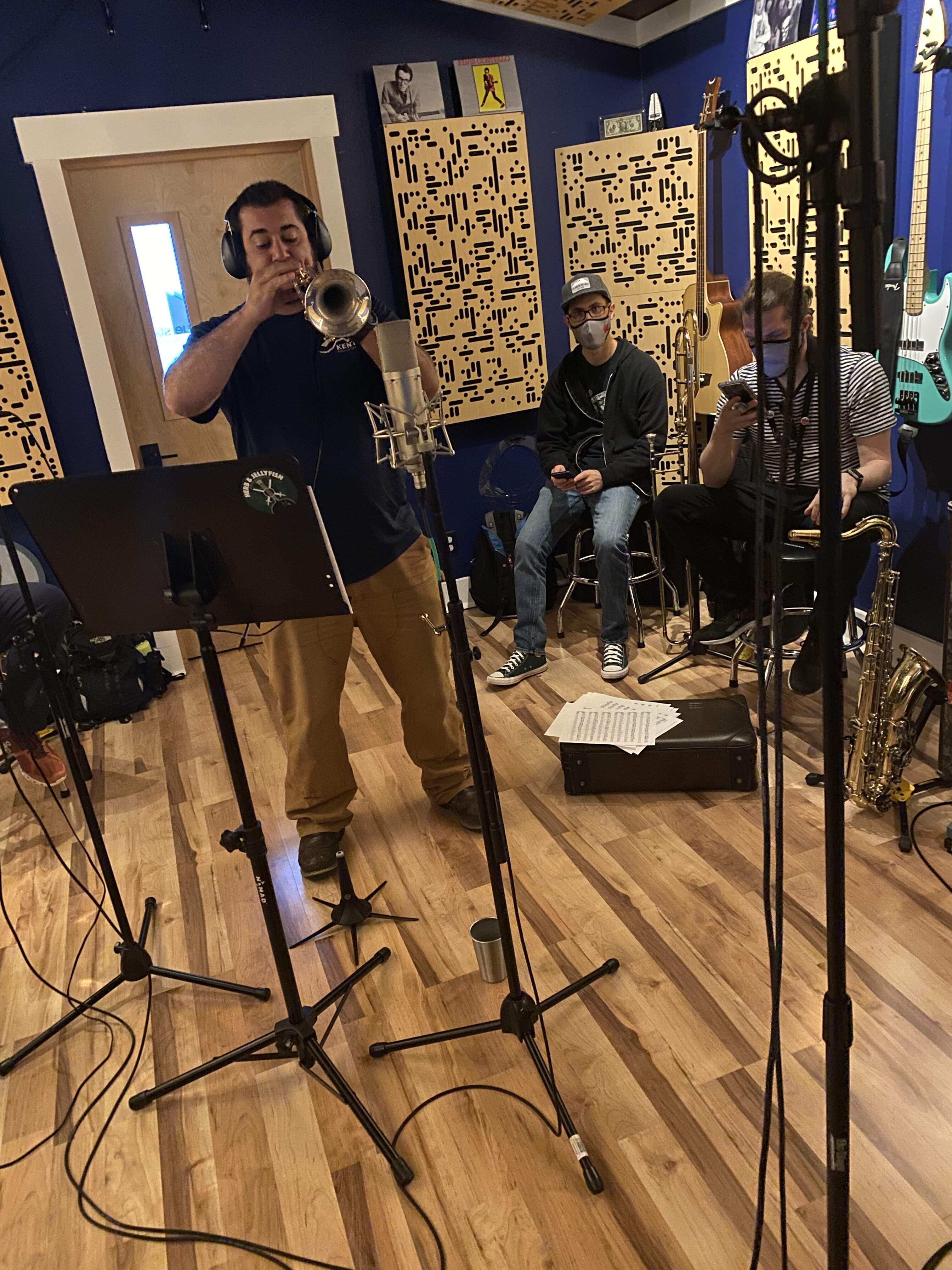
It’s been a while since I posted a studio update. For those of you that follow my Instagram (aroguestory) you may have seen my stories from tonight laying down some horns. Well as it happens those were for a fellow TB’er. @letsgethandsome hired me to find a horn section and record tracks for a song his band is putting together. It’s sort of an updated and modern take on a yacht rock tune with some cool synths, screaming guitar and very nice bass playing… now it has a five piece horn section too! Well… as soon as I edit the tracks down and send them 
Capture was done with a D87 into an 8MP, stereo C02s into an 8MP and an X15 (stereo) into a TransX. Plenty of options for @letsgethandsome when he starts mixing. Hopefully he digs them! Feel free to follow me on Instagram to see the clips I posted tonight, and check out @letsgethandsome on Instagram as well to hear his band and hopefully this track once it’s finished.
D87 for getting a good close mic sound. This is a vintage U87 clone that I built with a buddy who happens to own both a modern U87ai and an actual vintage U87. He recently told me how jealous of this mic he is. To make it better I have a matched stereo pair! I built these with a SYT-5 body, a Microphone-Parts RK-87 capsule, and an AMI Tab Funkenwerk T13 transformer.
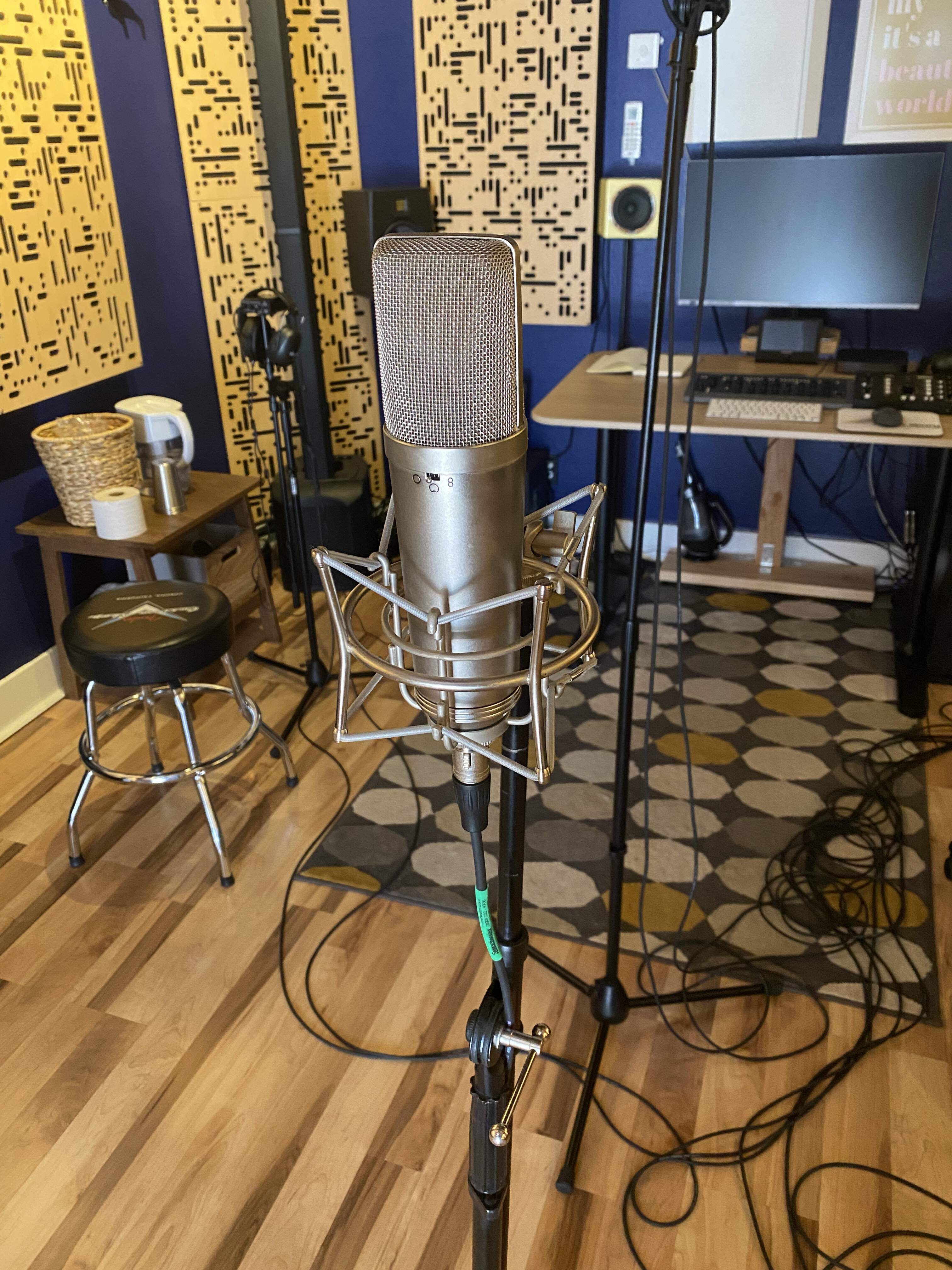
Here’s the Cascade X15 stereo ribbon set in line with the D87 but with the mic stand maxed out. Sort of a quasi-Blumlein mic in this arrangement. Really roomy with the sides hard panned left and right. Lots of midrange, minimal bottom end and that smooth roll off up top from the ribbon.
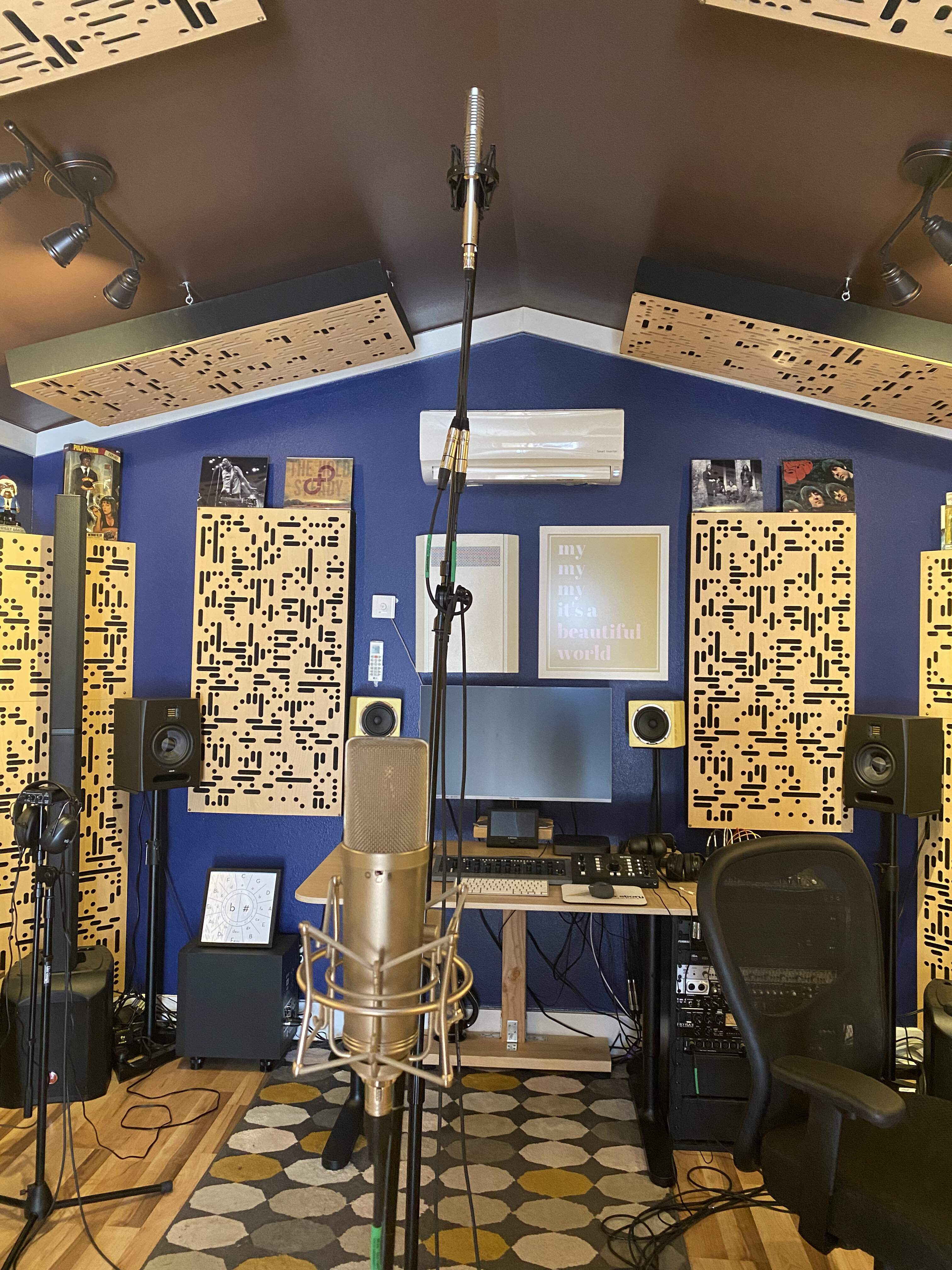
Above the door are a pair of cheapo Samson C02 SDCs with windscreens in an ORTF arrangement. These are my permanent room mics that mostly get used as rehearsal recording mics but for things like this it’s easy to patch them in since they’re permanently flown and wired. Despite their cheapness they sound excellent as long as they’re not used as a close mic for anything with bottom end. In this placement that’s never an issue. Just as roomy as the X15 but being SDC mics it’s a different flavor of roomy. Also being behind the performers you capture more of the reflected sound than the directional sound coming off the horns. More phase to deal with but it’s often just the thing.
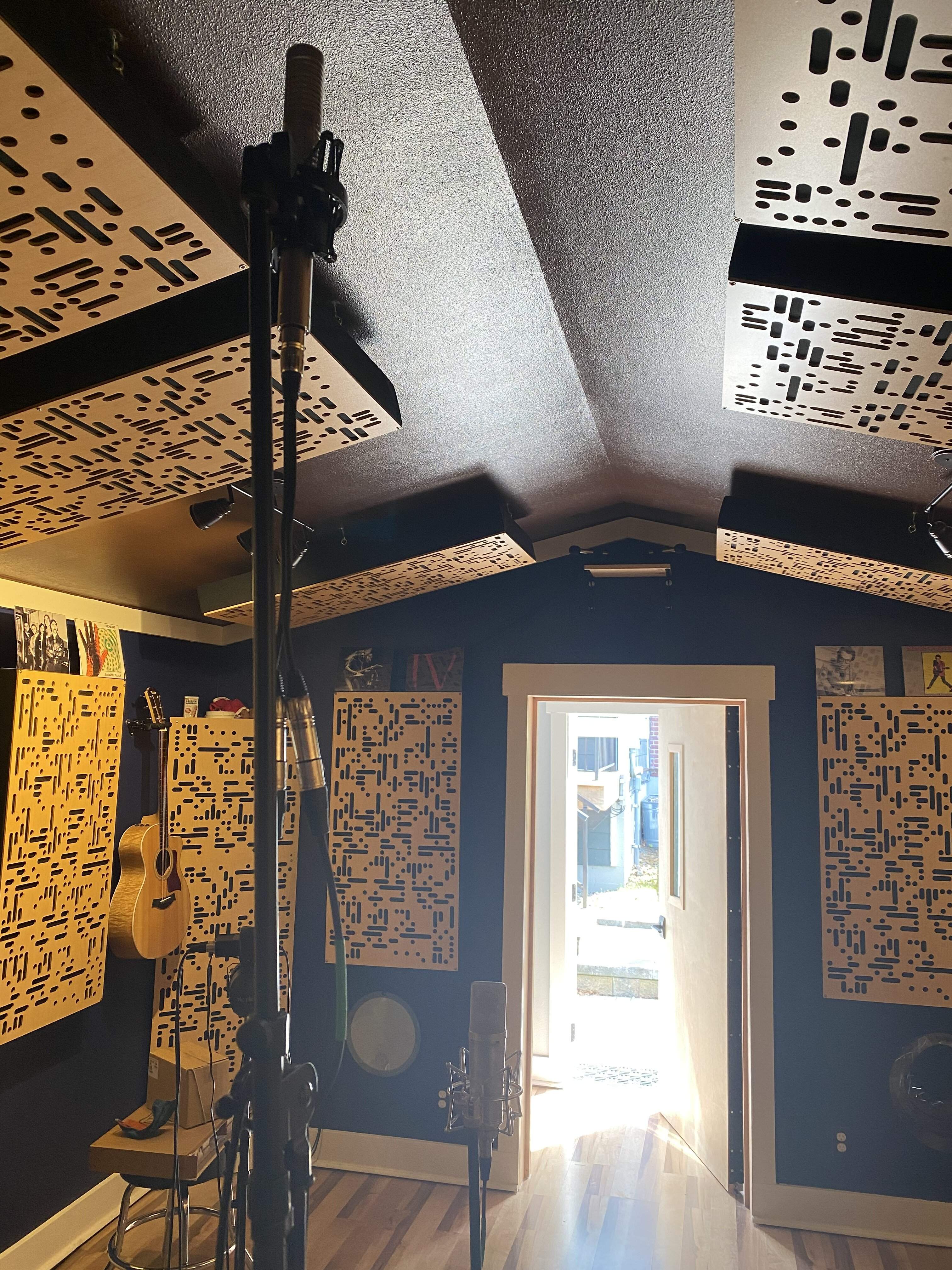
My buddy Chris laying down a take while his bandmates lament not driving separately to the session
Capture was done with a D87 into an 8MP, stereo C02s into an 8MP and an X15 (stereo) into a TransX. Plenty of options for @letsgethandsome when he starts mixing. Hopefully he digs them! Feel free to follow me on Instagram to see the clips I posted tonight, and check out @letsgethandsome on Instagram as well to hear his band and hopefully this track once it’s finished.
D87 for getting a good close mic sound. This is a vintage U87 clone that I built with a buddy who happens to own both a modern U87ai and an actual vintage U87. He recently told me how jealous of this mic he is. To make it better I have a matched stereo pair! I built these with a SYT-5 body, a Microphone-Parts RK-87 capsule, and an AMI Tab Funkenwerk T13 transformer.
Here’s the Cascade X15 stereo ribbon set in line with the D87 but with the mic stand maxed out. Sort of a quasi-Blumlein mic in this arrangement. Really roomy with the sides hard panned left and right. Lots of midrange, minimal bottom end and that smooth roll off up top from the ribbon.
Above the door are a pair of cheapo Samson C02 SDCs with windscreens in an ORTF arrangement. These are my permanent room mics that mostly get used as rehearsal recording mics but for things like this it’s easy to patch them in since they’re permanently flown and wired. Despite their cheapness they sound excellent as long as they’re not used as a close mic for anything with bottom end. In this placement that’s never an issue. Just as roomy as the X15 but being SDC mics it’s a different flavor of roomy. Also being behind the performers you capture more of the reflected sound than the directional sound coming off the horns. More phase to deal with but it’s often just the thing.
My buddy Chris laying down a take while his bandmates lament not driving separately to the session
Last edited:
It’s been a while since I posted a studio update. For those of you that follow my Instagram (aroguestory) you may have seen my stories from tonight laying down some horns. Well as it happens those were for a fellow TB’er. @letsgethandsome hired me to find a horn section and record tracks for a song his band is putting together. It’s sort of an updated and modern take on a yacht rock tune with some cool synths, screaming guitar and very nice bass playing… now it has a five piece horn section too! Well… as soon as I edit the tracks down and send them
Capture was done with a D87 into an 8MP, stereo C02s into an 8MP and an X15 (stereo) into a TransX. Plenty of options for @letsgethandsome when he starts mixing. Hopefully he digs them! Feel free to follow me on Instagram to see the clips I posted tonight, and check out @letsgethandsome on Instagram as well to hear his band and hopefully this track once it’s finished.
D87 for getting a good close mic sound. This is a vintage U87 clone that I built with a buddy who happens to own both a modern U87ai and an actual vintage U87. He recently told me how jealous of this mic he is. To make it better I have a matched stereo pair! I built these with a SYT-5 body, a Microphone-Parts RK-87 capsule, and an AMI Tab Funkenwerk T13 transformer.
View attachment 4265128
Here’s the Cascade X15 stereo ribbon set in line with the D87 but with the mic stand maxed out. Sort of a quasi-Blumlein mic in this arrangement. Really roomy with the sides hard panned left and right. Lots of midrange, minimal bottom end and that smooth roll off up top from the ribbon.
View attachment 4265129
Above the door are a pair of cheapo Samson C02 SDCs with windscreens in an ORTF arrangement. These are my permanent room mics that mostly get used as rehearsal recording mics but for things like this it’s easy to patch them in since they’re permanently flown and wired. Despite their cheapness they sound excellent as long as they’re not used as a close mic for anything with bottom end. In this placement that’s never an issue. Just as roomy as the X15 but being SDC mics it’s a different flavor of roomy. Also being behind the performers you capture more of the reflected sound than the directional sound coming off the horns. More phase to deal with but it’s often just the thing.
View attachment 4265130
My buddy Chris laying down a take while his bandmates lament not driving separately to the session
View attachment 4265131
We’re super excited! I will definitely post the track once it’s done… We’ve been working on vocals over here on our end. It’s a little outside of our vocalists wheelhouse but we’re getting there

My buddy Chris laying down a take while his bandmates lament not driving separately to the session
OK that’s just funny
Previously I had mentioned not wanting to drop a bunch of cash on “money” channels for the time being as I had other higher priority purchases to make. A deal came up on a Heritage Audio TT-73, which is a very highly regarded Neve 1073 clone, and I couldn’t pass it up. It arrived late yesterday so I haven’t had time to even hook it up yet, but by all accounts it does the Neve 1073 thing very well. I’m excited to give it a shot. I have a vocalist coming in tomorrow, so hopefully that will give me an opportunity to put it through its paces.
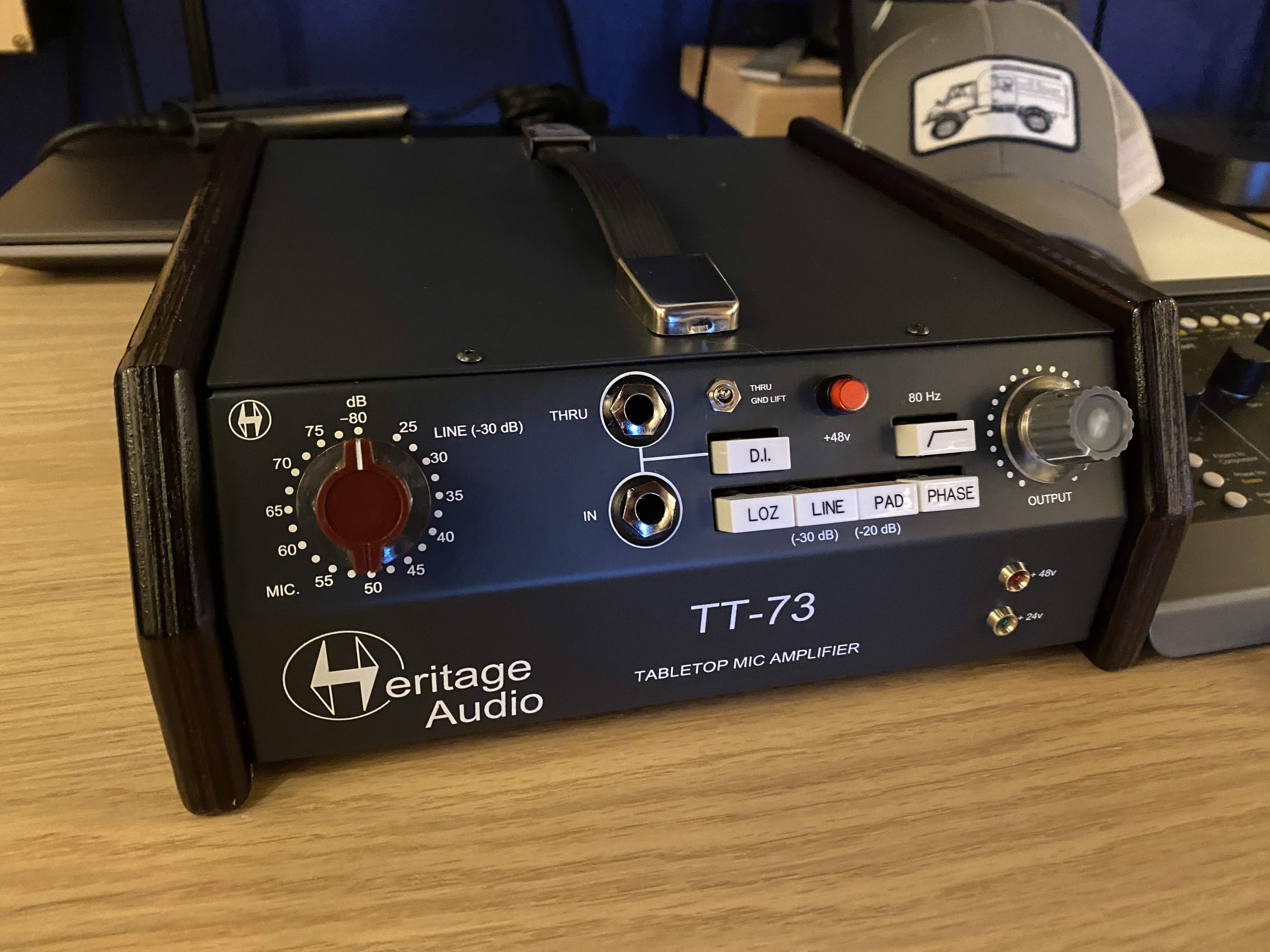
Aaaaaaand now I realize I’m short a 15’ female XLR to TRS cable that I need to connect the output of my new TT-73 to the analog inputs of my 16A 
I could steal one from another preamp channel but then I’d end up replacing that one later. Looks like it’ll be a few days before a new one arrives from Sweetwater and I can demo this fun new toy. It looks good sitting on my desk in the meantime.
I could steal one from another preamp channel but then I’d end up replacing that one later. Looks like it’ll be a few days before a new one arrives from Sweetwater and I can demo this fun new toy. It looks good sitting on my desk in the meantime.

Ok, "like" isn't accurate, but I sure feel your pain!
Plenty of stuff in here is going over my head, but I also can see there is a lot of really incredible reading for me to dig back into. Exciting!
Plenty of stuff in here is going over my head, but I also can see there is a lot of really incredible reading for me to dig back into. Exciting!
Update on the Heritage Audio TT-73 now that I have the missing cable on-hand and have done some testing. It sounds VERY similar to a modern 1073 like the OPX which makes it a little brighter than a vintage 1073. The input gain knob is a little confusing as it operates backwards to how I would anticipate. Rather than being a control to indicate how hard the input is being driven like a gain knob it's more of an indicator of the level coming in. In this case setting it to -80 is hotter than setting it to -25. Effectively this means that at -80 the preamp is expecting to be hit with a fairly low level signal around -80 therefore it's going to push the signal through the preamp at a higher level to compensate. Same result as an input gain knob, just a different way of thinking about it. The output trim is nice for cranking the front end and then trimming it back to an acceptable level before it hits the converters. The DI is very nice on bass. It's a 1073 style preamp, so everything going in has some added weight and thickness to it which works well on bass. Compared to my significantly cheaper Line Audio 8MP (~$100 per channel) and ART TransX (~$245 per channel) it's quite nice for significantly more money ($1,300 per channel). That said it's not a silver bullet. The TransX does a better job of copping that Hardy style preamp vibe where rather than adding thickness and audible saturation it just adds sparkle and some very mild compression. The 8MP is better at being totally linear and allowing for quick setups when session times are limited and I have to rush. If I want to add weight and possible audible saturation on a track, and I have time to dial it in, this TT-73 will be invaluable.
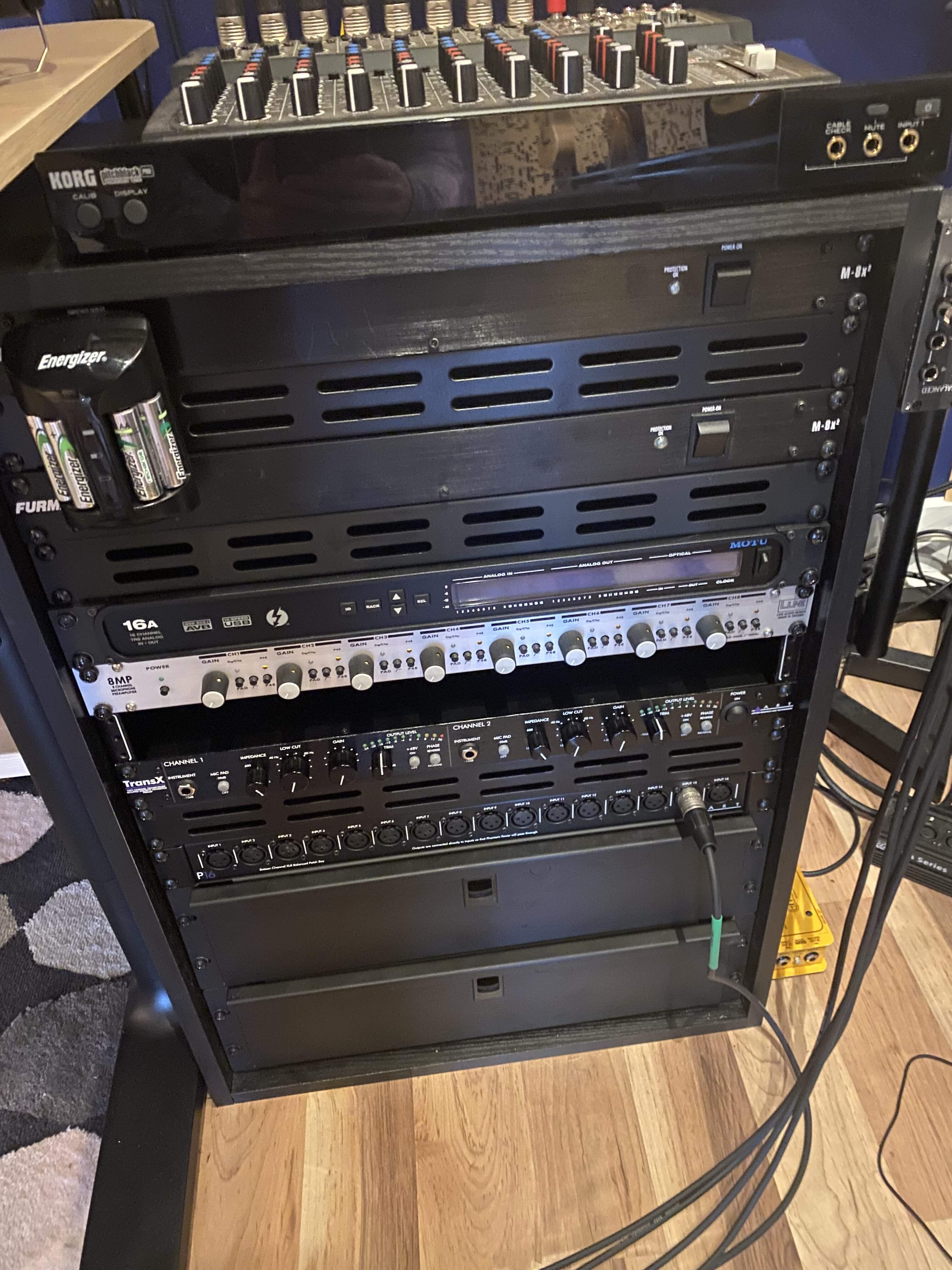
Simplified the rack a bit. Ditched the in-line compressor and added some spaces below the power distribution to make the cabling more tidy. All I need to add is a Vintage Audio M12 MK2 to that blank space, and a UA Solo 610 next to my TT-73 on my desk and I can stop thinking about preamps.
Final update on the TT-73: Did a session with a killer vocalist tonight. Had him about 12-18” off of a D87 in cardioid mode feeding into the TT-73 with its input set to -50 and the output trimmed to peak at -12dbfs on the DAW meters. Maybe the best vocal capture I’ve ever gotten. Just stunning. Thick in all the right spots, present and airy where you want it without it getting spitty. Just stunning. Added some TLA-100 ITB and couldn’t have been happier.
Sounds like some sort of new-age work out.... cardioid mode ...
Just had a fun conversation with a client. He wanted to come in over the weekend and do all of the lead vocals for his record. Knowing that he wouldn't be able to get all of them done for a full length LP in one weekend I went back and listened to all of the scratch vocal tracks he had laid down to begin prioritizing. When doing lots of vocal takes it's important to consider the singer's voice and how it will become degraded after long tracking sessions which will then result in bad takes even if the singer is game to keep going. Upon listening to these scratch vocals it struck me that... wow... these are REALLY good takes. An odd pitchy note here or a timing issue there notwithstanding I've never been happier with the quality of a demo vocal. I went back to him and said "You know, rather than redoing the leads why don't we just punch in the little problem spots and then do doubles where they're needed. It'll take a fraction of the time and won't kill your voice in the process." He of course protested and said that they're just demo vocals. He NEEDED to have final takes done. I'm happy to oblige. It's his money he's lining my bank account with, so who am I to turn him down? Still, I pressured him to take a critical listen to what he had previously recorded. He calls me back an hour later and says "Damn, those are REALLY good takes aren't they?"
Sometimes sessions go really well. So well in fact that they don't even need to happen
Sometimes sessions go really well. So well in fact that they don't even need to happen
Just had a fun conversation with a client. He wanted to come in over the weekend and do all of the lead vocals for his record. Knowing that he wouldn't be able to get all of them done for a full length LP in one weekend I went back and listened to all of the scratch vocal tracks he had laid down to begin prioritizing. When doing lots of vocal takes it's important to consider the singer's voice and how it will become degraded after long tracking sessions which will then result in bad takes even if the singer is game to keep going. Upon listening to these scratch vocals it struck me that... wow... these are REALLY good takes. An odd pitchy note here or a timing issue there notwithstanding I've never been happier with the quality of a demo vocal. I went back to him and said "You know, rather than redoing the leads why don't we just punch in the little problem spots and then do doubles where they're needed. It'll take a fraction of the time and won't kill your voice in the process." He of course protested and said that they're just demo vocals. He NEEDED to have final takes done. I'm happy to oblige. It's his money he's lining my bank account with, so who am I to turn him down? Still, I pressured him to take a critical listen to what he had previously recorded. He calls me back an hour later and says "Damn, those are REALLY good takes aren't they?"
Sometimes sessions go really well. So well in fact that they don't even need to happen
You may make more $ in the long term by positive word of mouth & recommendations, too.


