• TalkBass has been independent since 1998. Add your voice.
    Create a free account to reply to discussions, view embedded media, and browse with fewer display ads.
    Join freeLog in
    Want zero display ads or expanded classifieds tools? Compare plans.

My overly bright bass

This morning during a church set of 4 somewhat mellow songs, I really struggled with string noise from my fingers as I changed chords.

My bass just seemed really bright. It’s an active,jazz looking ESP/LTD. I used a compressor for the first time live, with everything set to 12 noon. There are passive and active input jacks on the amp, and I used the passive in an attempt to soften the sound. Just felt like I was battling the instrument the whole time.

It’s got round wounds on it, so I’m going to try half rounds, which I have seen lots of love and hate for around here. Apart from changing strings and adjusting the tone knobs on the bass itself, are there any other things that I should try? Maybe with the compressor or technique?

Any and all ideas appreciated. I’m new at performing in front of people; it’s much easier to make mistakes and adjustments in my home! Thanks in advance...
Can you cut the treble on the onboard preamp? I've never played an active bass with a boost/cut preamp that didn't mellow out with a good roll off of the treble knob.
 
  • Like
Reactions: Korladis
Seems like you didn't read the title of the thread "my overly bright bass" or this sentence of the OP, "My bass just seemed really bright."

Of course a compressor will make fret and handling noise louder. I've never suggested otherwise.

No idea why you're being snarky, you seemed genuinely confused why people kept mentioning the compressor.

Sentences like "I really struggled with string noise from my fingers as I changed chords." and "I used a compressor for the first time live, with everything set to 12 noon." are why people kept mentioning the compressor.
 
I do know what the function of a compressor is. It was recommended to me by the other bassist at the church, to control how quickly a note registers and how long it sustains after being played. I picked up a MXR M87 off of CL and was hoping that it would help to mask some of my inadequacies as I learn and improve. I had some issues powering it, as the daisy chain that I purchased to power it (and an EH Big Muff Pi that I borrowed for one of the songs that required distortion) was not supplying adequate power. It wouldn't stay on at home, regardless of which connections I tried. So I didn't have as much time to manipulate the settings as I would like. I left everything at noon, knowing that it probably wasn't doing anything, but thinking that it wouldn't hurt to eliminate the extremes. I appreciate the thoughts on that pedal, and I'll definitely dial it in or simply put it away for next time (in two weeks).

That's really not how a compressor works.

Compression actually makes sloppy technique MORE noticeable, because by reducing the peaks of the very loudest sounds, those quieter sounds (sloppy fretting, string noise, etc.) become louder in context.

Leaving the controls at noon also more than likely means a higher ratio, as well as faster attack and slower release times, that what you'd probably want.

Definitely take the time to learn how it works and if you like how it effects your sound before using it live again :thumbsup:
 
i didn't read all the replies, and i'm sure someone already suggested this, but i had a tele, and the darn thing was so bright it was way past twangy. i screwed the pickups down further from the strings, and it helped a ton. then i changed, amps, then i changed cables, then i changed guitars...haha, just kidding. moving the pickups away helped quite a bit.
 
  • Like
Reactions: saabfender
No idea why you're being snarky
I was just responding in kind. Didn't notice you calling out anyone who suggest flatwounds.

The OP clearly has a couple things going wrong. It's all just for fun and trying to help that guy anyway. No offense.
i didn't read all the replies, and i'm sure someone already suggested this, but i had a tele, and the darn thing was so bright it was way past twangy. i screwed the pickups down further from the strings, and it helped a ton. then i changed, amps, then i changed cables, then i changed guitars...haha, just kidding. moving the pickups away helped quite a bit.
Why yes I did.
 
Probably worth noting that not all active basses have passive tone controls and many times rely on a treble boost/cut to do a job that it really can’t if the frequency points are designed too high, at which point the treble and mid controls won’t be much help anyway. Unfortunately, that leaves the amp to do the heavy EQ lifting, and it can only work with what it’s being given.
 
I'm gonna join the club that says the compressor is the likely culprit, when I first started using a compressor I had the same thing, it increased the level of string noise. It wasn't a huge surprise, the trick was what to do about it.

My solution was similar, on my J I used to favor the neck pickup, switched to favoring the bridge pickup to kill the string noise. I also dialed the compressor down a bit. And I also worked on my technique a bit, in my case it was clankiness that got amplified.

So switching to strings that make less string noise is one way to go.
 
  • Like
Reactions: Big Jelly
I was just responding in kind. Didn't notice you calling out anyone who suggest flatwounds.

The OP clearly has a couple things going wrong. It's all just for fun and trying to help that guy anyway. No offense.
Why yes I did.

I didn't "call out" anyone; the context of your reply indicated you'd either only read the title before responding, or missed the sections of the OP that discussed the obvious compressor issues.

As to your original question, any of the Cali compressors can add noticeable brightness to the tone/transients, as will the Diamond, depending on how they are set; there may be others as well, but those are the models I've tried that fit the mold you were asking for.
 
Last edited:
Boys. Boysboysboys. You're both pretty.

Not as pretty as a Cali compressor, that's for sure...especially the Cali76 TX-LP :cool:

Origin-Effects-Cali76-STD-TX-LP-Review-Best-Compression-Pedals-10.jpg
 
Thank you for the helpful and humorous responses.
I didn't expect this level of scrutiny or assistance, and all of it is welcome.

I'll try and answer the myriad of questions as best as I can, but I think where I truly messed up is plugging into the passive input on the bass head.
------------
I do know what the function of a compressor is. It was recommended to me by the other bassist at the church, to control how quickly a note registers and how long it sustains after being played. I picked up a MXR M87 off of CL and was hoping that it would help to mask some of my inadequacies as I learn and improve. ... So I didn't have as much time to manipulate the settings as I would like. I left everything at noon, knowing that it probably wasn't doing anything, but thinking that it wouldn't hurt to eliminate the extremes.
--------------
I did not mess with the tone knob on my bass. I am uncomfortable at this point making adjustments on the fly or even during rehearsal, as I'm not totally familiar with what effect it will have to change the tone or rearrange which pickup is being used. So I set it at home while practicing to what I think sounds good, and then just leave everything as it is for the performance. Brutal honesty there, so be gentle. I'm sure a more experienced bassist would have no issue spinning tone knobs like a DJ. Maybe adjusting the tone on the fly would have solved it, but I didn't want to do something that would be distracting to people trying to worship.

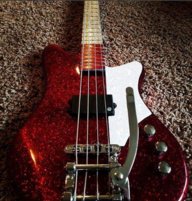
View attachment 2921577 Here's my bass. Thought that would help, if only to ensure that we aren't discussing carrots.
A couple of additional thoughts on the points in bold above... like others I'm sure that the comptrssor and its settings either caused the issues or, at least, made them worse. You mentioned leaving all the compressor controls on 12 noon - that's not like an active bass//amp EQ where that's a neutral, uneffected setting - that's actually going to be a relatively significant level of compression. Compression is one of those effects you really need to understand and understand how the controls work and interact before you use it. For context, I used a compressor for the first five or so years of my playing because I "thought I should"/"thought I ought/needed to". Eventually realised that it wasn't really achieving anything for me and I haven't used one in about the last 25 years. Just don't miss it!

A few thoughts on your reluctance to adjust bass tone controls on the fly. This is really a more immediate priority for you to get on top of and will provide you with more benefit than most other things. Again, the tone controls are there to "spin like a DJ" (love that! :) ), they are controls which give you the ability to adjust your sound to suit. And a pretty common bass player mantra is "If it sounds good in your bedroom it probably doesn't sound good in the band!!" So it's kinda a given. I've been having a look at your bass and it looks like a pretty cool model. Good quality and lots of flexibility. I don't know ho much you know about it but it looks pretty much like this model in a natural finish...

ESP LTD Surveyor-4 Electric Bass Guitar
Invalid Link Removed
http://www.musiciansfriend.com/bass/open-box-esp-ltd-surveyor-4-electric-bass-guitar

Nice! So it looks like the controls you've got on the bass are as follows...
Controls
  • Master Volume
  • Balance (pickup blend control)
  • Treble Boost/Cut
  • Mid Boost/Cut
  • Bass Boost/Cut
  • Mini Switch Coil Tap (Bridge Pickup)
It's worth experimenting with what each one does and getting to know them. I'm not clear which two controls the stacked knob is but is you spend time with them that should become clear. As a general rule, I'd mostly leave them centered and only adjust them as much as needed to achieve your desired result, using the minimum levels of boost and cut you can. When you know what each one does it should be straightforward to reduce the treble knob (or maybe the mid knob) a little to reduce string noise and bite.

As an aside, it looks like your mini switch (presuming you have this active circuit - and it looks like you do) is not an active/passive switch (like I think you mentioned somewhere in the thread). Rather it's a "coil tap". This will either turn off one of the coils on your bridge humbucker, giving it a thinner less bassy tone or reduce the number of coils being used on the pickup to give a less punchy, loud tone. Hard to know. "Coil tap" gets used randomly for both those applications even though only the second one is ACTUALLY coil tapping.

And finally, do also work on your left hand technique to increase the precision of your fretting movements and reduce the amount of string noise when you change notes. Again, that will improve not just your tone but your overall playing ability more than solutions like changing strings to flats etc.
 
  • Like
Reactions: Big Jelly
So....

You should be using the active input. It has nothing to do with "softening the sound", it lowers the gain so you don't distort the preamp stage of your head.

Regarding the use of the active input or not... I feel they're wrongly labelled. They should be high and low level or something similar. The active input has an attenuator, it assumes active = higher output bass, which is just not true.

Active and passive basses come in a range of output levels, which overlap by quite some margin. The G&L L2000 is probably one of the hottest basses I ever had, even in passive mode. I have a Precision with Entwistle neodymium pickups and it's the loudest thing I own. Passive. My lowest output bass is a passive Jazz too. My two Stingrays (active) are somewhere in the middle, with similar outputs to any of my other passive basses... etc.

I'd always try "passive" (i.e.: non-attenuated) input first, regardless whether it's an active or a passive bass. If it overloads the preamp and distorts and I cannot adjust the input gain... then and only then switch to "active". You'll find that most instruments are quite happy on the "passive" input (unless you use a crazy bass boost on your active or something like that)
 
Regarding the use of the active input or not... I feel they're wrongly labelled. They should be high and low level or something similar. The active input has an attenuator, it assumes active = higher output bass, which is just not true.

Active and passive basses come in a range of output levels, which overlap by quite some margin. The G&L L2000 is probably one of the hottest basses I ever had, even in passive mode. I have a Precision with Entwistle neodymium pickups and it's the loudest thing I own. Passive. My lowest output bass is a passive Jazz too. My two Stingrays (active) are somewhere in the middle, with similar outputs to any of my other passive basses... etc.

I'd always try "passive" (i.e.: non-attenuated) input first, regardless whether it's an active or a passive bass. If it overloads the preamp and distorts and I cannot adjust the input gain... then and only then switch to "active". You'll find that most instruments are quite happy on the "passive" input (unless you use a crazy bass boost on your active or something like that)
 
That's really not how a compressor works.

Compression actually makes sloppy technique MORE noticeable, because by reducing the peaks of the very loudest sounds, those quieter sounds (sloppy fretting, string noise, etc.) become louder in context.

Leaving the controls at noon also more than likely means a higher ratio, as well as faster attack and slower release times, that what you'd probably want.

Definitely take the time to learn how it works and if you like how it effects your sound before using it live again :thumbsup:

100% this. Thank you, MDBass, and everyone else, for your direction on the compressor.

Since last I posted, I purchased a boss chromatic tuner pedal for muting and tuning.
I should have done that a long time ago.

I also took some time to mess around with all of the control knobs to better understand what each does. Thanks, Trevor, for the encouragement in that regard.

Most importantly, I put the compressor away for now.

I played yesterday morning at church, and it went great. Besides not bringing the compressor to the party, I used the active input on the bass head, as many advised.
I was better able to control my tone, and had practiced significantly which really boosted my confidence. Thank you all for steering me in the right direction!