• TalkBass has been independent since 1998. Add your voice.
    Create a free account to reply to discussions, view embedded media, and browse with fewer display ads.
    Join freeLog in
    Want zero display ads or expanded classifieds tools? Compare plans.

My overly bright bass

1. Put your credit card back in your wallet and log off Musician’s Friend. Buying new gear is a TB default to solve any problem and 90% of the time it’s wrong answer.

2. Set everything flat on your bass and on the amplifier, lose the compressor, and take the time to figure out what the EQ knobs actually do.

3. Improve your technique.

My God, I can’t believe it took so long for someone to give this advice!! Yes, do the above and listen to no one else until you have done these things!!!!!!

This whole worn out bit of, “try flats” is as old as “fire the drummer.”
 
This morning during a church set of 4 somewhat mellow songs, I really struggled with string noise from my fingers as I changed chords.

My bass just seemed really bright. It’s an active,jazz looking ESP/LTD. I used a compressor for the first time live, with everything set to 12 noon. There are passive and active input jacks on the amp, and I used the passive in an attempt to soften the sound. Just felt like I was battling the instrument the whole time.

It’s got round wounds on it, so I’m going to try half rounds, which I have seen lots of love and hate for around here. Apart from changing strings and adjusting the tone knobs on the bass itself, are there any other things that I should try? Maybe with the compressor or technique?

Any and all ideas appreciated. I’m new at performing in front of people; it’s much easier to make mistakes and adjustments in my home! Thanks in advance...
Drop your treble EQ at least to flat or a couple of notches down from flat and it will get rid of a LOT of string noise. Good news is that the string noise usually gets lost in the mix unless you are right next to the speakers. Dial down that treble a bit and give her another go.
 
  • Like
Reactions: Korladis
Thank you for the helpful and humorous responses.
I didn't expect this level of scrutiny or assistance, and all of it is welcome.

I'll try and answer the myriad of questions as best as I can, but I think where I truly messed up is plugging into the passive input on the bass head.
------------
I do know what the function of a compressor is. It was recommended to me by the other bassist at the church, to control how quickly a note registers and how long it sustains after being played. I picked up a MXR M87 off of CL and was hoping that it would help to mask some of my inadequacies as I learn and improve. I had some issues powering it, as the daisy chain that I purchased to power it (and an EH Big Muff Pi that I borrowed for one of the songs that required distortion) was not supplying adequate power. It wouldn't stay on at home, regardless of which connections I tried. So I didn't have as much time to manipulate the settings as I would like. I left everything at noon, knowing that it probably wasn't doing anything, but thinking that it wouldn't hurt to eliminate the extremes. I appreciate the thoughts on that pedal, and I'll definitely dial it in or simply put it away for next time (in two weeks).
--------------
The strings are plain old rounds, and they have been on the bass since I bought it used two + years ago. For all I know, they are original to the bass. The bass was in pristine condition, so I didn't think I needed to replace them at the time, and haven't since. They have been fine in the past. I have always wondered if I should replace them, as I don't know their origin or age, but they stay in tune and are what I am used to.
---------------
The signal chain is bass-compressor-muff pi-bass head which is also connected to the PA, and plays through several monstrous speaker enclosures hanging from the ceiling. The room looks like a large theatre in the round and holds around 500 people. In the past, I skipped the pedals and went straight into the head, but I'm not sure if I plugged into active or passive input. I don't manipulate the settings on the head, and just leave the master at 9 AM. My bass has a switch that can toggle that as well. I usually keep it active, but felt like this time it really emphasized every single hand movement. FWIW, the other bassist was in the crowd and he noticed that it was loud as well.
-----------
There is a sound booth, and they have full control back there. The guy can change anything he wants to and can lock into any single frequency/instrument. We had two singers, two guitarists, drummer, keys, and me.
----------
I did not mess with the tone knob on my bass. I am uncomfortable at this point making adjustments on the fly or even during rehearsal, as I'm not totally familiar with what effect it will have to change the tone or rearrange which pickup is being used. So I set it at home while practicing to what I think sounds good, and then just leave everything as it is for the performance. Brutal honesty there, so be gentle. I'm sure a more experienced bassist would have no issue spinning tone knobs like a DJ. Maybe adjusting the tone on the fly would have solved it, but I didn't want to do something that would be distracting to people trying to worship.
-------------
I hit all of my notes correctly this time, so I was pumped about that. I just had a lot of issues muting strings and with noisy transitions. I've played several other times and made mistakes with playing the wrong note a few times, but didn't have the same brightness issues. This time was definitely different, and apart from the mistake with the input jack, the only other new variables that were added were the two pedals.
--------
LOL to the guy who told me to put my credit card back in my wallet and step away from MF (Sweetwater!). I did order a Boss tuner pedal, because simply holding my strings was insufficient to mute them this weekend, and my scratchy volume knob is awful to turn down. I'll be muting myself with that during segments of songs where I'm not supposed to play, as opposed to just using my hands to mute the strings.

I hope that answers some of the questions that folks had as they diagnose my issue. I really appreciate everyone's thoughts. Again, I'm new to this, and trying to improve. It took a few years of practice to get to the point where I was adequate enough to play with this group. I appreciate the expertise and experience on here. Thanks all...

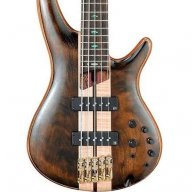
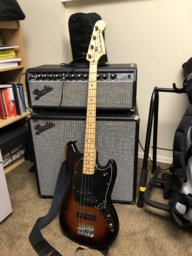
IMG_5219.JPG.JPG Here's my bass. Thought that would help, if only to ensure that we aren't discussing carrots.
 
  • Like
Reactions: MDBass and Hercules
Thank you for the helpful and humorous responses.
I didn't expect this level of scrutiny or assistance, and all of it is welcome.

I'll try and answer the myriad of questions as best as I can, but I think where I truly messed up is plugging into the passive input on the bass head.
------------
I do know what the function of a compressor is. It was recommended to me by the other bassist at the church, to control how quickly a note registers and how long it sustains after being played. I picked up a MXR M87 off of CL and was hoping that it would help to mask some of my inadequacies as I learn and improve. I had some issues powering it, as the daisy chain that I purchased to power it (and an EH Big Muff Pi that I borrowed for one of the songs that required distortion) was not supplying adequate power. It wouldn't stay on at home, regardless of which connections I tried. So I didn't have as much time to manipulate the settings as I would like. I left everything at noon, knowing that it probably wasn't doing anything, but thinking that it wouldn't hurt to eliminate the extremes. I appreciate the thoughts on that pedal, and I'll definitely dial it in or simply put it away for next time (in two weeks).
--------------
The strings are plain old rounds, and they have been on the bass since I bought it used two + years ago. For all I know, they are original to the bass. The bass was in pristine condition, so I didn't think I needed to replace them at the time, and haven't since. They have been fine in the past. I have always wondered if I should replace them, as I don't know their origin or age, but they stay in tune and are what I am used to.
---------------
The signal chain is bass-compressor-muff pi-bass head which is also connected to the PA, and plays through several monstrous speaker enclosures hanging from the ceiling. The room looks like a large theatre in the round and holds around 500 people. In the past, I skipped the pedals and went straight into the head, but I'm not sure if I plugged into active or passive input. I don't manipulate the settings on the head, and just leave the master at 9 AM. My bass has a switch that can toggle that as well. I usually keep it active, but felt like this time it really emphasized every single hand movement. FWIW, the other bassist was in the crowd and he noticed that it was loud as well.
-----------
There is a sound booth, and they have full control back there. The guy can change anything he wants to and can lock into any single frequency/instrument. We had two singers, two guitarists, drummer, keys, and me.
----------
I did not mess with the tone knob on my bass. I am uncomfortable at this point making adjustments on the fly or even during rehearsal, as I'm not totally familiar with what effect it will have to change the tone or rearrange which pickup is being used. So I set it at home while practicing to what I think sounds good, and then just leave everything as it is for the performance. Brutal honesty there, so be gentle. I'm sure a more experienced bassist would have no issue spinning tone knobs like a DJ. Maybe adjusting the tone on the fly would have solved it, but I didn't want to do something that would be distracting to people trying to worship.
-------------
I hit all of my notes correctly this time, so I was pumped about that. I just had a lot of issues muting strings and with noisy transitions. I've played several other times and made mistakes with playing the wrong note a few times, but didn't have the same brightness issues. This time was definitely different, and apart from the mistake with the input jack, the only other new variables that were added were the two pedals.
--------
LOL to the guy who told me to put my credit card back in my wallet and step away from MF (Sweetwater!). I did order a Boss tuner pedal, because simply holding my strings was insufficient to mute them this weekend, and my scratchy volume knob is awful to turn down. I'll be muting myself with that during segments of songs where I'm not supposed to play, as opposed to just using my hands to mute the strings.

I hope that answers some of the questions that folks had as they diagnose my issue. I really appreciate everyone's thoughts. Again, I'm new to this, and trying to improve. It took a few years of practice to get to the point where I was adequate enough to play with this group. I appreciate the expertise and experience on here. Thanks all...

View attachment 2921577 Here's my bass. Thought that would help, if only to ensure that we aren't discussing carrots.
I think a good exercise would be to set your bass' onboard eq flat, crank the amps bass knob and then turn the other eq down to zero. Then you can experiment adding mids and highs to your tone.
 
You will read on this forum many guys who get a new bass or a new amp or a new cab and suddenly hear all the mistakes they are making. You just went through this. Work on you technique and the fret noise will go away. It's all part of the master plan. (lol)
 
Thank you for the helpful and humorous responses.
I didn't expect this level of scrutiny or assistance, and all of it is welcome.

I'll try and answer the myriad of questions as best as I can, but I think where I truly messed up is plugging into the passive input on the bass head.
------------
I do know what the function of a compressor is. It was recommended to me by the other bassist at the church, to control how quickly a note registers and how long it sustains after being played. I picked up a MXR M87 off of CL and was hoping that it would help to mask some of my inadequacies as I learn and improve. I had some issues powering it, as the daisy chain that I purchased to power it (and an EH Big Muff Pi that I borrowed for one of the songs that required distortion) was not supplying adequate power. It wouldn't stay on at home, regardless of which connections I tried. So I didn't have as much time to manipulate the settings as I would like. I left everything at noon, knowing that it probably wasn't doing anything, but thinking that it wouldn't hurt to eliminate the extremes. I appreciate the thoughts on that pedal, and I'll definitely dial it in or simply put it away for next time (in two weeks).
--------------
The strings are plain old rounds, and they have been on the bass since I bought it used two + years ago. For all I know, they are original to the bass. The bass was in pristine condition, so I didn't think I needed to replace them at the time, and haven't since. They have been fine in the past. I have always wondered if I should replace them, as I don't know their origin or age, but they stay in tune and are what I am used to.
---------------
The signal chain is bass-compressor-muff pi-bass head which is also connected to the PA, and plays through several monstrous speaker enclosures hanging from the ceiling. The room looks like a large theatre in the round and holds around 500 people. In the past, I skipped the pedals and went straight into the head, but I'm not sure if I plugged into active or passive input. I don't manipulate the settings on the head, and just leave the master at 9 AM. My bass has a switch that can toggle that as well. I usually keep it active, but felt like this time it really emphasized every single hand movement. FWIW, the other bassist was in the crowd and he noticed that it was loud as well.
-----------
There is a sound booth, and they have full control back there. The guy can change anything he wants to and can lock into any single frequency/instrument. We had two singers, two guitarists, drummer, keys, and me.
----------
I did not mess with the tone knob on my bass. I am uncomfortable at this point making adjustments on the fly or even during rehearsal, as I'm not totally familiar with what effect it will have to change the tone or rearrange which pickup is being used. So I set it at home while practicing to what I think sounds good, and then just leave everything as it is for the performance. Brutal honesty there, so be gentle. I'm sure a more experienced bassist would have no issue spinning tone knobs like a DJ. Maybe adjusting the tone on the fly would have solved it, but I didn't want to do something that would be distracting to people trying to worship.
-------------
I hit all of my notes correctly this time, so I was pumped about that. I just had a lot of issues muting strings and with noisy transitions. I've played several other times and made mistakes with playing the wrong note a few times, but didn't have the same brightness issues. This time was definitely different, and apart from the mistake with the input jack, the only other new variables that were added were the two pedals.
--------
LOL to the guy who told me to put my credit card back in my wallet and step away from MF (Sweetwater!). I did order a Boss tuner pedal, because simply holding my strings was insufficient to mute them this weekend, and my scratchy volume knob is awful to turn down. I'll be muting myself with that during segments of songs where I'm not supposed to play, as opposed to just using my hands to mute the strings.

I hope that answers some of the questions that folks had as they diagnose my issue. I really appreciate everyone's thoughts. Again, I'm new to this, and trying to improve. It took a few years of practice to get to the point where I was adequate enough to play with this group. I appreciate the expertise and experience on here. Thanks all...

View attachment 2921577 Here's my bass. Thought that would help, if only to ensure that we aren't discussing carrots.
From what I read here, you need to spend quality time learning what the controls on your bass do, as well as those on the amp you use. As you appear to not be technically up on that stuff, I would ditch any extraneous gear (pedals, compressors, etc.) until you have a total grasp on the basics, first.

Good luck on the journey to understanding your gear. It's not hard but you do need to do so.
 
Thank you for the helpful and humorous responses.
I didn't expect this level of scrutiny or assistance, and all of it is welcome.

I'll try and answer the myriad of questions as best as I can, but I think where I truly messed up is plugging into the passive input on the bass head.
------------
I do know what the function of a compressor is. It was recommended to me by the other bassist at the church, to control how quickly a note registers and how long it sustains after being played. I picked up a MXR M87 off of CL and was hoping that it would help to mask some of my inadequacies as I learn and improve. I had some issues powering it, as the daisy chain that I purchased to power it (and an EH Big Muff Pi that I borrowed for one of the songs that required distortion) was not supplying adequate power. It wouldn't stay on at home, regardless of which connections I tried. So I didn't have as much time to manipulate the settings as I would like. I left everything at noon, knowing that it probably wasn't doing anything, but thinking that it wouldn't hurt to eliminate the extremes. I appreciate the thoughts on that pedal, and I'll definitely dial it in or simply put it away for next time (in two weeks).
--------------
The strings are plain old rounds, and they have been on the bass since I bought it used two + years ago. For all I know, they are original to the bass. The bass was in pristine condition, so I didn't think I needed to replace them at the time, and haven't since. They have been fine in the past. I have always wondered if I should replace them, as I don't know their origin or age, but they stay in tune and are what I am used to.
---------------
The signal chain is bass-compressor-muff pi-bass head which is also connected to the PA, and plays through several monstrous speaker enclosures hanging from the ceiling. The room looks like a large theatre in the round and holds around 500 people. In the past, I skipped the pedals and went straight into the head, but I'm not sure if I plugged into active or passive input. I don't manipulate the settings on the head, and just leave the master at 9 AM. My bass has a switch that can toggle that as well. I usually keep it active, but felt like this time it really emphasized every single hand movement. FWIW, the other bassist was in the crowd and he noticed that it was loud as well.
-----------
There is a sound booth, and they have full control back there. The guy can change anything he wants to and can lock into any single frequency/instrument. We had two singers, two guitarists, drummer, keys, and me.
----------
I did not mess with the tone knob on my bass. I am uncomfortable at this point making adjustments on the fly or even during rehearsal, as I'm not totally familiar with what effect it will have to change the tone or rearrange which pickup is being used. So I set it at home while practicing to what I think sounds good, and then just leave everything as it is for the performance. Brutal honesty there, so be gentle. I'm sure a more experienced bassist would have no issue spinning tone knobs like a DJ. Maybe adjusting the tone on the fly would have solved it, but I didn't want to do something that would be distracting to people trying to worship.
-------------
I hit all of my notes correctly this time, so I was pumped about that. I just had a lot of issues muting strings and with noisy transitions. I've played several other times and made mistakes with playing the wrong note a few times, but didn't have the same brightness issues. This time was definitely different, and apart from the mistake with the input jack, the only other new variables that were added were the two pedals.
--------
LOL to the guy who told me to put my credit card back in my wallet and step away from MF (Sweetwater!). I did order a Boss tuner pedal, because simply holding my strings was insufficient to mute them this weekend, and my scratchy volume knob is awful to turn down. I'll be muting myself with that during segments of songs where I'm not supposed to play, as opposed to just using my hands to mute the strings.

I hope that answers some of the questions that folks had as they diagnose my issue. I really appreciate everyone's thoughts. Again, I'm new to this, and trying to improve. It took a few years of practice to get to the point where I was adequate enough to play with this group. I appreciate the expertise and experience on here. Thanks all...

View attachment 2921577 Here's my bass. Thought that would help, if only to ensure that we aren't discussing carrots.

A tuner pedal is a good thing to have, but it’s not meant to be a mute pedal to cover a noisy instrument. It’s just not a thing normally done. A $10 can of contact cleaner could fix that scratchy pot in about 2 minutes. Sometimes fully rotating the knob back and forth for a few dozen turns will work too.
 
This morning during a church set of 4 somewhat mellow songs, I really struggled with string noise from my fingers as I changed chords.

My bass just seemed really bright. It’s an active,jazz looking ESP/LTD. I used a compressor for the first time live, with everything set to 12 noon. There are passive and active input jacks on the amp, and I used the passive in an attempt to soften the sound. Just felt like I was battling the instrument the whole time.

It’s got round wounds on it, so I’m going to try half rounds, which I have seen lots of love and hate for around here. Apart from changing strings and adjusting the tone knobs on the bass itself, are there any other things that I should try? Maybe with the compressor or technique?

Any and all ideas appreciated. I’m new at performing in front of people; it’s much easier to make mistakes and adjustments in my home! Thanks in advance...

Set the volume controls on the bass at 80%, set your onboard EQ to flat. Then incrementally roll off the highs until you get to where you are comfortable. If you are still squawking and clacking, check out the Tone settings on your amp I’m fairly certain you have an EQ issue, not a string issue.
 
  • Like
Reactions: TrevorR
Long post... My bad... I'm bored... Just trying to help a newbie out...
Any and all ideas appreciated. I’m new at performing in front of people; it’s much easier to make mistakes and adjustments in my home! Thanks in advance...
Your first mistake is in thinking that playing in front of a crowd of people is somehow different or more demanding on you than playing at home. Just relax and play your parts to the best of your ability. What happens, happens. You either hit every mark just perfect or you make a mistake or two... I have played guitar and bass in front of crowds of up to tens of thousands for over 40 years, and I still make the occasional goof from time to time. The trick is to learn to hide it, blow it off like it never happened, and continue on as if you meant to do that...

It was recommended to me by the other bassist at the church, to control how quickly a note registers and how long it sustains after being played
Your second mistake is in trying to rely on gadgets, technology and on the advice of other people to get to where you want to be and have the "sound" you want from your instrument. As you learn different techniques you will be able to do all of this and more without any devices. I played almost every weekend or more for about 30 years and I never used anything but a wireless or cord straight to the amp. (I never played a song that required distortion on the bass so I can't relate to that.)

The strings are plain old rounds, and they have been on the bass since I bought it used two + years ago. For all I know, they are original to the bass. The bass was in pristine condition, so I didn't think I needed to replace them at the time, and haven't since.
Since I discovered them, I never used anything but La Bella deep talkin bass roundwounds on my vintage 62 Fender Jazz (passive) or my 89 Fender PJ (active). When I was playing steady 5 nights a week I would change them about every 6 months or when I could no longer detect the bright highlights from the stings. (I used a 4x10 or 8x10 cab with the same amp and could still get a sound I liked out of either with minor EQ adjustments.) Some people prefer a more dull almost muffled sound and some people like a brighter more intense crisp sound... meh... It depends on the song... You might try several different types of strings before you find the ones that have the sound you want to hear coming from your amp...

The signal chain is bass-compressor-muff pi-bass head which is also connected to the PA, and plays through several monstrous speaker enclosures hanging from the ceiling.
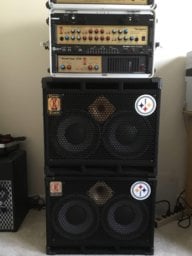
You did not say whether or not you are using a speaker cabinet as a monitor or relying on floor wedges or in ear monitors??? If you are using that little cabinet in the picture with your bass as your monitor I really hope you have it up on a table or something so that it is up between your elbow and shoulder. Or if you are sitting in a chair it is sitting in one right behind you...
There is no need for you to worry about what goes out to the PA other than if the output is pre or post EQ. (Pre EQ is always preferred to a good sound engineer.) As long as you don't turn any knobs on your bass drastically one way or another a competent sound person should be able to get a sound that is best for the overall mix. (Not your problem so don't worry about it...)

I did not mess with the tone knob on my bass. I am uncomfortable at this point making adjustments on the fly or even during rehearsal, as I'm not totally familiar with what effect it will have to change the tone or rearrange which pickup is being used. So I set it at home while practicing to what I think sounds good, and then just leave everything as it is for the performance. Brutal honesty there, so be gentle. I'm sure a more experienced bassist would have no issue spinning tone knobs like a DJ. Maybe adjusting the tone on the fly would have solved it, but I didn't want to do something that would be distracting to people trying to worship.
Not knowing what changes the controls on your bass make to your sound is like being a mechanic and not knowing what size wrench you need or what a socket is... You have to turn the knobs until you understand what changes they make in the sound you get from your bass. Don't make drastic changes between songs unless the sound guy is really on top of it because it can drastically change the sound in the mix. (Once you find a sound that works in the church, make notes as to your settings so that you can dial it back to the same basic settings the next time you play there.)
I found after many years that the only knob I needed to turn on a regular basis was the volume. It was either all the way up (While playing.) or all the way down (While sitting on the stand.). Everything else was accomplished with years of practice and technique including tone variations to a large extent. (Where and how I plucked the string.)

my scratchy volume knob is awful to turn down
You need to fix this ASAP... Take it to a local guitar repair place and have the pots cleaned if you are not comfortable with doing it yourself (You MUST have the right cleaner.). It should only cost a few bucks and it would be well worth the effort... My local guy does mine for free while I wait...

To sum it up... Ditch the pedals except the tuner and maybe the distortion if you need it. Practice, practice, practice!!!
Turn your amp EQs to 0 (No boost, no gain.). Turn the knobs on your bass until you fully understand what they do (Get them cleaned.) then work on the amp settings. Don't expect the sound you hear at home when you practice to be anywhere close to what you will hear when you play in the church building. When you move any instrument to a new environment you will get a totally different sound or tone as a lot of people here like to call it. Put your speaker in roughly the same position at home as it will be in at the church if possible, but remember it will not sound exactly the same regardless. Don't go turning knobs on your bass from song to song without a very good reason. (Use the force Luke.)
I could go on and on and on, but I think I've written enough for today...

Oh... Nice carrot BTW
 
Last edited:
I'm aware of no compressor that makes the tone brighter, esp. to point of being overly-bright. Not being a jerk but if you know one that does, what is it so I can look into it. Compressors shave off transients, which is where most of the high frequency content lives. Ones that minimize this loss or downplay it in attractive ways are typically "good" compressors. Ones that minimize it ways characterized as dull or cloudy are typically "Behringer" compressors.

Seriously, I'd like to find one that makes a bass guitar tone bright.

Seems like you didn't read the OP carefully: he had an issue with fret noise, and a compressor set incorrectly will absolutely make that issue worse.

Also, simply saying that he had his controls "at noon" implies that he doesn't really understand how the controls work.
 
  • Like
Reactions: Korladis
This morning during a church set of 4 somewhat mellow songs, I really struggled with string noise from my fingers as I changed chords.

My bass just seemed really bright. It’s an active,jazz looking ESP/LTD. I used a compressor for the first time live, with everything set to 12 noon. There are passive and active input jacks on the amp, and I used the passive in an attempt to soften the sound. Just felt like I was battling the instrument the whole time.

It’s got round wounds on it, so I’m going to try half rounds, which I have seen lots of love and hate for around here. Apart from changing strings and adjusting the tone knobs on the bass itself, are there any other things that I should try? Maybe with the compressor or technique?

Any and all ideas appreciated. I’m new at performing in front of people; it’s much easier to make mistakes and adjustments in my home! Thanks in advance...
You need to plug into the active input of your amp. It cuts your signal by ~15db depending on the amp. That is what it is for to keep your signal from being too hot. Your thinking on using the passive input is backwards.
Compressor settings at Noon mean nothing.

You need to understand how the compressor functions in order to get desirable results..

OP, these are both the answer to your question.

The passive input simply makes your input signal hotter than the active input: the active input is generally a simple -15dB pad.

Sounds like your input was set too hot.

Every compressor is built entirely differently, so having the controls "at noon" doesn't tell you anything about how it's functioning.

Sounds like you had an excessive amount of compression going on, which will definitely make fret noise louder.

Good luck!
 
Last edited:
  • Like
Reactions: Korladis
Seems like you didn't read the OP carefully: he had an issue with fret noise, and a compressor set incorrectly will absolutely make that issue worse.

Also, simply saying that he had his controls "at noon" implies that he doesn't really understand how the controls work.
Seems like you didn't read the title of the thread "my overly bright bass" or this sentence of the OP, "My bass just seemed really bright."

Of course a compressor will make fret and handling noise louder. I've never suggested otherwise.