
Okay, after the '64 I had to get the matching set.
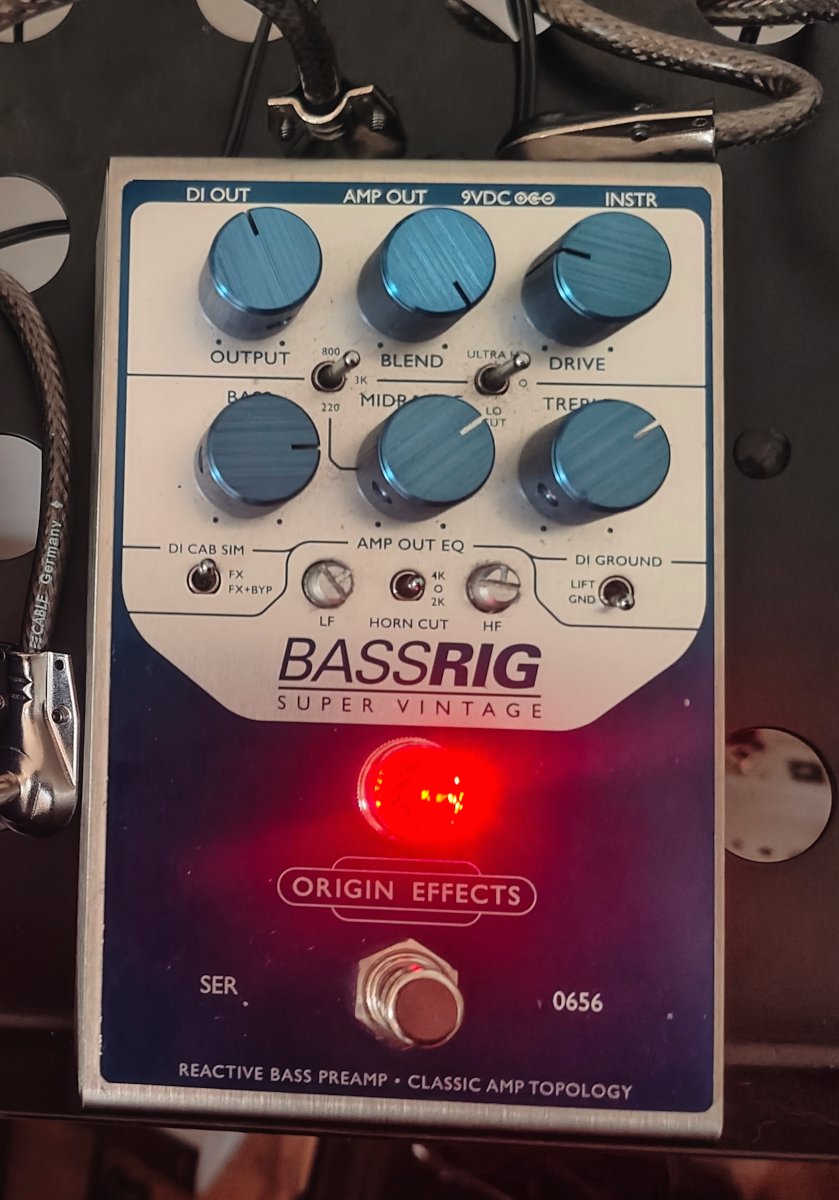
And it is a bit weird. I really prefer what the '64 has to offer over the SV, and prefer amps with the Fender Tone Stack over the Ampeg ones.
However!
First of all, let's get that out of the way: The XLR out on the '64 was basically unusable for me, since all it does is muffling the sound, and not in a good way. The XLR out on the SV totally works. It does a fair impression of the 810, as far as I can remember from playing the Fridge live. It is even possible to use the amp out eq section to limit the 1/4" out signal and approach the XLR out signal very closely, so you can send something quite similar to amp and FOH (as long as your own cabinet has more top end than the 810 has).
Speaking of the cab sim, I found that I can work with it. It feels a bit like the cab sim on the Sansamp. Something useful, that does not really get in the way.
Let's get to a comparison between the Origins:
1. The '64 goes deeper. I have not researched how the EQ works on the SV, but on the '64 you have shelving lows - I suppose the SV does a bell at around 40Hz. If you are after a big, warm and clean sound, the '64 goes way further than the SV.
2. The SV has a lot more control over the mids. Obvious. The Fender Tone Stack gets you scoop and nothing else- the SV gets you parametric mids with boost and cut.
3. The treble control of the SV is more complex, which can be better or worse, depending on your personal preferences.
The EQ for the treble on the SV is, to my knowledge, sitting at 4k. Then you get the Ultra Hi switch which boosts even higher. Plus, you can set the parametric mids to 3k and toy around with the post gain treble knob.
All in all I want to say the SV feels a lot like a guitar amp when it comes to drive. It's not fighting to stay clean and it does not really push back. There's no real edge of breakup, it happens naturally and you glide over seamlessly. With my P bass a slight grind in the background starts when the drive knob approaches 10 o'clock.
And it is a bit weird. I really prefer what the '64 has to offer over the SV, and prefer amps with the Fender Tone Stack over the Ampeg ones.
However!
First of all, let's get that out of the way: The XLR out on the '64 was basically unusable for me, since all it does is muffling the sound, and not in a good way. The XLR out on the SV totally works. It does a fair impression of the 810, as far as I can remember from playing the Fridge live. It is even possible to use the amp out eq section to limit the 1/4" out signal and approach the XLR out signal very closely, so you can send something quite similar to amp and FOH (as long as your own cabinet has more top end than the 810 has).
Speaking of the cab sim, I found that I can work with it. It feels a bit like the cab sim on the Sansamp. Something useful, that does not really get in the way.
Let's get to a comparison between the Origins:
1. The '64 goes deeper. I have not researched how the EQ works on the SV, but on the '64 you have shelving lows - I suppose the SV does a bell at around 40Hz. If you are after a big, warm and clean sound, the '64 goes way further than the SV.
2. The SV has a lot more control over the mids. Obvious. The Fender Tone Stack gets you scoop and nothing else- the SV gets you parametric mids with boost and cut.
3. The treble control of the SV is more complex, which can be better or worse, depending on your personal preferences.
The EQ for the treble on the SV is, to my knowledge, sitting at 4k. Then you get the Ultra Hi switch which boosts even higher. Plus, you can set the parametric mids to 3k and toy around with the post gain treble knob.
All in all I want to say the SV feels a lot like a guitar amp when it comes to drive. It's not fighting to stay clean and it does not really push back. There's no real edge of breakup, it happens naturally and you glide over seamlessly. With my P bass a slight grind in the background starts when the drive knob approaches 10 o'clock.


