• TalkBass has been independent since 1998. Add your voice.
    Create a free account to reply to discussions, view embedded media, and browse with fewer display ads.
    Join freeLog in
    Want zero display ads or expanded classifieds tools? Compare plans.

My thoughts....

There are a number of ways to shape sound. First and foremost, it happens with your fingers and your technique. But it also is shaped by the "electronics" on your instrument, the "electronics" in your amp, your speaker cabinet, the room you're playing, and the musicians/instrumentation you're playing with. Some of those things you have control over during a gig, others you don't. So flexibility can be key. In addition, eq can be used more as an effect as opposed to trying to dial in "neutral" (whatever that means).

There's not only one sound or function for bass...
 
  • Like
Reactions: wvbass
The AK-47 was a design made in 1947, hence the number designation, yet it is used by millions of insurgents, armies, gangs, and regular people around the world. The Russians tried to develop a "modernized" version of the AK, known as the AK-12 series, but it failed. They reverted back to the AK-74. Shows you that not all things can be improved. Some things are just made perfectly the first time and any sort of attempt to innoate the design just makes it worse.

Like the P Bass.
Like the wheel.
Like the iPhone 4.
Like the pencil.
 
  • Like
Reactions: sharkbait130
You shouldn't be playing your equalization. You should be playing your bass.

That's a logical fallacy; concern for one's EQ does not detract from concern from one's playing in any way. Quite the opposite in fact- a good bassist strives to achieve the most desired tone possible and will use whatever tools are at their disposal to get there.

It's also disingenuous; if someone dimed the treble and bottomed out the mids and bass on your amp, you wouldn't just keep it that way and say "the playing is all that matters." I can also guarantee that a lot of your favorite music sounds the way it does because the musicians and producers put a lot of time and thought into the EQ, effects, and other secondary musical elements.

sb1.jpg

That's some high action on that B string! Are those the first headless Foderas? It's beautiful.
 
Wait, wait, wait...........what in the Sam Hill am I looking at? That looks like a Status S2 sandwiched with an iPad and an extra neck that doesn't appear to be, well, anything but a neck, but I can't be seeing that, because well, that would be weird. :thumbsdown:

Chris Wolstenholme is at least trying to think outside the box, but I don't know how revolutionary the materials are... also this might be deviating from what a bass really is...
Chris
Muse-Chris-Wolstenholme-SNL-06-10-12.jpg
 
That's a logical fallacy; concern for one's EQ does not detract from concern from one's playing in any way. Quite the opposite in fact- a good bassist strives to achieve the most desired tone possible and will use whatever tools are at their disposal to get there.

It's also disingenuous; if someone dimed the treble and bottomed out the mids and bass on your amp, you wouldn't just keep it that way and say "the playing is all that matters." I can also guarantee that a lot of your favorite music sounds the way it does because the musicians and producers put a lot of time and thought into the EQ, effects, and other secondary musical elements.


That's some high action on that B string! Are those the first headless Foderas? It's beautiful.

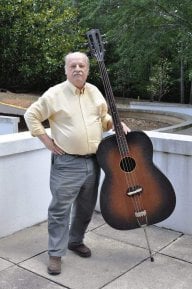
Steuart had literally just gotten the pair that night. I invited him to sit in at my gig, and I checked it out during the break. They are the first headless basses they've done, and they are crazy good instruments. Custom Nordstrand pickups - Steuart knows what he's going for and between working with Vinny and Carey, has hit two home runs...
 
Steuart had literally just gotten the pair that night. I invited him to sit in at my gig, and I checked it out during the break. They are the first headless basses they've done, and they are crazy good instruments. Custom Nordstrand pickups - Steuart knows what he's going for and between working with Vinny and Carey, has hit two home runs...

Cool. I just noticed that it looks like a bolt on too. Is that for Fodera's first bolt-on singlecut as well?
 
Between the first two, mostly the amount of automation in the production methods. The last one (Fodera) in fact is the most "old school" of the three, though it is a bit schizophrenic. There is more hands-on work for the Fodera than the Fenders, as well as Pleking and high-end active electronics.

Also, the '58 is passive, the AmDlx has two pickups and a preamp and arguably has a much broader set of tone options.

The Fodera could be almost anything - a half dozen possible body shapes, neck dimensions, electronics, etc. So there isn't much of a point to your point. But a buddy (and sick player) just got a pair of these from Fodera (one fretted, one fretless) - notice anything different from the Fender? (note - not him holding the bass)

sb1.jpg

That picture is a pretty great and most welcome thread derailment! I have to say, I think that bass in a fretted five string with a specific set of neck parameters is pretty much "the bass in my head." It is nice to see that somebody out there owns something like this.
 
That's a logical fallacy; concern for one's EQ does not detract from concern from one's playing in any way. Quite the opposite in fact- a good bassist strives to achieve the most desired tone possible and will use whatever tools are at their disposal to get there.

It's also disingenuous; if someone dimed the treble and bottomed out the mids and bass on your amp, you wouldn't just keep it that way and say "the playing is all that matters." I can also guarantee that a lot of your favorite music sounds the way it does because the musicians and producers put a lot of time and thought into the EQ, effects, and other secondary musical elements.


That's some high action on that B string! Are those the first headless Foderas? It's beautiful.
I guess I could just stand there and flick the switches back and forth on my Alembic next audition.
 
You've probably got a better chance of getting hit crossing the road to your gig than your active electronics malfunctioning during it. The "I don't want it because it's just something else that can go wrong" stuff is just silliness- you're not going to avoid using every other bit of electronics involved in and out of your gig because of it, so writing off an active preamp makes no sense. "Guys- don't use stage lights! They could malfunction!" "You want a picture of us? Don't use your phone camera- it could break. We'll just stand here while you draw us" :D

If you don't like active electronics, that's fine- but it's poor logic to not use them because they could fail. Anything can fail. If you take care of your gear, the likelihood of your active electronics failing is incredibly small. You can however take excellent care of yourself, and you will still, without exception, die. I'm not going to cancel my next gig because I might have a heart attack during it ;)

And if you think that onboard EQs sounds like a Casio, you're probably listening to some pretty cheap EQs or basses. A lot of preamps are built and sound better than the EQs in certain amps- the EQ being inside of an amp rather than in a pedal or preamp doesn't make it better.
Anything can fail. But there's less chance with passive pots and pickups.
 
Anything can fail. But there's less chance with passive pots and pickups.

Very little, and certainly nowhere near enough to where it should be a consideration. There's a thousand things that are more likely to go wrong that are more worthy of consideration. Reductionist thinking can go on forever until you've completely hamstrung yourself out of fear for the highly unlikely- there's no benefit in that. Not using active electronics because you don't like them is a reasonable action; not using them for fear of them failing is not.