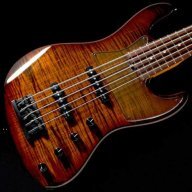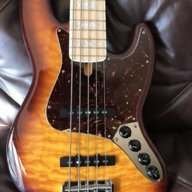
I visited Randall Wyn Fullmer (Randy) at Wyn Guitars on Tuesday September 30th to discuss my upcoming custom build and select the woods. Not everyone has the benefit of a one hour $69 each way flight to Burbank CA so I decided to share a few of my findings with the rest of our community.
The most notable take away from my visit was the depth of Randy's talent, knowledge and skill in shaping tone. It was the aesthetic beauty which drove my initial interest in Wyn. It is difficult to find a more beautiful and unique display of bass guitars than the galleries on the Wyn website. It is my obsession with that beauty which drives my endless tweaking and playing around with the possibilities for my future Wyn build. But, tone was not the element I was obsessing about. It should have been, but it wasn't. Something else hit me during that visit which changed all of that.
Randy is an artist (literally - paint, canvas, sculpt etc. etc) and the aesthetic principles about creating a pleasing work of art are ingrained into him and largely intuitive. That is what we see in those galleries which is so stunning. However, it is the other side of Randy which is perhaps not as well known which I now more fully appreciate. For every obsessive fantasy I have about appearance with a particular wood material or shape, he has the corresponding one involving the corresponding tone. He has invested tremendous time, energy and creativity into understanding tone properties and how shapes, positioning, combinations and the the amount of space for the wavelengths to resonate before encountering and becoming influenced by the next design element given the material's properties etc. etc. end up as a whole "sound" for that instrument. He has developed a "visual" if you will of the tone shape as you add, remove or replace each material element of a particular build.
It was very apparent that he has created countless little "tricks of the trade" if you will for how to optimally tune the sonic response for each combination of materials at various points of the bass build. His example of how he spent and extra two hours on a seemingly minor element of a bass he was working on which no one in the world will ever know about or see was pretty remarkable to me. When you consider the shear volume of options which are available in custom Wyn basses in terms of neck and body lams and woods and fretboard, this skill becomes even more critical to ensure a great sonic outcome. For every comment I had about a particular wood or material combination visually he would have these complex insights five steps down the road about the tone flavor depending on where that particular material was in the build, what shape it had, the way the grains were facing, what was right next to it etc. etc. His obsession with developing a feel and understanding for the tonal dimension of each "visual element" he is putting into the build and how he can tweak, influence, shape and mold that tonal dimension has lead to an intuitive wisdom that perhaps makes him even more of a "tonal artist" than he is an aesthetic one.
I was concerned going in that given the complexity of options offered (Multi lam bodies (up to 5 layers - 5 woods), multi lam necks (7 layers - 3 woods), fretboards, body shapes and styles etc. with such a broad variety and selection of materials, that tone would risk becoming a secondary outcome to satisfying my jones as a customer for all of the visual splash. Randy is such a remarkable and unusually talented individual (just look at his background and how he got to where he is today) and is so obsessed with the tonal elements of every build that it gives me great comfort to know that no matter how I unknowingly try to screw up my build, Randy will be working feverishly to counter the impact of my screw up with his use of relative thicknesses, layer ordering and shapes and then mold it so the end product is still an amazing tone.
The other most memorable aspect of the visit was in response to my question of what his bass would look like, what specific pieces he would use, what design elements, etc. he would employ if he were to build just one bass from scratch that he was to use only for himself and no one else would ever see. He started talking about stuff which made my head spin (I sure wish I had asked it earlier when I was not so mentally exhausted and overloaded) and he took me over to this thick slab of quilted maple the likes of which I had never seen before. This piece of wood was gigantic and went coast to coast (bark end to bark end). It was rough cut so no finish or polish etc. and I swear it was making my eyes cross from the 3D tricks it was playing. I had to keep reaching out and touching it to make sure I was seeing it right. He also pointed out this piece of African Mahogany (I think) which seemed like it was filled with lead shot. It was so heavy for its size that I kept looking at the bottom of it wondering what was pulling down on it so much. I held it up between by thumb and fingers (not easy to do) and then tapped it with the first and second fingers of my right hand. It rang out like a bell. I couldn't believe what I was hearing (and feeling through my fingers). He then showed me some ebony pieces and some Ziricote and a couple of others I can't even remember. Time had way since run out and with a plane to catch I had to rush out of there. Head spinning big time.
Invalid Link Removed
The most notable take away from my visit was the depth of Randy's talent, knowledge and skill in shaping tone. It was the aesthetic beauty which drove my initial interest in Wyn. It is difficult to find a more beautiful and unique display of bass guitars than the galleries on the Wyn website. It is my obsession with that beauty which drives my endless tweaking and playing around with the possibilities for my future Wyn build. But, tone was not the element I was obsessing about. It should have been, but it wasn't. Something else hit me during that visit which changed all of that.
Randy is an artist (literally - paint, canvas, sculpt etc. etc) and the aesthetic principles about creating a pleasing work of art are ingrained into him and largely intuitive. That is what we see in those galleries which is so stunning. However, it is the other side of Randy which is perhaps not as well known which I now more fully appreciate. For every obsessive fantasy I have about appearance with a particular wood material or shape, he has the corresponding one involving the corresponding tone. He has invested tremendous time, energy and creativity into understanding tone properties and how shapes, positioning, combinations and the the amount of space for the wavelengths to resonate before encountering and becoming influenced by the next design element given the material's properties etc. etc. end up as a whole "sound" for that instrument. He has developed a "visual" if you will of the tone shape as you add, remove or replace each material element of a particular build.
It was very apparent that he has created countless little "tricks of the trade" if you will for how to optimally tune the sonic response for each combination of materials at various points of the bass build. His example of how he spent and extra two hours on a seemingly minor element of a bass he was working on which no one in the world will ever know about or see was pretty remarkable to me. When you consider the shear volume of options which are available in custom Wyn basses in terms of neck and body lams and woods and fretboard, this skill becomes even more critical to ensure a great sonic outcome. For every comment I had about a particular wood or material combination visually he would have these complex insights five steps down the road about the tone flavor depending on where that particular material was in the build, what shape it had, the way the grains were facing, what was right next to it etc. etc. His obsession with developing a feel and understanding for the tonal dimension of each "visual element" he is putting into the build and how he can tweak, influence, shape and mold that tonal dimension has lead to an intuitive wisdom that perhaps makes him even more of a "tonal artist" than he is an aesthetic one.
I was concerned going in that given the complexity of options offered (Multi lam bodies (up to 5 layers - 5 woods), multi lam necks (7 layers - 3 woods), fretboards, body shapes and styles etc. with such a broad variety and selection of materials, that tone would risk becoming a secondary outcome to satisfying my jones as a customer for all of the visual splash. Randy is such a remarkable and unusually talented individual (just look at his background and how he got to where he is today) and is so obsessed with the tonal elements of every build that it gives me great comfort to know that no matter how I unknowingly try to screw up my build, Randy will be working feverishly to counter the impact of my screw up with his use of relative thicknesses, layer ordering and shapes and then mold it so the end product is still an amazing tone.
The other most memorable aspect of the visit was in response to my question of what his bass would look like, what specific pieces he would use, what design elements, etc. he would employ if he were to build just one bass from scratch that he was to use only for himself and no one else would ever see. He started talking about stuff which made my head spin (I sure wish I had asked it earlier when I was not so mentally exhausted and overloaded) and he took me over to this thick slab of quilted maple the likes of which I had never seen before. This piece of wood was gigantic and went coast to coast (bark end to bark end). It was rough cut so no finish or polish etc. and I swear it was making my eyes cross from the 3D tricks it was playing. I had to keep reaching out and touching it to make sure I was seeing it right. He also pointed out this piece of African Mahogany (I think) which seemed like it was filled with lead shot. It was so heavy for its size that I kept looking at the bottom of it wondering what was pulling down on it so much. I held it up between by thumb and fingers (not easy to do) and then tapped it with the first and second fingers of my right hand. It rang out like a bell. I couldn't believe what I was hearing (and feeling through my fingers). He then showed me some ebony pieces and some Ziricote and a couple of others I can't even remember. Time had way since run out and with a plane to catch I had to rush out of there. Head spinning big time.
Invalid Link Removed
Last edited:

 Hey Neuroman, check out the Wyn bass thread. Welcome to the club.