• TalkBass has been independent since 1998. Add your voice.
    Create a free account to reply to discussions, view embedded media, and browse with fewer display ads.
    Join freeLog in
    Want zero display ads or expanded classifieds tools? Compare plans.

NBD…what do I do with it?

Any suggestions on how to adapt to a 6 string?


Lock up your other basses and play this exclusively until it feels like home. Learn the notes of the B and C string until you know them as well as the other four strings.
Play the bass, play it again, and when you're done, play some more.
Rinse and repeat.
 
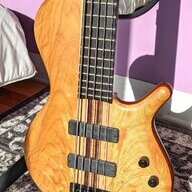
GAS got to me and I did a thing. What do I do with one of these? :D

View attachment 4969412

Seriously though. I bought it for improvising and melodies, but it feels and sounds so good I would like to get the most out of the instrument. Any suggestions on how to adapt to a 6 string?

I'd take it to the local blues open mic, just for laughs :D
 
Congrats on that beauty! As many have said, just lock yourself away with it and play away! :)

I am VERY interested in the "cousin" to that bass, which is set to hit the market pretty soon.:hyper:


L98381000001000-02-500x500.jpg
 
I've been playing 6s for years. There has to be a reason for a 6? But, there is also something I was told and learned a long time ago. "IF" you don't need or use all the strings, you don't need a 6 string. In other words, If you just use the standard 4 strings on a 6, you don't need it. If you bought it just to look cool, you don't need it, you are carrying extra weight you don't need. It's like the guy that buys a Harley that sets in the garage. But, he can tell everyone he has a "Harley ". Garage queen, poser. As for learning a 6, you have to put in the time, and play it everyday! Run scales with it and "learn the neck". Good luck.
 
  • Like
Reactions: Sean150
6s are so much fun to play! If you can, start learning to play chords on it and learn all of the inversions of the chords, too. The most fun I've had (and one of the reasons I bought my first 6) with my 6-string basses is writing instrumentals with them, since you can cover a wide range with them.

What's the string spacing on this one? It's such a cool looking Ibby.
 
6s are so much fun to play! If you can, start learning to play chords on it and learn all of the inversions of the chords, too. The most fun I've had (and one of the reasons I bought my first 6) with my 6-string basses is writing instrumentals with them, since you can cover a wide range with them.

What's the string spacing on this one? It's such a cool looking Ibby.
17mm stock. In theory you can adjust the string spacing, but I haven’t looked into that yet.
 
  • Like
Reactions: Kubicki Fan
Get a Gruv Gear fret wrap to help with muting. Muting is the big challenge. You’ll need to develop a flatter left hand technique. You probably need to wear the bass a bit higher to help get your hand around it.

It’s going to need to be all six string, all the time for the foreseeable future. It’s going to take a while to adjust to the extra strings, tight string spacing and new foggy areas of fretboard.

Try some light strings and try flats. I loved TI jazz flats on the six string.

Six strings are super fun with a looper. Bass, chords, and it’s noodle time!

It’s a beauty!
 
Awesome! I bought the short scale 5er last year.

Play whatever you want! Maybe the 6 will give you some more range to lay down chords with a looper and then funk out on the bottom end.

BTW, not much more than a MIM Fender and you get carbon rods, adjustable string spacing, and stainless frets!
 
  • Like
Reactions: TN WOODMAN
GAS got to me and I did a thing. What do I do with one of these? :D

View attachment 4969412

Seriously though. I bought it for improvising and melodies, but it feels and sounds so good I would like to get the most out of the instrument. Any suggestions on how to adapt to a 6 string?
The temptation will be to look at the 6-string bass as a 4-string with a couple of extra strings. Doing that will severely limit your progress as a 6-string player. Get into the practice habit of running scales in the same position using all 6 strings in that position. Then move up to the next key. The beauty of a 5 or 6 string is economy of movement. You can cover so much more ground in the same spot. It's a lot of fun!
 
Welcome to a brand new world. I think you're going to find you think of things in a completely different way on one of these. Put your four and five string basses in their cases and put them aside for a while. There is a new world of chords now available to you with intervals that used to be physically impossible at your fingertips, tapping will allow you to play two parts at once, you'll start thinking of lines differently given you can travel across the board rather than the length of it. A good place to start is find every "C" on the fingerboard and go from there. Enjoy!
 
Last edited: