• TalkBass has been independent since 1998. Add your voice.
    Create a free account to reply to discussions, view embedded media, and browse with fewer display ads.
    Join freeLog in
    Want zero display ads or expanded classifieds tools? Compare plans.

NBD - Fender Coronado II Modern Player

So I'd been trying to sell a early 70's Matsumoku hollowbody for a while. I bought it because I owned one 20 years ago, put too much money into it, and ended up not liking it much at all. But it looked cool. Seemed nobody else wanted to buy it either. Until last week a guy offered to trade me one of the reissue Coronados from about 12 years ago. Sure, I said I'd look at it. He came over, and we did a straight up swap. I was honestly kind of shocked he wanted to do the deal. It came with a really nice hard case. Pick guard was in the case with the film still on it. I haven't found much info on these - apparently they weren't popular and are fairly uncommon.
It's in great shape, though wiring seems a bit strange. From the little I can find, this might be the way they came from the factory. If I keep it, I may have it re-wired similar to a Ric.

PXL_20250908_190318326.jpg
PXL_20250908_190313126.jpg
PXL_20250908_190321521.jpg
 
Nice trade! These are very cool basses and look good, IMHO. I do love that headstock. But yeah, the control setup is a little wonky (and they are awkward for me to play sitting down).

I remember reading somewhere - might have been on TB, or maybe not - about other players who did the Ric re-wire and said it really changed the whole tone of the bass.

Anyway, congrats on the new trade.

EDIT: found this.
 
  • Like
Reactions: Brandon Shea
Nice trade! These are very cool basses and look good, IMHO. I do love that headstock. But yeah, the control setup is a little wonky (and they are awkward for me to play sitting down).

I remember reading somewhere - might have been on TB, or maybe not - about other players who did the Ric re-wire and said it really changed the whole tone of the bass.

Anyway, congrats on the new trade.

EDIT: found this.
That's where I saw it too. I think the guy who traded it to me thought the wiring or the switch was faulty or dirty, and so did I at first, figuring I'd need to take it in. It definitely seemed off from similar 2-pickup/2 tone/2 volume/3 way switch basses I've played. Until I read that same link you posted. If you didn't know that's how it was supposed to work (and why would you?) you'd almost automatically think there was something screwed up.

But now that I know it, and since my first post, I replaced the strings, I've realized you can get different tones from it. The new strings really woke it up.
Speaking of strings, it takes medium scale strings, of which there appear to be very few options for flatwounds. Di'Addario chromes are about it.

But not sure if it will stay in the stable. I already have a Rumblekat, which kind of serves the same niche, only about five pounds lighter. Oh and I tried to put the pick guard back on it. It interferes with the g-string pretty awkwardly.

But it's a really high quality instrument IMHO. I was very close to buying a Jack Casady about three years ago, but the quality control on all the ones I played was really poor I felt (and I own two other Epiphones). This is a better quality bass.
 
I had one of the original Coronado II basses in Candy Apple Red (which I understand was a rare color) that picked it up used in maybe 1973 or ’74. At the time I was playing the Sears bass I had started with in 1968, and was lusting after a “real” (read name-brand) bass when I came across it at a local guitar shop in Houston.

I had never seen a Fender like this one, but all that mattered was that it was a Fender. Best of all, it was cheap compared the other Fenders in the store. I don’t recall the price, but I doubt I paid more than a couple hundred dollars for it, if that.

However, it didn’t take long for the Coronado to be a disappointment. Being a hollow body, the neck was heavy, so playing it standing up was awkward. On top of that, it had very poor sustain, akin to an upright. Small wonder why Fender discontinued the Coronado after only a few years.

I came across one of the re-issues several years ago. They solved the sustain and neck-dive issues by making it kind of a neck-through, running a piece of wood inside the body, maybe 4 inches wide, from the neck to the end. It’s the same thickness as the body, essentially giving it left and right chambers.

All in all, I felt it was a significant improvement over the original. If I were going to get a Coronado II, it would be a re-issue. You couldn’t give me another original. The prices people are asking for those turkeys is laughable. I do prefer the original black headstock over the reissue’s natural finish, however.

Unfortunately, I never got any pictures of the one I had, but here are a few from the internet.

1968 Fender Coronado II.jpg


1968 Fender Coronado II top b.jpg


1968 Fender Coronado II headstock.jpg


Regards,
Wayne A. Pflughaupt

Make Your Own Cables: A How-To Guide Unique Arrangements of Hymns, P&W Standards, and Original Tunes
Official Pedulla Club #45
Administrator, Official Heartfield Club #36
Administrator, Official Tobias Club #133
Administrator, Official Pre-Gibson Tobias Owners Club
Administrator, Fretless Club #943
Big Cabs Club #23
My Basses
My Rig: Stage and FOH Friendly
Make Your Own Cables: A How-To Guide
 
I had one of the original Coronado II basses in Candy Apple Red (which I understand was a rare color) that picked it up used in maybe 1973 or ’74. At the time I was playing the Sears bass I had started with in 1968, and was lusting after a “real” (read name-brand) bass when I came across it at a local guitar shop in Houston.

I had never seen a Fender like this one, but all that mattered was that it was a Fender. Best of all, it was cheap compared the other Fenders in the store. I don’t recall the price, but I doubt I paid more than a couple hundred dollars for it, if that.

However, it didn’t take long for the Coronado to be a disappointment. Being a hollow body, the neck was heavy, so playing it standing up was awkward. On top of that, it had very poor sustain, akin to an upright. Small wonder why Fender discontinued the Coronado after only a few years.

I came across one of the re-issues several years ago. They solved the sustain and neck-dive issues by making it kind of a neck-through, running a piece of wood inside the body, maybe 4 inches wide, from the neck to the end. It’s the same thickness as the body, essentially giving it left and right chambers.

All in all, I felt it was a significant improvement over the original. If I were going to get a Coronado II, it would be a re-issue. You couldn’t give me another original. The prices people are asking for those turkeys is laughable. I do prefer the original black headstock over the reissue’s natural finish, however.

Unfortunately, I never got any pictures of the one I had, but here are a few from the internet.

View attachment 7317789

View attachment 7317788

View attachment 7317787
Even though it would have been American made, I bet that was pretty well equivalent to the two Matsumoku's (Lyle and Epiphone) I had. Beautiful looking, but not the greatest to play.
 
Good score! Especially as a trade for a bass you admittedly do not like. I think very highly of these basses....almost bought a red one used at a shop around here last year, but I hesitated, went back too many times, and someone had bought it by the time I got my head around YES.

My hesitation wasn't about the bass itself... It played well (for a short scale,) had surprisingly good intonation at 30.5" scale, and wasn't banged up like a lot of used hollows end up when they don't come with a case...the one I was looking at didn't have one, which is why I was surprised it looked as good as it did. But I was hesitant because, importantly, this is not an everyday driver and I did not have a clear role for this to play in my life... it was just cool enough I wanted it anyways.

The negatives? They exist, certainly: The hollow body means that, even at short scale, it's a bit neck heavy. And the body shape is awkward, with no countoured cutaway for my mighty belly, so playing a show standing up with it the whole time would be a lot.... This is a great "spot" bass....pull it out for ballads or old covers or the occasional jazz tune. I saw a guy on YouTube playing jazz christmas carols on a hollow Guild Starfire II and I bet you could get basically the same tones (or pretty close) out of this bass with minimal effort.
 
  • Like
Reactions: WayneP
Played it at rehearsal tonight. Great neck, good sound, though the amp where we practice isn't the best (ancient Sunn head and Yamaha 1x18 cab from like, 1982). It is really heavy, but it's surprisingly well-balanced. I think it'll be fun to bring to a gig, but probably not something I'd play every single time out. I'll definitely keep it. Unlike the old Lyle I traded for it, this is a much more usable instrument.

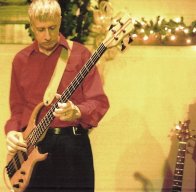
I've posted photos of the bass itself before, but here's me and the old Lyle (Matsumoku) from our band photo shoot. It really was a pretty guitar, even though I never bonded with it like I'd hoped. Looked great for the shoot though.

chris-2025.jpg
 
Last edited:
I had one of the original Coronado II basses in Candy Apple Red (which I understand was a rare color) that picked it up used in maybe 1973 or ’74. At the time I was playing the Sears bass I had started with in 1968, and was lusting after a “real” (read name-brand) bass when I came across it at a local guitar shop in Houston.

I had never seen a Fender like this one, but all that mattered was that it was a Fender. Best of all, it was cheap compared the other Fenders in the store. I don’t recall the price, but I doubt I paid more than a couple hundred dollars for it, if that.

However, it didn’t take long for the Coronado to be a disappointment. Being a hollow body, the neck was heavy, so playing it standing up was awkward. On top of that, it had very poor sustain, akin to an upright. Small wonder why Fender discontinued the Coronado after only a few years.

I came across one of the re-issues several years ago. They solved the sustain and neck-dive issues by making it kind of a neck-through, running a piece of wood inside the body, maybe 4 inches wide, from the neck to the end. It’s the same thickness as the body, essentially giving it left and right chambers.

All in all, I felt it was a significant improvement over the original. If I were going to get a Coronado II, it would be a re-issue. You couldn’t give me another original. The prices people are asking for those turkeys is laughable. I do prefer the original black headstock over the reissue’s natural finish, however.

Unfortunately, I never got any pictures of the one I had, but here are a few from the internet.

View attachment 7317789

View attachment 7317788

View attachment 7317787


Regards,
Wayne A. Pflughaupt

Make Your Own Cables: A How-To Guide Unique Arrangements of Hymns, P&W Standards, and Original Tunes
Official Pedulla Club #45
Administrator, Official Heartfield Club #36
Administrator, Official Tobias Club #133
Administrator, Official Pre-Gibson Tobias Owners Club
Administrator, Fretless Club #943
Big Cabs Club #23
My Basses
My Rig: Stage and FOH Friendly
Make Your Own Cables: A How-To Guide
I had one of the originals as well, probably in ‘69 or so. It was cool-looking and I was able to pick it up for under $200. However, I found it challenging to play, and I could never get the tailpiece, bridge, pickup, intonation alignment set up to my satisfaction, so the action was high and the string response uneven. I don’t even recall the electronics, but the sound was the last straw for me - I didn’t keep it long. It sure looked cool though - mine was sunburst - and they made some in “Wildwood” finish, which must be really rare today.
 

Latest posts