• TalkBass has been independent since 1998. Add your voice.
    Create a free account to reply to discussions, view embedded media, and browse with fewer display ads.
    Join freeLog in
    Want zero display ads or expanded classifieds tools? Compare plans.

Double Bass NBD - Kinda bass guitar (viol)

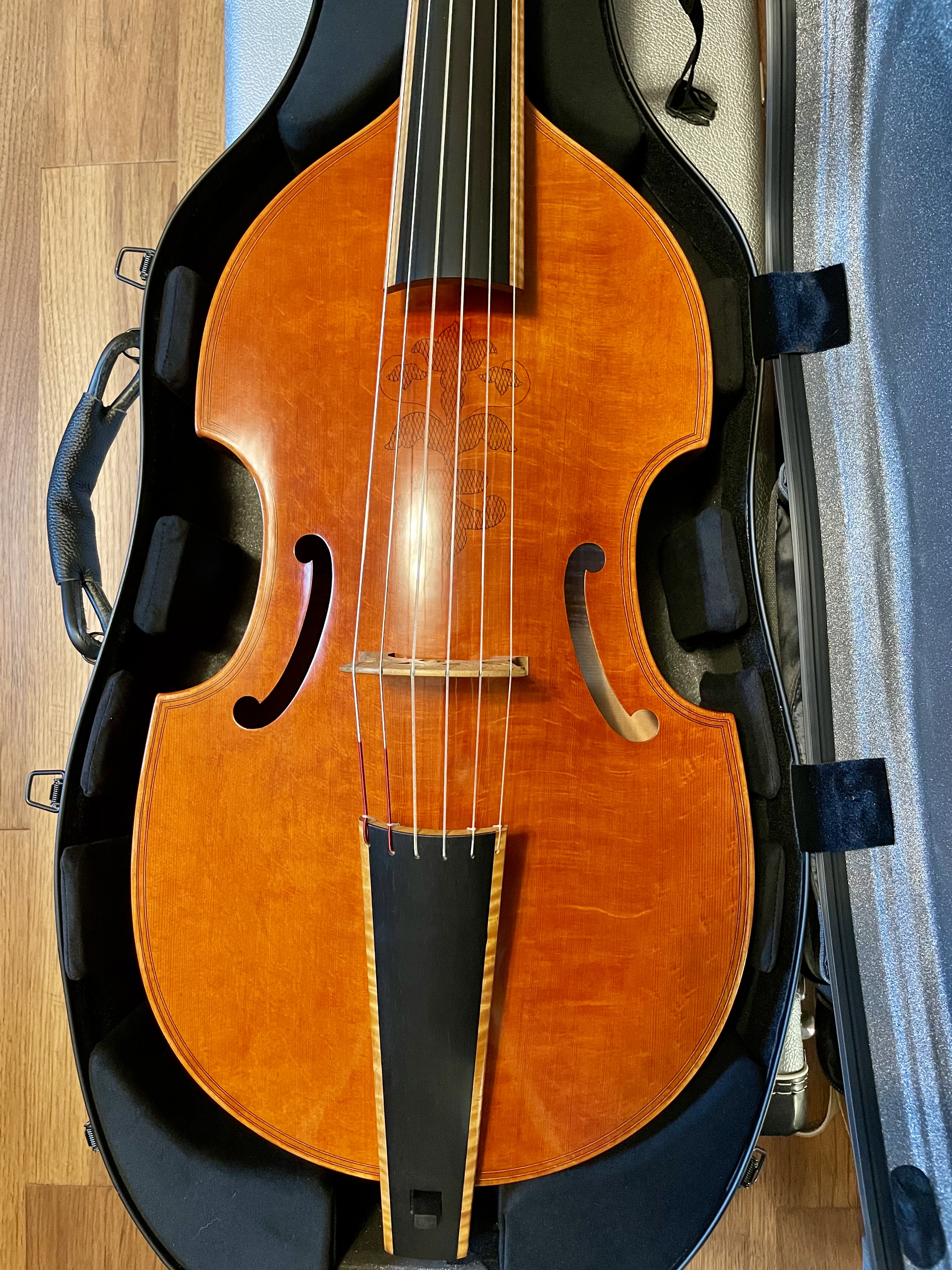
Just picked up this guy. It's a Lu-Mi Meares bass viol. Sounds and plays magnificently. It's constructed of spruce and sycamore (European maple), and weighs around 1.5kg.

mods: if it's inappropriate here, please feel free to move it.
IMG_0456.jpeg
IMG_0453.jpeg
IMG_0452.jpeg
IMG_0450.jpeg
 
Wow ! Awesome sound. Kind of half/cello half/double bass ancestor with 6 strings ? Thanks for sharing, i didn't known this instrument. :cool:


i've been learning viol the last year or so.

they were quite popular up until the 18th century when they lost popularity. the biggest drawback to the viol is that the sound just does not project the same way a violin family instrument does.

throughout the 18th century, concert halls started getting bigger, and the need for volume outweighed the benefits of the viol.

one of the interesting things about this instrument is that it was never really modernized. a violin from 1680 would sound quite different than a modern instrument. a viol is still going to be more or less the same - the big thing being gut strings.

there is a lot of repertoire for solo viol. some of it is really, really wonderful.

I am attracted to the viol for a number of reasons, but historical music is not necessarily one of them. having frets and a bow creates a very unique voice that i really love.

if one is interested, i'd start by hearing the three sonatas by bach for gamba. they're really wonderful pieces of music.
 
I am attracted to the viol for a number of reasons, but historical music is not necessarily one of them. having frets and a bow creates a very unique voice that i really love.

Congratulations! A gamba is a rare find indeed.

The thing I like most about the viol family is that they all share a similar timber and tone across their entire family regardless of the size. So they blend really nicely when played in ensemble. It’s a very different sound compared to that of a modern string quartet where the violin, viola, cello, and double bass are each distinctly different instruments with their own respective sonorities.

There has been a more recent effort to create a new violin family of instruments with matched acoustic properties. This new violin family is known as the ‘violin octet.’ More info on that can be found here if anyone is interested.


i've been learning viol the last year or so.

they were quite popular up until the 18th century when they lost popularity. the biggest drawback to the viol is that the sound just does not project the same way a violin family instrument does.

throughout the 18th century, concert halls started getting bigger, and the need for volume outweighed the benefits of the viol.

one of the interesting things about this instrument is that it was never really modernized. a violin from 1680 would sound quite different than a modern instrument. a viol is still going to be more or less the same - the big thing being gut strings.

there is a lot of repertoire for solo viol. some of it is really, really wonderful.

I am attracted to the viol for a number of reasons, but historical music is not necessarily one of them. having frets and a bow creates a very unique voice that i really love.

if one is interested, i'd start by hearing the three sonatas by bach for gamba. they're really wonderful pieces of music.


Very nice playing ! And awesome sound. Thanks all for sharing and help us learn new things. Very interesting article about the Violin familly.
 
  • Like
Reactions: groooooove
Congratulations! A gamba is a rare find indeed.

The thing I like most about the viol family is that they all share a similar timber and tone across their entire family regardless of the size. So they blend really nicely when played in ensemble. It’s a very different sound compared to that of a modern string quartet where the violin, viola, cello, and double bass are each distinctly different instruments with their own respective sonorities.

There has been a more recent effort to create a new violin family of instruments with matched acoustic properties. This new violin family is known as the ‘violin octet.’ More info on that can be found here if anyone is interested.

that is quite true about viols. the ensemble music - of which there is plenty - has a very particular quality.

it's almost a reed-like sound.

that, plus frets for clean intonation, create such a beautiful texture.

if anyone is interested in the viol, i very strongly encourage you to at least take one or two lessons with a teacher, you can even do o via zoom. the viola da gamba society of america has lots of good resources and ways to find teachers.

i studied with lisa terry in new york to get my basics going and i'm very glad i did.

the underhanded bow and gut strings go together. don't fight it, especially if you've ever played cello or double bass, i think the technique is idiomatic to the viol for good reason.

but, back the the op's point, it sort of is a bass guitar-ish thing. don't forget many bass viols are 7 strings, and go down to a low A - same as your bass guitars A string.
 
Wow ! Awesome sound. Kind of half/cello half/double bass ancestor with 6 strings ? Thanks for sharing, i didn't known this instrument. :cool:
Right on the money! The double bass is actually a member of the viol family, not violin - the flat back, sloped shoulders, and fourths tuning give it away.

My thought, given that a viol doesn't project as well as a violin, is that neither does an electric bass. The solution that the electric bass uses would lend itself well to a gamba, I think: a piezo transducer in/around the bridge could make it as loud as you'd want. :)
 
  • Like
Reactions: Polfuste
@Koshchei - are you tuning in straight 4ths across the board or do you have a major 3rd in the middle like the gamba players I know use. I’ve seen them tuned both ways with although having that 3rd tuned much like a vihuela is (I’m told) the traditional and more correct way. Which makes sense since it makes chording considerably easier.
 
Last edited:
@Koshchei - are you tuning in straight 4ths across the board or do you have a major 3rd in the middle like the gamba players I know use. I’ve seen them tuned both ways with although having that 3rd tuned much like a vihuela is (I’m told) the traditional and more correct way. Which makes sense since it makes chording considerably easier.
I've got the major third in the middle for now. Most lyra, bastard, consort, and division repertoire is written for this tuning.

I may change it to all fourths, but it really depends on how my left hand technique develops, and whether I can reach the notes when I get to Abel or Marais repertoire. I might also shift the major third over a string, so that it's guitar standard tuning (though a tone lower), so I can play standards without having to relearn the chord fingerings (having to maintain two sets of inversion fingerings all over the neck depending on instrument would break me!)

So many options when the instrument has no modern repertoire, but so much potential though.
 
Last edited:
  • Like
Reactions: AGCurry
Not sure if I’m in the correct thread or not, I apologize ahead of time.
I notice there are 4/4, 3/4, 2/4 etc. sized double basses. Can someone explain the difference please and are they sonically the same?
 
In a nutshell, they are not the same in terms of either size or sonically. As the fractions indicate, the bodies are smaller, with corresponding shorter scales. They all respond to plucking or the bow the same way, but the smaller you go the more bass you lose from the tonal palette as things shift to emphasize the mids more.

By this time tomorrow you should have at least a dozen additional answers that are better than mine to these questions.
 
Not sure if I’m in the correct thread or not, I apologize ahead of time.
I notice there are 4/4, 3/4, 2/4 etc. sized double basses. Can someone explain the difference please and are they sonically the same?

This pinned post has links to more than a dozen threads discussing that question. And this thread is about the viol, a close cousin of the bass, but not a fractional/small bass per se.
 
  • Like
Reactions: AGCurry