People have asked for pics and an NBD on my Orfeus Plovdiv bass, so we will see how this goes. This may be a long thread-starter, so y'all may want to pop some popcorn and get a couple of Barq's out of the fridge now.
Before getting to the bass itself I want to give a shout-out to musicimysoul, the eBay seller, who was very prompt and courteous in answering my questions and who got the bass shipped from himself in Kyiv all the way to me in Alabama in just ten days. TEN DAYS!!! By far the most satisfying transaction I have had in almost thirty years of eBaying. But it's not my bass anymore. Once I got the bass set up and intonated, got new strings on, etc., I gifted it to my friend who was raised in Plovdiv. She was thrilled; even scoured the offices of her academic department to conscript a junior faculty who could take pictures of the exchange. The whole experience went far better than I had dared hope, considering that she never came right out and told me she wanted a Plovdiv bass. Only thing is, in doing the set-up I fell in love with the danged bass -- I couldn't put it down -- and now I don't have it.
Regarding the bass itself, I was flabbergasted. Gobsmacked. Completely bowled over. I wasn't expecting much, but what I got was well over my expectations.
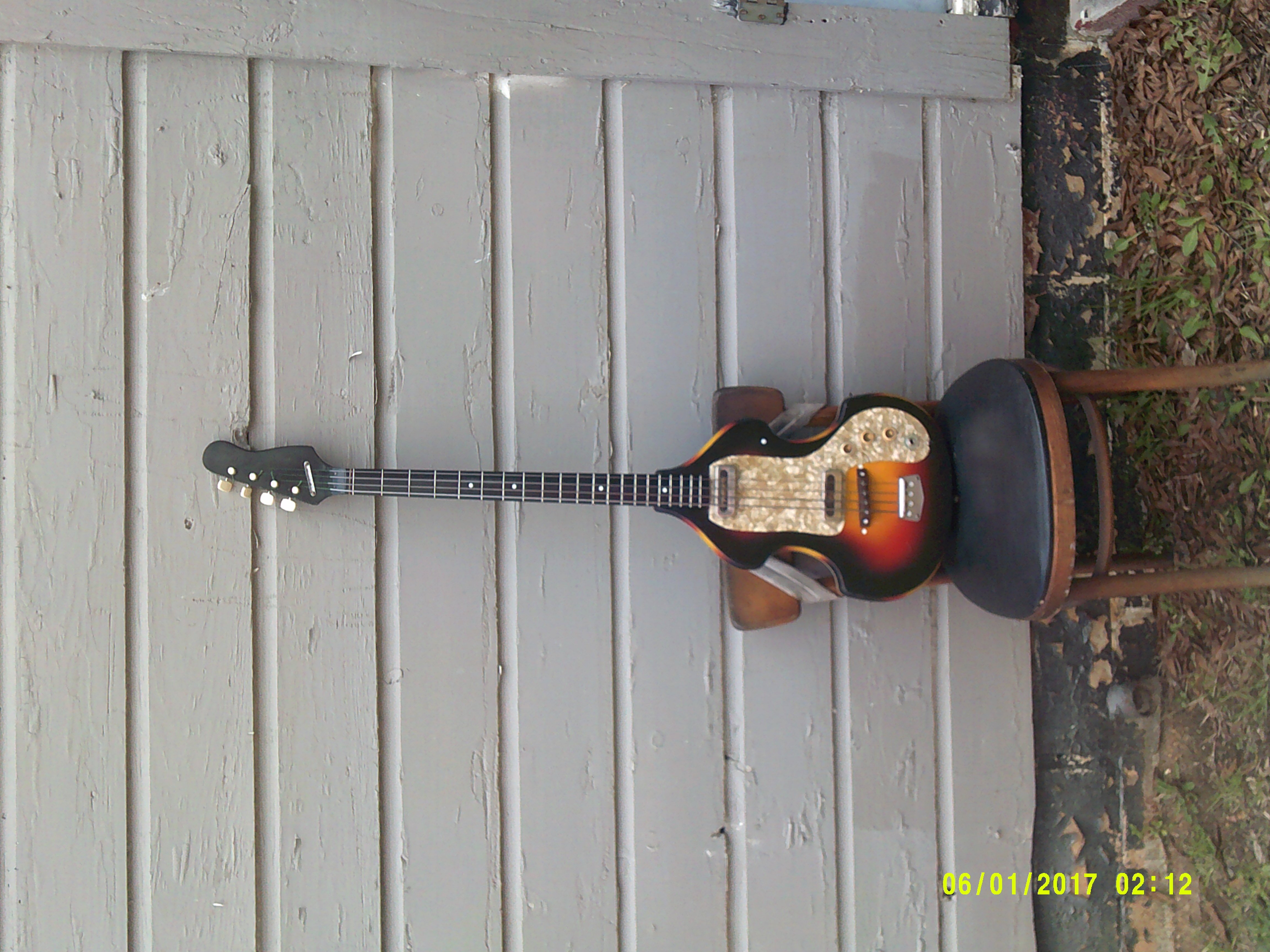
The Plovdiv bass is a simple bass: solid, viol-shaped body (one source speculates spruce) with a twenty fret bolt-on neck with a Fender style headstock. Mensure is about 29 ¾ inches, making the bass a short-scale; but the after-length behind the bridge makes it look visually like a long-scale, total length being 44/45 inches, about the same length as the Magnatone Hurricane and just a bit shorter than a Fender P. Dates of manufacture are guessed to be anywhere from 1960 to 1969. I find the first date too early to be credible; I suspect 1966/67 through 1972 is the more likely case.
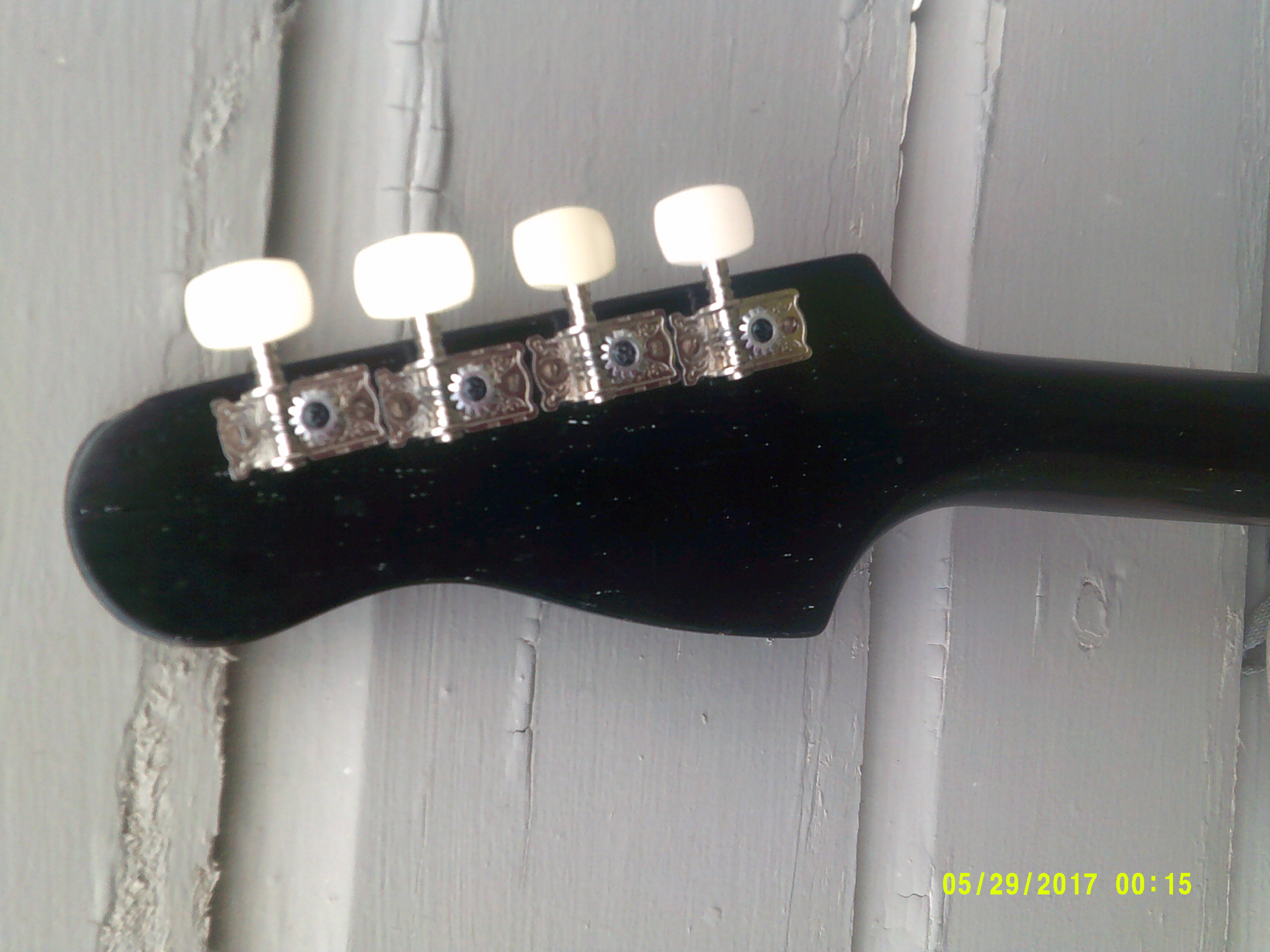
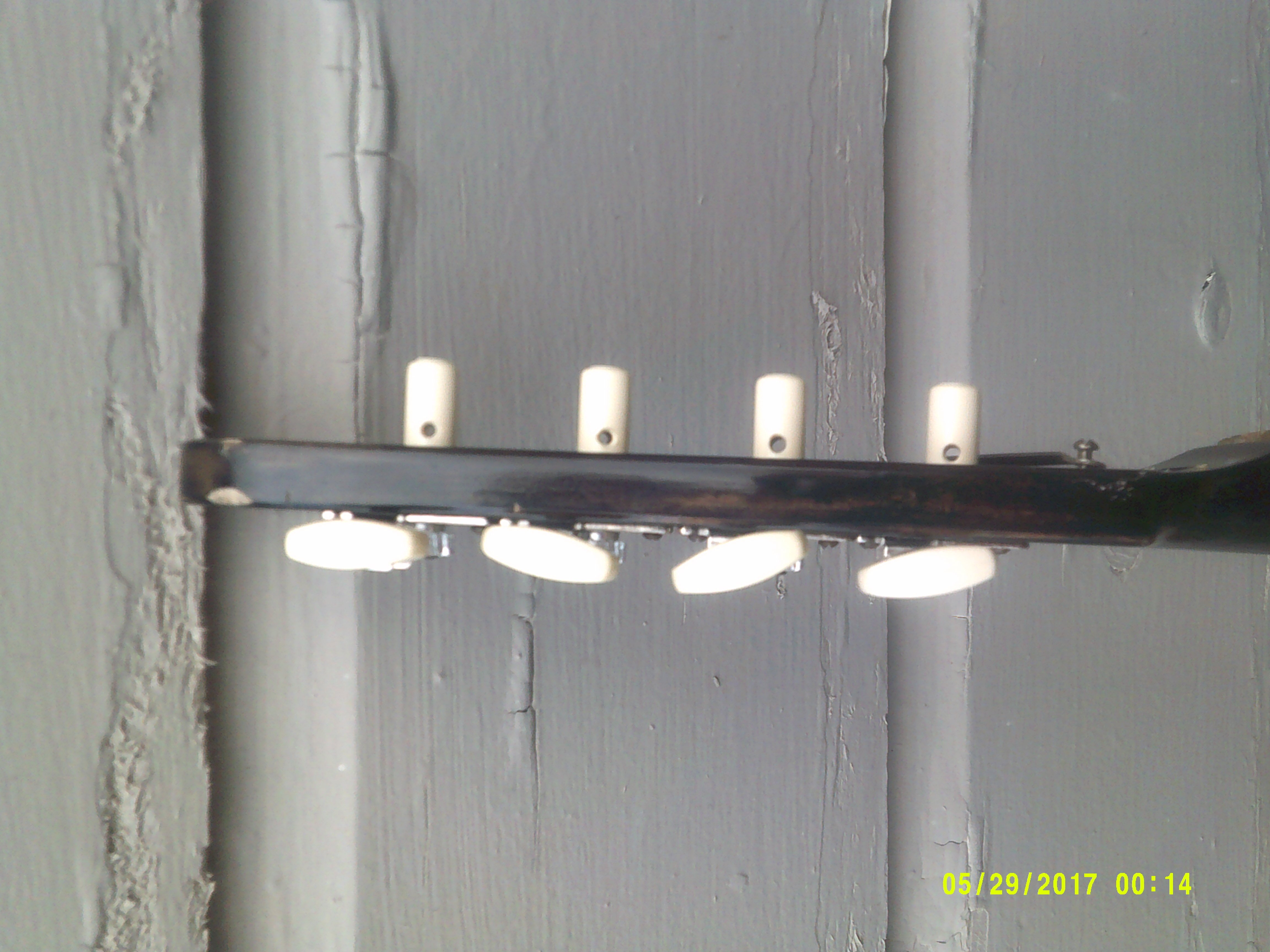
And now we enter the Monty Python world of "something completely different." The tuner capstans on the headstock are plastic and have no bushings. Even worse, the string anchor holes are guitar sized and barely above the headstock surface. No way, I'm thinking, I'm going to get two wraps of string beneath those holes. So I took the only course open to me which was to take the forbidden path of winding each successive wrap above the preceding wrap, moving up the capstan, in hopes that the full-service string tree would bail me out on break angle and witness point at the zero fret and at the tiniest top nut I have ever seen.
But the strings weren't having any of this. Each wrap persisted in going beneath its preceding wrap. But as it went beneath, each successive wrap pushed its preceding wrap up the capstan. Never expected this; I guess slick plastic has its place in bass-building.
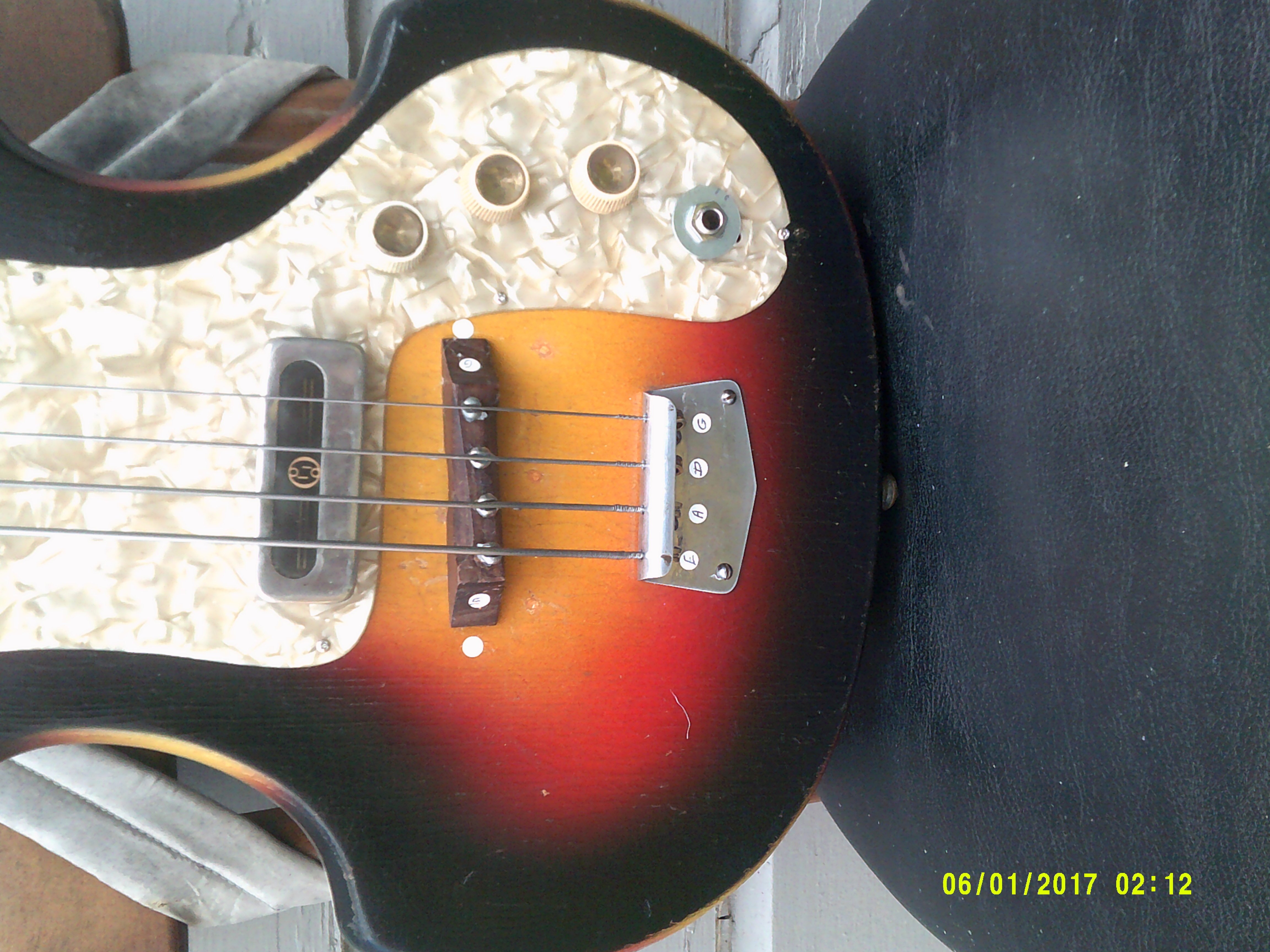
One (I suppose I should say "yet another") oddity with this bass is that except for the screws through the tuner spur gears and into the capstan and those holding the pickguard in place, every screw on this thing is a standard slot-head requiring a flat blade screwdriver. Even the bridge, a hack almost ingenious in its simplicity, is just a wooden base with four holes drilled into it at 16mm spacing (works for me), with a dome-head slotted bolt in each hole, and with the slots filed a bit on the E and A bolts to accommodate the larger strings. These set the action. Hilarious, but intriguingly functional.
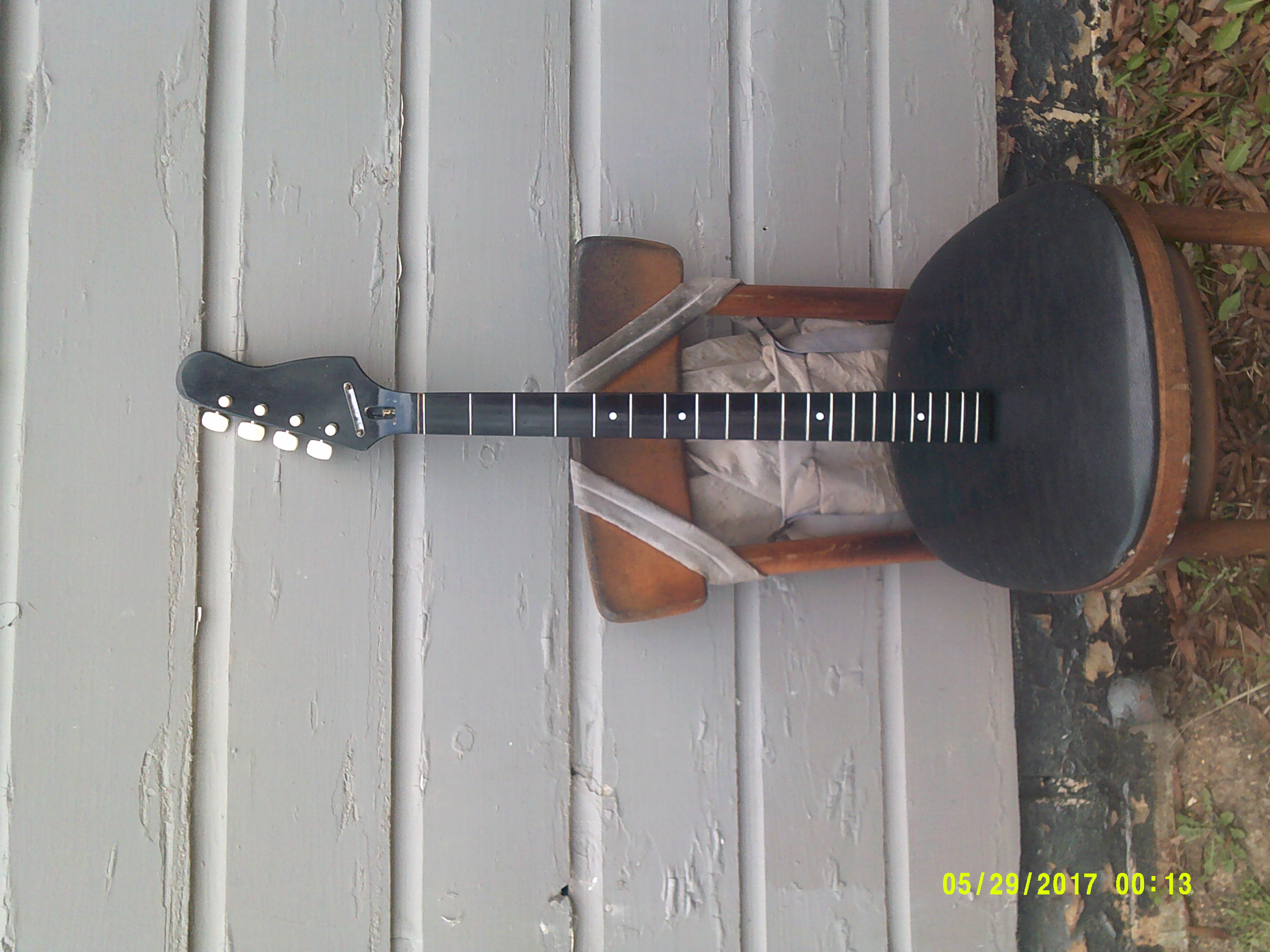
The neck is what sold me; by far the most perfect fit for my hand of any I have encountered. The contemporary Dano necks, as well as those for the Magnatone Hurricane and the Daion Savage, come close, but this is the real deal. It's the reason I could not put the bass down, and also a reason why I almost regretted promising the bass to another. But my friend from Plovdiv was going to have her Plovdiv bass come hale or high water. The fingerboard has minimal radiusing and the back has a nice deep curve, nothing nearly approaching wide and flat. Dimensions are 1 3/8" at the zero fret and 1 7/8" at the heel, very little taper. And the entire thing is painted black, even the fingerboard. I am persuaded this neck is the inspiration for the Rolling Stones' hit single.
There are no side markers on the fretboard, and the top dots are just . . . weird. There are only four, located at frets five, seven, twelve, and seventeen. I cannot even begin to fathom the reasons for this, but I have seen the same thing on other Orfeus basses, such as the Hebros. Surprisingly, there is an identifying number stamped (mallet and tap) on the butt end of the neck, but no corresponding number (or any other number) on the body.
One other thing about this neck: it has no dead spots. Not even the least hint or suggestion of a dead spot.
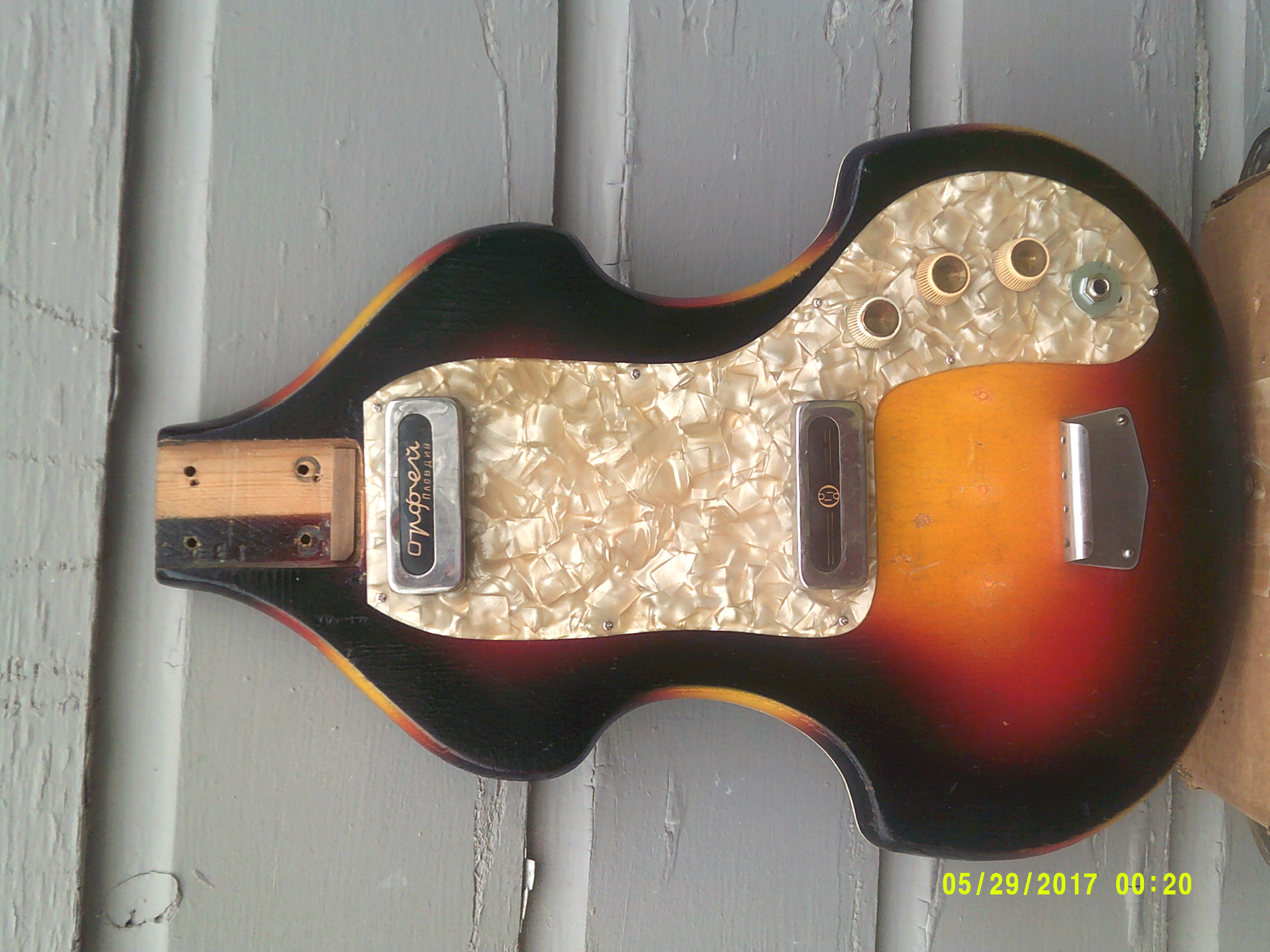
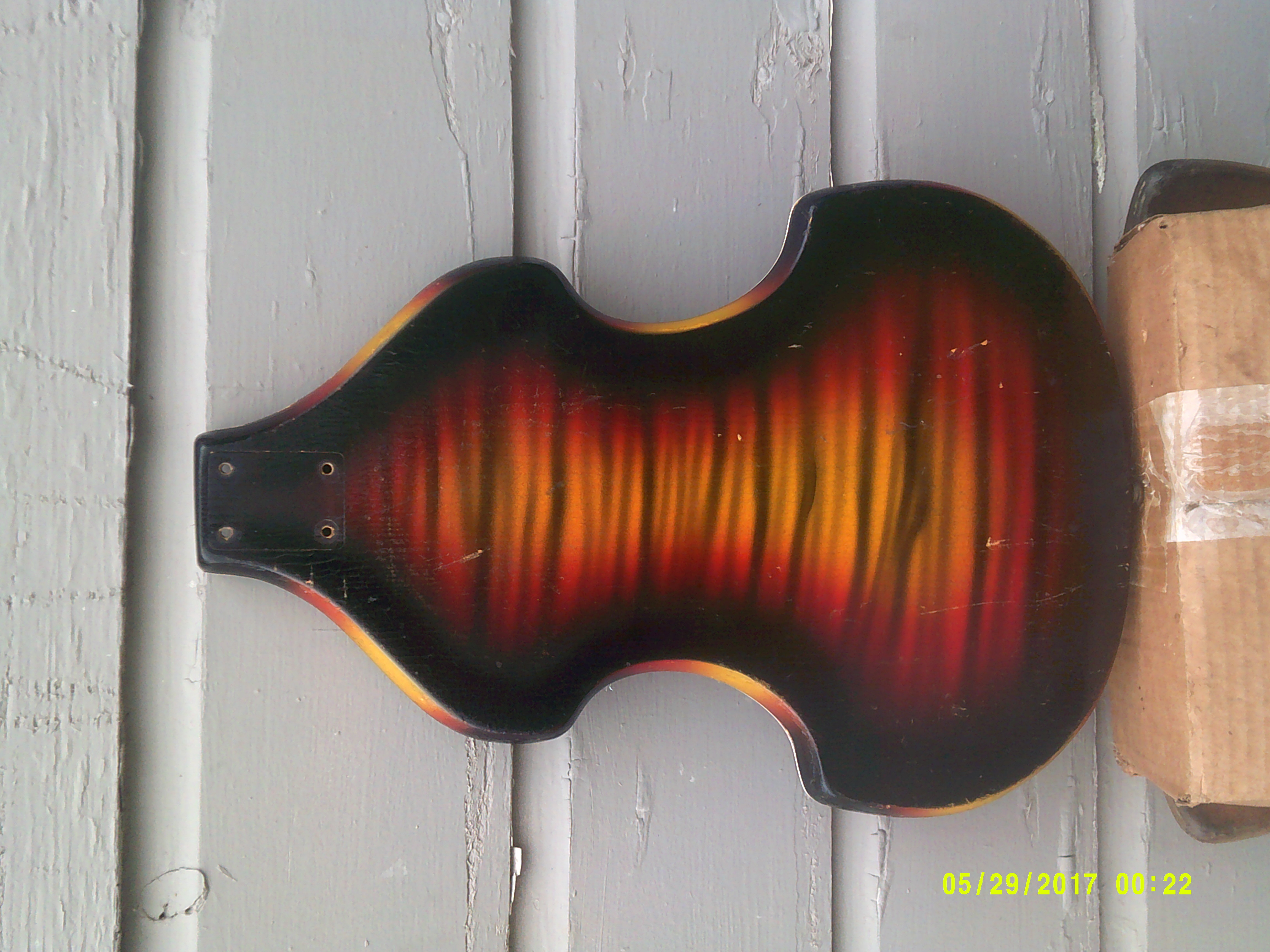
The body is smallish, even for a violin bass, and light. Postal scale weight for the entire bass, strung up, is 5 pounds 7.3 ounces, unimaginably light for a solid body. Balance on the thigh is comfortable; I have not tried strapping it, but I doubt neck dive would be a problem. Midway around the perimeter a channel has been routed for a vinyl inlay. Two pickups, one neck, one bridge, with the Orfeus Plovdiv in Cyrillic script -- which is a principal motivator for me buying the bass -- on the cover of the neck pickup. The pickups, whose magnets suggest squares of taffy, are surprisingly powerful and are distinct enough in tonality that you don't have to worry about getting the same sound twice. Controls are VVT, which suggests a Jazz Bass wiring pattern, mounted into a two-ply pickguard. (There are images of the pickup magnets on Google, but I am blocked from doing a copy/paste, so you will have to go your own way.)
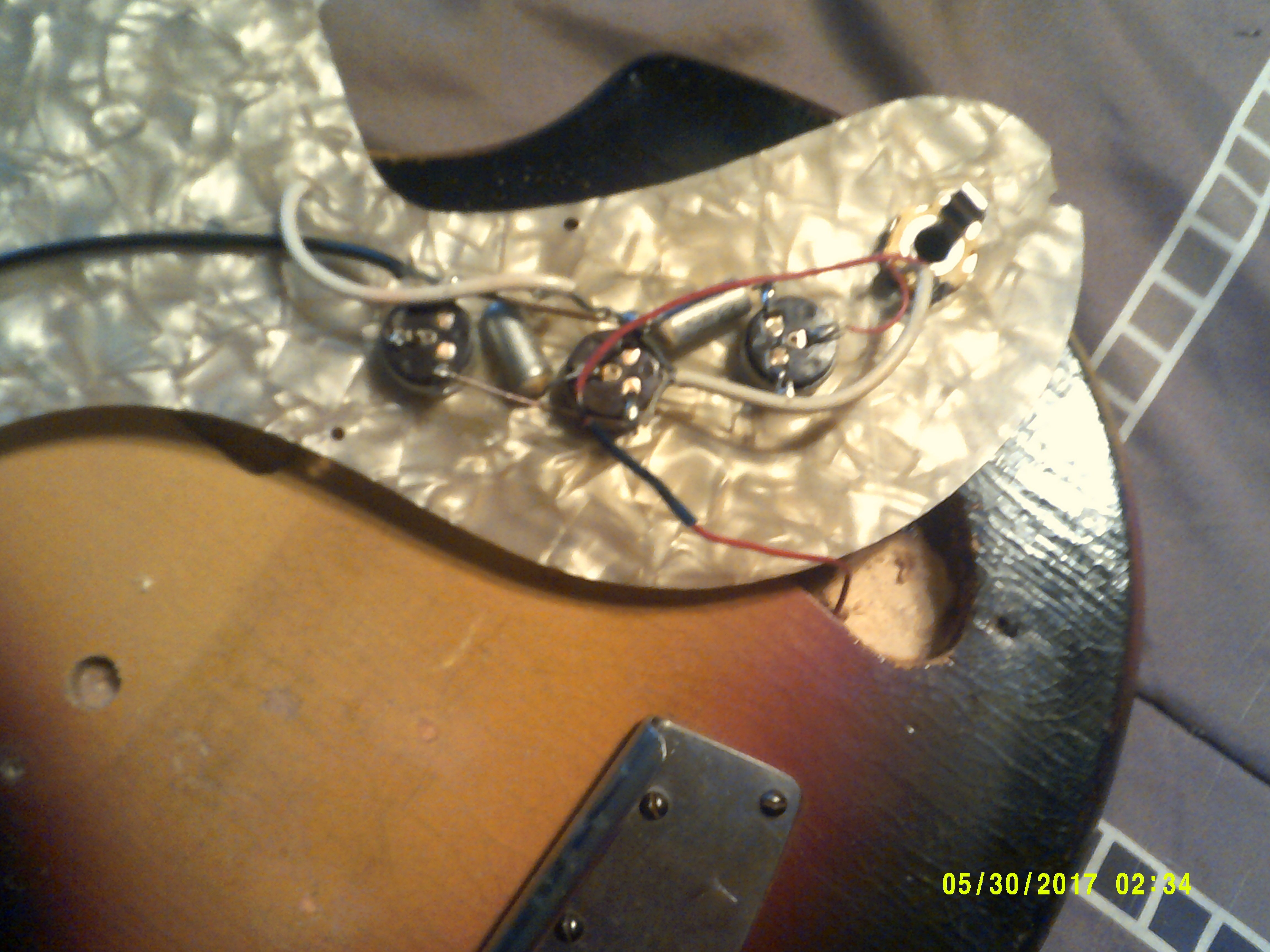
Pickups are surface mount, with a height adjustment that suggests a previous-owner hack. I was not going to pop the tops on pickups for a bass I intended to gift, but what I could see (barely) was stacked washer support pillars placed beneath the pickup over the mounting screws. Pics of that were impossible to obtain.
I have almost three graduate degrees from LSU (Master's in English, Master's in Library Science, DQGT in English), so the tiger stripes on the back do not bother me at all.
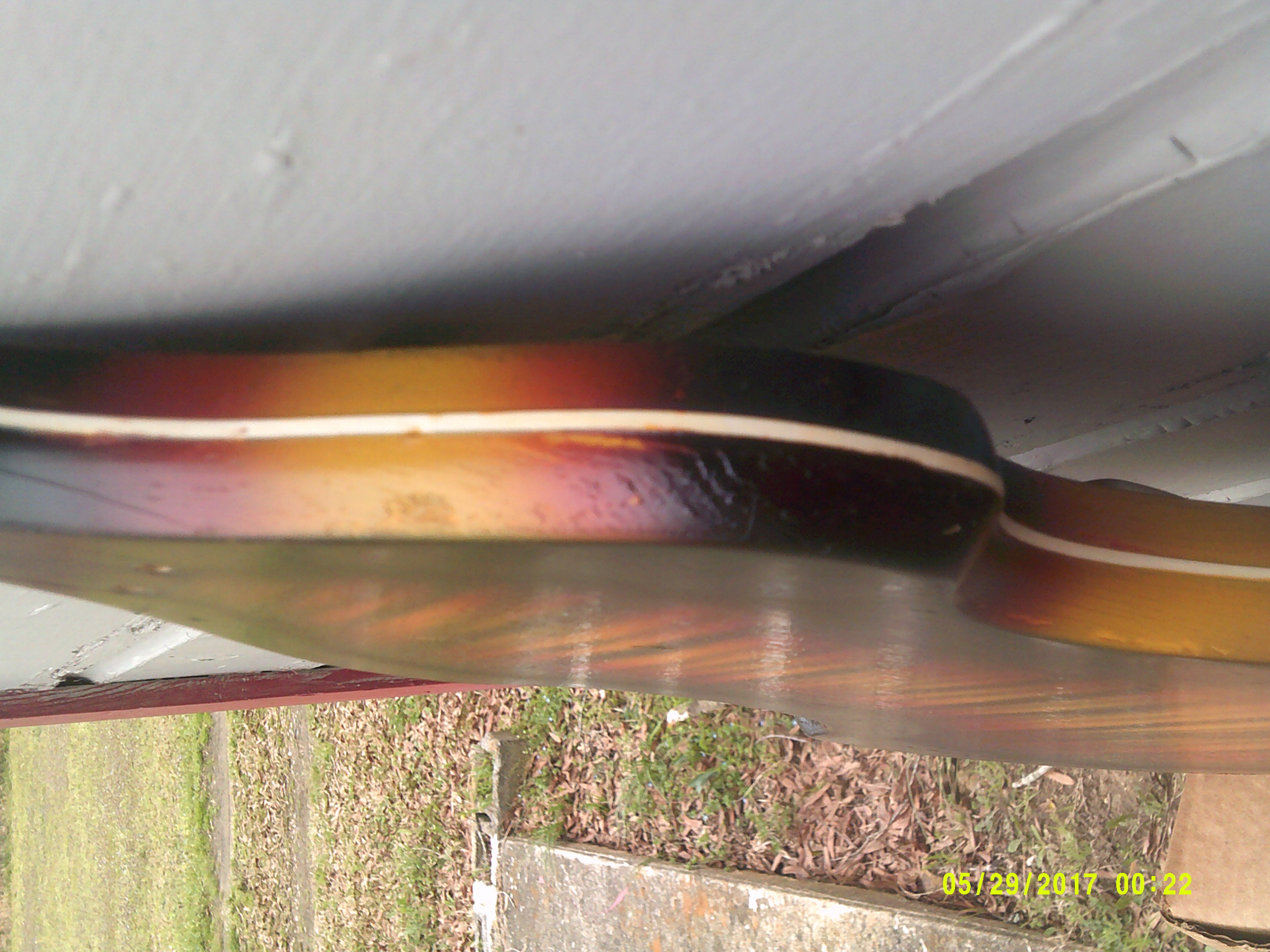
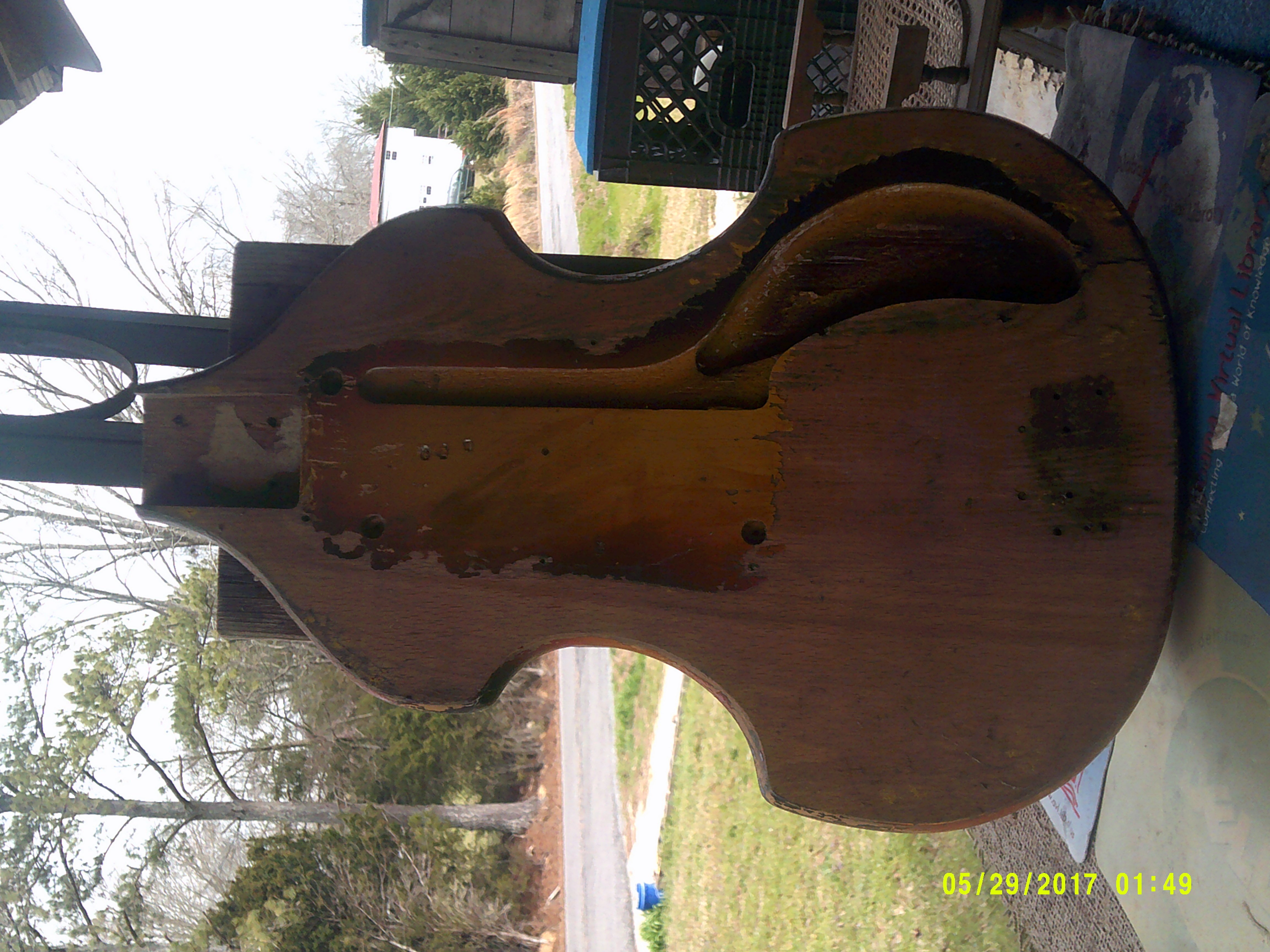
This is what the top-routes in the body look like.
And the goofiest, cherry-on-top-of-the-sundae to all of this, is that you can buy Plovdiv pickup labels online.
Stickers for guitar pickups
Of all the labels they could choose . . . .
Before getting to the bass itself I want to give a shout-out to musicimysoul, the eBay seller, who was very prompt and courteous in answering my questions and who got the bass shipped from himself in Kyiv all the way to me in Alabama in just ten days. TEN DAYS!!! By far the most satisfying transaction I have had in almost thirty years of eBaying. But it's not my bass anymore. Once I got the bass set up and intonated, got new strings on, etc., I gifted it to my friend who was raised in Plovdiv. She was thrilled; even scoured the offices of her academic department to conscript a junior faculty who could take pictures of the exchange. The whole experience went far better than I had dared hope, considering that she never came right out and told me she wanted a Plovdiv bass. Only thing is, in doing the set-up I fell in love with the danged bass -- I couldn't put it down -- and now I don't have it.
Regarding the bass itself, I was flabbergasted. Gobsmacked. Completely bowled over. I wasn't expecting much, but what I got was well over my expectations.
The Plovdiv bass is a simple bass: solid, viol-shaped body (one source speculates spruce) with a twenty fret bolt-on neck with a Fender style headstock. Mensure is about 29 ¾ inches, making the bass a short-scale; but the after-length behind the bridge makes it look visually like a long-scale, total length being 44/45 inches, about the same length as the Magnatone Hurricane and just a bit shorter than a Fender P. Dates of manufacture are guessed to be anywhere from 1960 to 1969. I find the first date too early to be credible; I suspect 1966/67 through 1972 is the more likely case.
And now we enter the Monty Python world of "something completely different." The tuner capstans on the headstock are plastic and have no bushings. Even worse, the string anchor holes are guitar sized and barely above the headstock surface. No way, I'm thinking, I'm going to get two wraps of string beneath those holes. So I took the only course open to me which was to take the forbidden path of winding each successive wrap above the preceding wrap, moving up the capstan, in hopes that the full-service string tree would bail me out on break angle and witness point at the zero fret and at the tiniest top nut I have ever seen.
But the strings weren't having any of this. Each wrap persisted in going beneath its preceding wrap. But as it went beneath, each successive wrap pushed its preceding wrap up the capstan. Never expected this; I guess slick plastic has its place in bass-building.
One (I suppose I should say "yet another") oddity with this bass is that except for the screws through the tuner spur gears and into the capstan and those holding the pickguard in place, every screw on this thing is a standard slot-head requiring a flat blade screwdriver. Even the bridge, a hack almost ingenious in its simplicity, is just a wooden base with four holes drilled into it at 16mm spacing (works for me), with a dome-head slotted bolt in each hole, and with the slots filed a bit on the E and A bolts to accommodate the larger strings. These set the action. Hilarious, but intriguingly functional.
The neck is what sold me; by far the most perfect fit for my hand of any I have encountered. The contemporary Dano necks, as well as those for the Magnatone Hurricane and the Daion Savage, come close, but this is the real deal. It's the reason I could not put the bass down, and also a reason why I almost regretted promising the bass to another. But my friend from Plovdiv was going to have her Plovdiv bass come hale or high water. The fingerboard has minimal radiusing and the back has a nice deep curve, nothing nearly approaching wide and flat. Dimensions are 1 3/8" at the zero fret and 1 7/8" at the heel, very little taper. And the entire thing is painted black, even the fingerboard. I am persuaded this neck is the inspiration for the Rolling Stones' hit single.
There are no side markers on the fretboard, and the top dots are just . . . weird. There are only four, located at frets five, seven, twelve, and seventeen. I cannot even begin to fathom the reasons for this, but I have seen the same thing on other Orfeus basses, such as the Hebros. Surprisingly, there is an identifying number stamped (mallet and tap) on the butt end of the neck, but no corresponding number (or any other number) on the body.
One other thing about this neck: it has no dead spots. Not even the least hint or suggestion of a dead spot.
The body is smallish, even for a violin bass, and light. Postal scale weight for the entire bass, strung up, is 5 pounds 7.3 ounces, unimaginably light for a solid body. Balance on the thigh is comfortable; I have not tried strapping it, but I doubt neck dive would be a problem. Midway around the perimeter a channel has been routed for a vinyl inlay. Two pickups, one neck, one bridge, with the Orfeus Plovdiv in Cyrillic script -- which is a principal motivator for me buying the bass -- on the cover of the neck pickup. The pickups, whose magnets suggest squares of taffy, are surprisingly powerful and are distinct enough in tonality that you don't have to worry about getting the same sound twice. Controls are VVT, which suggests a Jazz Bass wiring pattern, mounted into a two-ply pickguard. (There are images of the pickup magnets on Google, but I am blocked from doing a copy/paste, so you will have to go your own way.)
Pickups are surface mount, with a height adjustment that suggests a previous-owner hack. I was not going to pop the tops on pickups for a bass I intended to gift, but what I could see (barely) was stacked washer support pillars placed beneath the pickup over the mounting screws. Pics of that were impossible to obtain.
I have almost three graduate degrees from LSU (Master's in English, Master's in Library Science, DQGT in English), so the tiger stripes on the back do not bother me at all.
This is what the top-routes in the body look like.
And the goofiest, cherry-on-top-of-the-sundae to all of this, is that you can buy Plovdiv pickup labels online.
Stickers for guitar pickups
Of all the labels they could choose . . . .
Last edited: