
Enjoy the benefits of a premium membership!
Upgrade Account
-
TalkBass has been independent since 1998. Add your voice.
Create a free account to reply to discussions, view embedded media, and browse with fewer display ads.
Join free Log in
Want zero display ads or expanded classifieds tools? Compare plans.
You are using an out of date browser. It may not display this or other websites correctly.
You should upgrade or use an alternative browser.
You should upgrade or use an alternative browser.
Neck Laminates with Powered Hand Tools?
- Thread starter ABtheBassPlayer
- Start date
More options
Who Replied?
you'll need nicely milled surfaces to laminate. your skill level will dictate how minimal you can go with tools.
From your post it 'sounds like' you want to slice up a premade neck blank to 'add' laminates? Typically, you'd make the blank from laminates, then rough out its shape.
in any case, a track saw (or equivialnt straightedge jig) would be helpful if you're working with a circular saw. And a router sled could work as a makeshift surface planer. Not the most efficient method but doable—if you want to put the time into all the prep needed.
"Right tool for the job" wins the day. (if you're getting started, hire out things you don't have the tools/experience for like milling wood—you can then take it to your workspace for assembly.)
From your post it 'sounds like' you want to slice up a premade neck blank to 'add' laminates? Typically, you'd make the blank from laminates, then rough out its shape.
in any case, a track saw (or equivialnt straightedge jig) would be helpful if you're working with a circular saw. And a router sled could work as a makeshift surface planer. Not the most efficient method but doable—if you want to put the time into all the prep needed.
"Right tool for the job" wins the day. (if you're getting started, hire out things you don't have the tools/experience for like milling wood—you can then take it to your workspace for assembly.)
Last edited:

Hello!
Looking into getting into building. I was wondering if it would be possible to cut a neck blank into laminates using a circular saw or jig saw?
Thanks for the help!
To continue what Karl is saying, Yes, you can use a circular saw or a jigsaw to do the basic sawing of wood boards into strips. A guide rail system would be helpful. A bandsaw would be better. But that's only for the rough sawing.
To make the strips suitable for laminating into a fine bass neck, they need to be planed flat to high accuracy. That can be done with an old-fashioned hand plane, an electric-powered hand plane, a Jointer, a Planer, or a router with a special planing fixture. Your choice.
Here's a long, detailed thread all about how to build the special fixtures to do planing with a router:

We've talked before about Router Planing; using routers and fixtures to cut boards down to thickness and make them precisely flat. I was just doing some router planing last night, so I shot a few quick pictures to show all of you one of these fixtures and how it works.
This is a wide version of a planing fixture, which I built specifically to cut the tops and backs of my Scroll Bass bodies. I make them from 4/4 poplar or walnut; two matched pieces 7 1/2" x 22", jointed and edge glued with epoxy into a 15" wide x 22" long board. I use this fixture to take that glued board down in thickness...
This is a wide version of a planing fixture, which I built specifically to cut the tops and backs of my Scroll Bass bodies. I make them from 4/4 poplar or walnut; two matched pieces 7 1/2" x 22", jointed and edge glued with epoxy into a 15" wide x 22" long board. I use this fixture to take that glued board down in thickness...
- Bruce Johnson
- Replies: 577
- Forum: Luthier's Corner

Yes, you can do it that way. I tend to use a bandsaw and then a router planer to get the final edge. I've found that for the flatness of surfaces I like to have , they are best produced with a router planing setup. I have several routing fixtures that can be used with the same two sleds for various parts. I prefer the bandsaw, but you could do that with a jigsaw or circular saw (more waste).
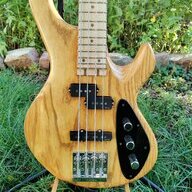
I'll add that what makes me able to build at all is a community maker space (in my case, Twin Cities Maker). If you haven't already, see if your city/town/area has a "makerspace," "hacker space", "community workshop," or whatever search terms make sense. In my case, my maker space has the bandsaws, jointer, planer, sanders, and drill presses that I need. I do my routing, finishing, and other smaller tasks at home.

Just so we're clear -- Do you mean to cut a bunch of wood laminates and make a neck from them, or do you mean to cut up a neck and add some laminates? Because if you're cutting up a neck blank my first question would be "why", and second would be "is there already a truss rod in it?"Hello!
Looking into getting into building. I was wondering if it would be possible to cut a neck blank into laminates using a circular saw or jig saw?
Thanks for the help!

Like somebody else mentioned, a track saw would work. With the right blade my track saw makes absurdly clean cuts.

I've never been brilliant with jigsaws but saying that all I have is an old single speed Black and Decker. It's OK for cutting rough profiles but I'd never try to do something on a guitar with it. Maybe they've got a lot better these days but I find reciprocating blades hard work.
Definitely a band saw (in my case) would be the preferred option and probably a little more accurate than a circular or jig saw, but as others have pointed out it depends upon your carpentry skill, mine's near to zero
Definitely a band saw (in my case) would be the preferred option and probably a little more accurate than a circular or jig saw, but as others have pointed out it depends upon your carpentry skill, mine's near to zero

You can use whatever is in the shop or convenient for cutting out the laminates, table saw, band saw, track saw, jig saw. The main difference is how close to the line you’ll want to cut and how much waste to leave so the laminates can be flattened out before gluing. That’s the more difficult part. I use a router jig that I’ve adapted for my pin router for flattening, it worked just fine with a hand held router and a sled before that. Read through the thread Bruce linked above about making a router planing jig. That’s probably the best bet unless your maker space has another option.

Yes you can use a circular saw to rough cut them.
But the challenge will be sanding your lams flat.
I don't think I'd attempt it without a drum sander.
If you had a sled and a router it might be possible, but it's the wrong tool for the job.
The other proper way to cut long lams is with a decently adjusted band saw with a nice wide blade and fence.
And I'll leave you with 1 more option. When I started building, I asked my local wood supplier about resawing my purchase.
They charged a slight upcharge to bookmatch a couple tops in a day or so.
Also had them edge and angle my neck through body blanks.
Now I just use technique #1 above, drum sanders rule for dimensioning my own woods.
But the challenge will be sanding your lams flat.
I don't think I'd attempt it without a drum sander.
If you had a sled and a router it might be possible, but it's the wrong tool for the job.
The other proper way to cut long lams is with a decently adjusted band saw with a nice wide blade and fence.
And I'll leave you with 1 more option. When I started building, I asked my local wood supplier about resawing my purchase.
They charged a slight upcharge to bookmatch a couple tops in a day or so.
Also had them edge and angle my neck through body blanks.
Now I just use technique #1 above, drum sanders rule for dimensioning my own woods.
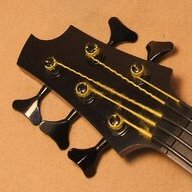
I’d find a small portable table saw. I used one to slice apart this Carvin to remove a damaged center section. With right jigs they can give a smooth enough surface for gluing. The bass was mounted to a sacrificial board to slow it to track straight through the saw. Best option to rip thin strips also.
Attachments


Last edited:


