• TalkBass has been independent since 1998. Add your voice.
    Create a free account to reply to discussions, view embedded media, and browse with fewer display ads.
    Join freeLog in
    Want zero display ads or expanded classifieds tools? Compare plans.

Need Help Repairing a Classical Guitar

I figured this sub-forum was the best place to post this.

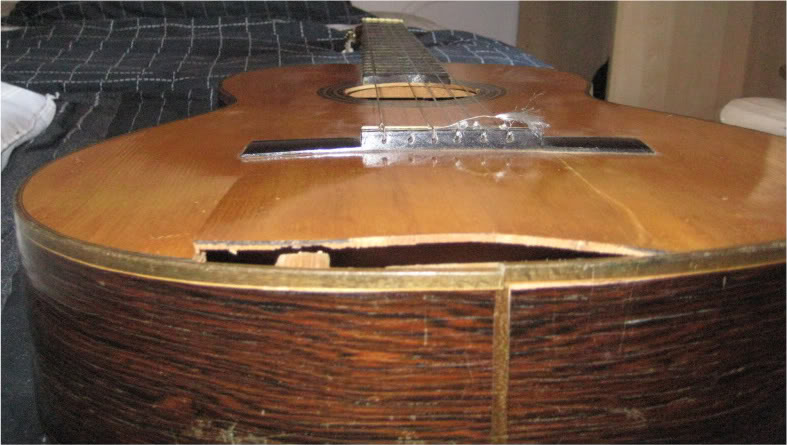
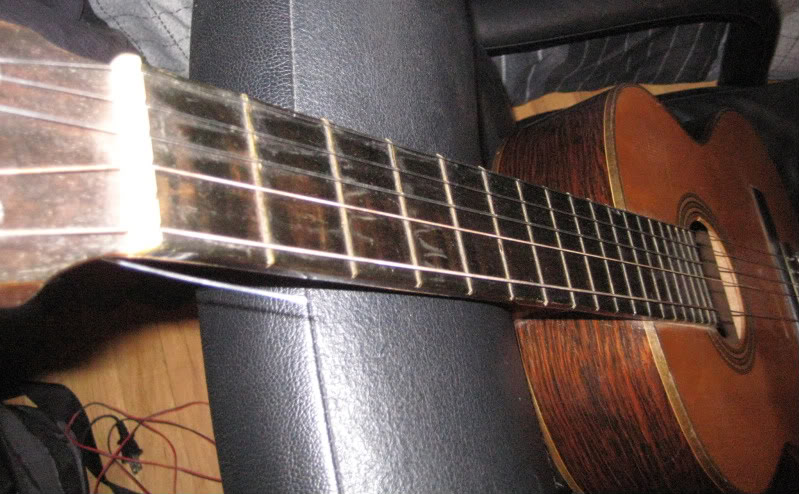
Over the summer I am interested in repairing an old classical guitar. I'll post pics of some of the issues (predominately cracking), but it could also use some fret-filing as well.

The guitar actually sounds really good with the nylon strings right now, but I don't want the cracking to get worse, and the neck needs some work.

IMG_3369.jpg

IMG_3370.jpg

IMG_3374.jpg


I am pretty much looking for tips on the best way to do repair it. Not looking for perfection, but I have no clue how to start. Is it enough to just use wood glue and clamps? :help:
 
Eek!

Wood glue and clamps is a simple way to describe it, but yes, basically that's about all you can do here.

I can't see what the condition of the lining is (the strip inside the side that the top is glued to), but if it's in good shape,
you would basically glue the top back in place.
If the cracks close up nicely when the top is bedded back down in position, then glue them at the same time. If not, you can fill the spaces with strips of spruce and do a little finish touch-up.

After that, you'll probably want to glue in a couple of "cleats" inside the guitar that bridge over the cracks, to help keep them together.

A little bit of looking on these two sites could be of great value for helping you through this project:

frets.com
mimf.com

Best of luck,
Martin
 
Thanks for the reply Martin, I really appreciate it.

I was beginning to think that no one would reply to this thread haha

When I apply pressure to put everything back into place, it all lines up almost perfectly, so I am hoping I'll be able to glue it back down without too much hassle.

I'll check out those sites, thanks.
 
If you can dry fit everything nicely with no bumps or chunks in the way, then you should be relatively good to go. I'd repair this with hide glue myself, but using some good wood glue would work too. Hide glue is preferable because it's easily undo-able and it shrinks as it dries, so under clamping pressure, it will actually suck the joins closed even tighter.

Martin is (of course) right that as long as the inner lining is still in good shape you should still be able to repair it pretty well.

If there are cracks visible on the surface after gluing from missing shards of wood, the best repair method is to razor out a triangular shaped sliver (wide on the guitar surface, narrow in the crack) carefully cutting right along the grain line. It is triangular shaped on the cross-section. This way when you glue in a new piece of spruce, it will fit right into the grain and when scraped and smoothed, should blend nearly invisibly into the top. If there is a cross-grain scratch or chip though, these are much more difficult to repair invisibly.

When the top is glued down, there will likely still be loose braces inside (the lower two braces look like they would have been knocked loose from the pics). The best way to assess this is to reach gently in through the soundhole and feel them. Anything that is loose will need to be re-glued to prevent noise/buzzing and keep the top integrity in good shape.

I've successfully gotten digital cameras into the soundhole and taken some pretty good pics of the interior using the timer on the camera. If you can get pics, they will tell you much more, otherwise, you can probably get an inspection mirror and a lightsource in there to help determine the problems, if any.

Cleats are a great repair, but I would use them only if I could not re-glue the braces inside (or if there is significant damage inside, but it's not worth removing the top). IMHO, the best is just re-gluing the braces back to where they are supposed to go. Again, hide glue is preferred because of the shrink factor, but it is also brittle and can't gap-fill worth a damn, so it needs to be used cautiously when things fit really tightly. You'll need a scissor jack to help support the braces in place while they glue, or get some creative clamping and bracing in place if you don't have access to a scissor jack.

Take your time and document the process so others can learn from it. The good news is that if you stick to classical strings, the likelihood of a successful repair is increased. This would be a bit more challenging on an acoustic guitar since the top integrity is more crucial for dealing with the higher tension.

Good luck, this looks like fun...
 
I would take it to a skilled luthier.

However, there are a series of maintenance vids on the Taylor Guitar site that you may find useful. In case the link does not work for you, they can be found under the "Customer Service & Support" tab on the main page, in "Customer Service" in the pull down menu. From there select the "videos" tab.

Next to the video that is ready to play is another menu. I think the series on humidity will be of great interest to you. It begins in the 3rd row of the 1st column. I suggest you look at these before you glue anything.

Sadly the videos do not have individual URLs. You might try starting with this. If not successful go back to the main page and try to follow what I have described.

[Invalid or Expired Link Removed]

Good luck, however you approach it.
 
Took off the strings and cleaned it off a little today.

IMG_3396.jpg


Showing how well the crack matches up.
IMG_3397.jpg

IMG_3392.jpg


Got a nice inside photo. I don't know what I'm looking at much, but everything looks intact. Seems like it just uplifted off of the wood inserts in there.
IMG_3389.jpg


Those frets are dangerous! Scratched myself on them earlier. I think the neck shrunk/curved a bit over the years.
IMG_3399.jpg


Should I be worried that it says "Telefono 666" on the inside? haha
IMG_3401.jpg


Thanks for the help so far guys. I checked out a bunch of those Taylor videos on humidity. Learned a lot that I never knew before. I've only owned electric guitars, never really acoustics.

P.S. Mike, those Taylor videos are all on youtube, so I just ended up watching them on there.. much easier.

Once finals are over I'll probably start this project more seriously and document it.
 
That guitar was made in Spain. The phone number inside tells me that guitar is pretty old!!! Good luck with the repair. I believe that you can just file those frets. Remember to protect the neck first before filing. Use some masking tape for that purpose. About that big crack, Keith and Beej told you the best options. It's all a matter of patience. Let the glue do it's work while keeping it clamped. Avoid humid places and tune down the strings if you're not playing it or storing for a long time to avoid excessive stress on the neck and body.
 
That looks like pretty repairable damage. If I were tackling this, I'd start by ensuring the sides near the tail are securely glued to the tailblock inside. This is easiest to do while the top is still off/loose. Then I'd clear off the gluing surfaces inside by scraping/sanding. Then I'd set up some blocks inside so I could glue the top back in place and have something to clamp against. The seams of the cracks are glued at the same time as the top. I have some notes on your pics too.

2w3n7na.jpg


2q3yd6v.gif


29w4my9.jpg
 
Thanks a lot for those pictures! I really appreciate it, and it definitely helps clarify things.

I have no clue if there was any previous repairs on this or not. I'll have to ask my mom since this was her guitar from many years ago.

EDIT: Spoke to my mom. The guitar was bought at least 40 years again in Spain, and to her knowledge, has never been repaired. So either it was built that way, or repaired prior to it being bought.
 
Judging by the cracks, I wouldn't be surprised if it was dropped at one point. It's also equally likely this happened over many years from the temperature changes and probably poor condition it was kept in.

You should see the gig bag that this thing was in too, it's hilariously old and not padded whatsoever. It certainly wasn't done any favors in it's 40+ year life. I'll snap some pictures of the gig bag whenever I get pictures of my progress on the guitar.