• TalkBass has been independent since 1998. Add your voice.
    Create a free account to reply to discussions, view embedded media, and browse with fewer display ads.
    Join freeLog in
    Want zero display ads or expanded classifieds tools? Compare plans.

New band has me going direct into mixer

I was a gigging guitarist until I fell in love with bass right after the pandemic, when we were allowed to gig again. I was bassist in a metal band last year using an amp. I'm recently in a new band (Yacht Rock, I love playing all kinds of music live) and for our first rehearsal they had me plug directly into the mixer.

I don't know the technicalities of mixers and... even though I know a lot about guitar gear... I don't know much about bass gear. It sounded fine, through our 4-hour rehearsal at moderate volume (E-Drums) and a good PA with subs.

Is it really that simple... To just plug into the mixer and go? Am I going to run into issues when we gig at slightly higher volume? Do I need anything at all? Seems too easy.

Should I at least play through an amp+cab sim, or an Elf or a pre-amp or something?

I didn't have IEMs at rehearsal but we will be using them from now on, so hearing myself on stage won't be an issue. I'm concerned about quality of my sound to the audience.
 
Last edited:
  • Like
Reactions: fretlessbass
As you saw for yourself, in that context, it was that simple

However, always plugging an instrument cable directly from your bass to the mixer would likely be impractical playing shows. You can use a plain DI or not-so-plain DI or pre-amp pedal or multi-fx pedal or amp modeler or some combination of those things...you could also use an Elf for its DI. What you should do is up to you and your situation. Will you use any effects? Do you use a tuner pedal? As you move to IEMs, you might find regardless of the mixer's ability to shape the FOH sound, that what's in your ears is too bare and dry...having some tone control would benefit you in that case.

A common thing to do is put together a pedalboard with the things that you'll use, and that's your rig. Mine is on the very simple end of the spectrum...it has a multi-fx pedal (with amp sims/tuner/DI) and my headphone amp for wired IEMs.
 
Last edited:
Do you have a passive or an active bass? If passive it might be a good idea to get a DI box as there's some chance that the mixer might not be close enough and you might have to use a longer cable that might affects the sound.

Personally I would get a simple preamp/DI to be on the safe side and if choose wisely can serve as a backup for the rest of your life.
Simple DI: Radial Engineering and Countryman are some of the standards.
Simple preamp/DI: Tech21 BDDI, Ampeg SCR-DI, EBS Microbass and Aguilar Tone Hammer are some examples. There are many more.

You didn't mention in your first post, but a tuner pedal is a most IMHO.

Since you also play guitar, I'm using an Eleven Rack for both guitar and bass. So if you already have a modeler, there's a good chance you can use it also for bass. IMHO, cab sims on bass is not necessary, I even prefer not using them live but I sometime use them playing alone at home.

Glad you left the dark side ;)
 
There are three issues plugging directly into a mixer:
  1. Bass is a line level signal
  2. Bass is an unbalanced signal
  3. You have to be able to control your monitor mix in real time.
Most decent mixers have the ability to switch a channel from XLR to line in with a corresponding match in impedance. Smaller, cheaper, consumer grade mixers may not have this adequate switching mechanism.

The benefit of a balanced signal (like that coming out of a DI box) Is that the cable is shielded and can withstand a long cable run from you to the snake to the soundboard. a guitar chord is unbalanced, and there will be signal degradation on any run longer than 50 feet or so.

And finally, you must be able to hear yourself – whether that is in a wedge monitor or IEM’s. You may do a sound check and hear yourself fine, but once the band starts playing, they may turn up and drown you out. So you must arrange for personal control of your own monitor signal.
 
Thank you all that's exactly the advice I needed. All the suggestions look good. I like that EBS Microbass because it has a tuner and compressor. Or i could build a small pedalboard with my choice of compressor, tuner and pre-amp. But that EBS Microbass seems to do everything I need.

What's weird is the reactions I get from guitarists about whatever I use. In the metal band they thought I was goofy for using a Helix, even though they all used Beringer rack multi effects. Why are their digital effects guitar processors acceptable but I'm a goofball for using a Helix with my bass?

In this new Yacht Rock band, I told them I have tube amps, ss amps or a processor, and I could use any one they prefer.

The guitarist grumbled uncomfortably when I mentioned a HX Stomp etc. He plays a Gibson LP Standard, analog pedals through a mic'd Fender, so I get the fact that he's old school....

But logically.... How is it any better for me to plug straight into the mixer (all digital, no control) than to go into an Hx Stomp then into the mixer? He thinks it's okay for me to plug straight into the mixer but not okay to use an Hx Stomp? What's up with that? That makes no sense to me.


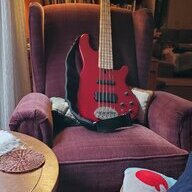
PS I'm playing a Schecter SLS Elite 5 and a Lakland Skyline 55-02
 
Last edited:
Unless your mixer has high-Z inputs or you're using an active bass with a not-too-long cable, you should be going into a DI in the very least. There will be all kinds of potential problems with a passive bass straight into a line-level input on the board. The HX stomp will give you a high-z input, balanced output (you'll want a TRS-XLR adapter to run XLR to the board), a tuner, and whatever signal shaping you want.

Tell the guitarist to get over it.
 
The HX stomp will give you a high-z input, balanced output (you'll want a TRS-XLR adapter to run XLR to the board), a tuner, and whatever signal shaping you want.

Tell the guitarist to get over it.


I get the feeling that many of these players, (even though they are great players and experienced at gigging), have no idea WTH they're talking about when it comes to bass.

In the metal band I asked if I could run my Helix DI. They said "that would sound horrible". Hm. It's like they don't even know what an amp and cab sim is. Meanwhile the guitarists are using a Beringer rack into our PA...

Makes no sense. I think I'm better off ignoring their opinions when it comes to bass..
 
Last edited:

Makes no sense. I think I'm better off ignoring their opinions when it comes to bass..

I’ve been chided for using “too many effects” on bass when what I had on the board was a wireless, tuner, and a DI box running into an all tube head. The whole time my only tone change was changing my pickups blend and plucking location on the strings.

Straight to board can work if the board can handle the signal and adjust EQ well, however I’d always have a DI box with just in case. Conditioning the signal level before it hits the board is helpful especially for long cable runs and you never know how capable or incapable the PA board is.

There are tons of options. If you need some character/dirt, Sansamp of your choice is always good. If you just need a clean DI, radial JDI or the active version are standards and tough to beat.

Of course you could just use your HX and you’d be fine. I hated multi effects so hadn’t used them in 20 years. Modern stuff is great. I’ve A/B’d my Hx stomp and my all tube heads and there is a difference but in a mix it’s nearly impossible for me to tell even if you know what to listen for. You can set up a pretty clean preset. Then you’d also have a muting tuner and access to anything else you could ever need.
 
There are three issues plugging directly into a mixer:
  1. Bass is a line level signal
  2. Bass is an unbalanced signal
  3. You have to be able to control your monitor mix in real time.
Most decent mixers have the ability to switch a channel from XLR to line in with a corresponding match in impedance. Smaller, cheaper, consumer grade mixers may not have this adequate switching mechanism.

The benefit of a balanced signal (like that coming out of a DI box) Is that the cable is shielded and can withstand a long cable run from you to the snake to the soundboard. a guitar chord is unbalanced, and there will be signal degradation on any run longer than 50 feet or so.

And finally, you must be able to hear yourself – whether that is in a wedge monitor or IEM’s. You may do a sound check and hear yourself fine, but once the band starts playing, they may turn up and drown you out. So you must arrange for personal control of your own monitor signal.
 
There's a huge adjustment to playing ampless gigs. The toughest thing is the mental adjustment for load in and load out. Instead of the exhilarating half hour of struggling with godawful heavy gear (where you feel like you're earning every one of the 50 dollars you're being paid for the gig), you have to face the empty awkward feeling when you pick up a bag of cables, a pedalboard, and your bass and walk into the venue in one trip without sweating or anything, and wonder "is that all there is?" The load out is similarly devoid of real struggle - is this really rock and roll? You also may get home a bit earlier than usual, and then have to explain to your wife why you used to get home later all the time.

I have somehow made the adjustment, and am OK with it. Your mileage may vary. Good luck!
 
A passive bass is not line level and requires some type of device to make it line level. You will have a pretty poor signal directly injecting a passive bass to the input of a console. Typically a powered DI box is required to upgrade that signal. A bass which is active and has built in ( preamp ) raises the signal to line level. To illustrate this, plug a standard set of headphones into a passive bass or bypass the active on your active circuit. You should hear almost nothing. With an active circuit you will hear a clear mono signal. That is line level.
 
There's a huge adjustment to playing ampless gigs. The toughest thing is the mental adjustment for load in and load out. Instead of the exhilarating half hour of struggling with godawful heavy gear (where you feel like you're earning every one of the 50 dollars you're being paid for the gig), you have to face the empty awkward feeling when you pick up a bag of cables, a pedalboard, and your bass and walk into the venue in one trip without sweating or anything, and wonder "is that all there is?" The load out is similarly devoid of real struggle - is this really rock and roll? You also may get home a bit earlier than usual, and then have to explain to your wife why you used to get home later all the time.

I have somehow made the adjustment, and am OK with it. Your mileage may vary. Good luck!

I don't think his issue is going ampless, it's being told to plug into the board without any pedals (Helix) or even a DI and then being ostracized for suggesting that he could do anything *other* than plug straight in sans DI. That's what I got from the OP. Maybe I got it wrong.
 
  • Like
Reactions: jdthaddeus
At our Community Centre, folks on the sound board were not up to speed on EQ details us bass players need and want. Unless you have a genius or someone who's a player themself running the band's sound, going straight to the PA is a poor choice IMHO. A SABDDI or equivent is a much better arrangement and you have EQ control. As someone else said here, your stage monitors need to be able to reproduce your bass. Where I live and play, the monitors can't do that so I tell them to leave me out of the monitor mix. The band all hears my stack on stage.
 

Latest posts