• TalkBass has been independent since 1998. Add your voice.
    Create a free account to reply to discussions, view embedded media, and browse with fewer display ads.
    Join freeLog in
    Want zero display ads or expanded classifieds tools? Compare plans.

New band has me going direct into mixer

Explaining each component in a setup to the questioner goes a long way towards shutting people up in the future.
It seams you know most of what your HX Stomp does.

If your bass is active and the mixer input is a High-Z, then you're probably fine for long cable runs. 20m shouldn't be a problem.

If however, your bass is passive, you can begin to experience tonal loss. This might or might not work to your advantage, if you like the outcome.

The idea that a HX Stomp should somehow be a problem doesn't make sense.
A HX Stomp is fully capable of being a transparent DI - it can take your high impedance, instrument level, unbalanced signal and convert it to a low impedance, microphone level balanced signal for very long cable runs.
Which other blocks you chose to enable will alter the sound. But you should be able to show your guitarist, that if you disengage all blocks, it just works as a DI.
And as said above - you might not need a DI for this particular mixer.
 
I get the feeling that many of these players, (even though they are great players and experienced at gigging), have no idea WTH they're talking about when it comes to bass.

In the metal band I asked if I could run my Helix DI. They said "that would sound horrible". Hm. It's like they don't even know what an amp and cab sim is. Meanwhile the guitarists are using a Beringer rack into our PA...

Makes no sense. I think I'm better off ignoring their opinions when it comes to bass..
You are on the right track. Learn all you can and politely tell them it's your instrument, you will decide on your gear.
 
I get the feeling that many of these players, (even though they are great players and experienced at gigging), have no idea WTH they're talking about when it comes to bass.

In the metal band I asked if I could run my Helix DI. They said "that would sound horrible". Hm. It's like they don't even know what an amp and cab sim is. Meanwhile the guitarists are using a Beringer rack into our PA...

Makes no sense. I think I'm better off ignoring their opinions when it comes to bass..

Yep, people are silly.

In your shoes I would either throw together a small pedal board, or use something like a fly rig to pick up a tuner/compressor / rudimentary EQ/di output. The Helix is certainly up to the task at hand.

I still see a fair amount of residual silliness from folks that never got over the early days of modeling when processing power to do the job assigned wasn't quite enough, or people heard presets and just tapped out. I'm talking about the era of the original pod, Johnson J station, line 6 axsys et al. Use what makes you happy and ignore 'em past that.
 
  • Like
Reactions: jdthaddeus
Explaining each component in a setup to the questioner goes a long way towards shutting people up in the future.
It seams you know most of what your HX Stomp does.

If your bass is active and the mixer input is a High-Z, then you're probably fine for long cable runs. 20m shouldn't be a problem.

If however, your bass is passive, you can begin to experience tonal loss. This might or might not work to your advantage, if you like the outcome.

The idea that a HX Stomp should somehow be a problem doesn't make sense.
A HX Stomp is fully capable of being a transparent DI - it can take your high impedance, instrument level, unbalanced signal and convert it to a low impedance, microphone level balanced signal for very long cable runs.
Which other blocks you chose to enable will alter the sound. But you should be able to show your guitarist, that if you disengage all blocks, it just works as a DI.
And as said above - you might not need a DI for this particular mixer.
 
I've been chided for using "too many effects" on bass when what I had on the board was a wireless, tuner, and a DI box running into an all tube head. The whole time my only tone change was changing my pickups blend and plucking location on the strings.
Someone that would chide you for a tuner and a DI needs serious psychological help.

I've had funny looks from production guys when I show up with a pedalboard.

But when I break it out and they see a tuner and a Khan VTDI DI on it, they smile and give thumbs up.

Now back to the topic at hand.....
 
While I personally agree with your comment, I do think that a decent Di is worth the investment if you have no other alternative. That said, many amps these days, have the ability to act in that capacity as well. Ive been using my Kemper toaster as a combo tool for just this reason. It has the required outputs, including a built in amp, so I can use it for in ear work, or cab shows. I can send a direct signal in either mono or stereo separately from my cab. I strongly advise people these days to consider the versatility of these amps. It really has changed the convenience of playing out. As for the OPs situation, Im still unclear as to why they insist on plugging direct into the console? I can only think that it is to get rid of amp and cab combos? We have gone to the p16s and really enjoy having the capacity to do individual mixes. Even still, the outputs on the Kemper make that super easy. One thing that also isn't terribly obvious, modern digital amps have the capacity to use headphones without the need for a dummy load like many other amps.
 
  • Like
Reactions: jdthaddeus
Yep, people are silly.

In your shoes I would either throw together a small pedal board, or use something like a fly rig to pick up a tuner/compressor / rudimentary EQ/di output. The Helix is certainly up to the task at hand.

I still see a fair amount of residual silliness from folks that never got over the early days of modeling when processing power to do the job assigned wasn't quite enough, or people heard presets and just tapped out. I'm talking about the era of the original pod, Johnson J station, line 6 axsys et al. Use what makes you happy and ignore 'em past that.
 
You're not kidding! Ive used tube amps, and many transister amps like GK and even an old monoblock and while they do sound great, they have a lot of drawbacks. They are often bulky and heavy, one trick ponies, fragile, expensive for what you get, have very limited outputs ( poor utility ) and if you add all that up, it seems that some people are just to stubborn to leave the analog world. That said, the improvements made in sound quality and responsiveness while playing has been massive over the last decade.
 
Make sure the stage monitors are sufficient.
To elaborate on this. A lot of small format monitors will have a 12" driver with a 1.5" diaphragm high frequency drive. This is designed purposely to reduce low end stage noise going into the house. Sometimes the monitors will be high passed at 100hz to 120hz for the same reason listed above. So relying on monitors can be a little tricky. I'd recommend doing what I've seen a lot of drummers doing over the years and going with a decent wired IEM system. You could also use a small 2channel mixer to simulate a traditional IEM. Split your signal before going to foh. Channel 1 is your input channel 2 is a general monitor mix from foh. Blend the 2 and send it to a set of good buds or cans that you wear.
Just don't ever use Bluetooth, ever to much latency if you want to go wireless use radio frequency transmission only.
 
  • Like
Reactions: jdthaddeus
To elaborate on this. A lot of small format monitors will have a 12" driver with a 1.5" diaphragm high frequency drive. This is designed purposely to reduce low end stage noise going into the house. Sometimes the monitors will be high passed at 100hz to 120hz for the same reason listed above. So relying on monitors can be a little tricky. I'd recommend doing what I've seen a lot of drummers doing over the years and going with a decent wired IEM system. You could also use a small 2channel mixer to simulate a traditional IEM. Split your signal before going to foh. Channel 1 is your input channel 2 is a general monitor mix from foh. Blend the 2 and send it to a set of good buds or cans that you wear.
Just don't ever use Bluetooth, ever to much latency if you want to go wireless use radio frequency transmission only.
The Beringher p16 ecosystem works remarkably well if anyone wants to make the switch from amps and floor wedges. Couple that with wireless in ears and you are in business.
 
I was a gigging guitarist until I fell in love with bass right after the pandemic, when we were allowed to gig again. I was bassist in a metal band last year using an amp. I'm recently in a new band (Yacht Rock, I love playing all kinds of music live) and for our first rehearsal they had me plug directly into the mixer.

I don't know the technicalities of mixers and... even though I know a lot about guitar gear... I don't know much about bass gear. It sounded fine, through our 4-hour rehearsal at moderate volume (E-Drums) and a good PA with subs.

Is it really that simple... To just plug into the mixer and go? Am I going to run into issues when we gig at slightly higher volume? Do I need anything at all? Seems too easy.

Should I at least play through an amp+cab sim, or an Elf or a pre-amp or something?

I didn't have IEMs at rehearsal but we will be using them from now on, so hearing myself on stage won't be an issue. I'm concerned about quality of my sound to the audience.
Been doing that most of my life: it's called being a D.I. player or Transparent player - it's all about the bass and string life and my amp/ cab play no part in my sound. With just a compressor, I can go through a small PA for a bass rig and be perfectly happy at a minimum.
There are plenty of players that are like this...it mostly comes from variety genre studio experience and wanting to bring that live. A modern example of a player that is like this is Henrik Linder of Dirty Loops who always records out of bass into a pre to board with no amp/cab....these days i use a Zoom B6 for self processing ( no Sims, usually just compressor and EQ bumps for certain basses and built in DI) and I will tell you that I always get compliments on my tone from sound engineers.....on my YouTube channel, all my bass demos are DI unless otherwise noted

It isn't for everybody. Some players like amp/ cab color.....even myself: I mostly play styles/genres that D.I. works fine for but there are certain genres, especially heavier rock, where even I wouldn't use just a DI.
 
Last edited:
Well, I have plenty of experience on this topic. Names and band identity will be avoided in this, its the events themselves that I will discuss.
About 15 years ago, I joined a band that evolved from a different one, and it was to be a no amps onstage thing. No exceptions. I leaned to use in-ears proper. I settled on a decent pair of Klipsch, as my budget did not allow for Westones or other high end ones. The Klipschs sounded excellent.
The gear they were using to ampify all the instruments- including the drum kit, two keyboards, guitar and bass- and all the vocals.. was two Mackie 2-15/horn cabs, and a single Mackie sub. Weighed a ton. There was a decent 24 channel mixer, and the speakers were all powered. No power amp required.
I hated it at first. I'm old school, I like the bass to be strong, onstage, and in the room. Allowing others to get my sound, and taking away my preferred monitoring system, one I've used for 40 years, was not easy to get used to. We used both Aviom, (see my avatar for me using that) and the Behringer Power Play IEM mixers. I preferred the Behringers,
The bandleader always told me things like "Don't worry Dave, I've got you pumpin' out there." I knew he was full of s*it. I have a lot of friends in my city, and all of them were quite clear that they either heard a buried bass in the mix dominated by the leaders crummy guitar tone, and the kick drum, or that I was inaudible. "I can't hear you out there," was something I heard frequently. I decided to just go along with the program, as well- I'm sure most of you know that when the bills arrive you have to be earning some money. So- I just did the gig. The leader, was a liar, and a weasel. Still is. I ended up quitting that band, boy did that ever feel good. The one thing it did, was give me a lot of experience as now, playing in some rooms requires yo to use in-ears and having knowledge of these small stand mount personal mixers. If you are going to be playing in-ears, do what I did- find a good DI- I use an older Zoom B3 effects with DI out. Love it. A good bass preamp pedal, like a Sansamp or EBS with a DI out will become your best friend.
There is one GREAT thing about in-ear/ Aviom type gigs. The load-in and out, is a breeze.
 
Thank you all that's exactly the advice I needed. All the suggestions look good. I like that EBS Microbass because it has a tuner and compressor. Or i could build a small pedalboard with my choice of compressor, tuner and pre-amp. But that EBS Microbass seems to do everything I need.

What's weird is the reactions I get from guitarists about whatever I use. In the metal band they thought I was goofy for using a Helix, even though they all used Beringer rack multi effects. Why are their digital effects guitar processors acceptable but I'm a goofball for using a Helix with my bass?

In this new Yacht Rock band, I told them I have tube amps, ss amps or a processor, and I could use any one they prefer.

The guitarist grumbled uncomfortably when I mentioned a HX Stomp etc. He plays a Gibson LP Standard, analog pedals through a mic'd Fender, so I get the fact that he's old school....

But logically.... How is it any better for me to plug straight into the mixer (all digital, no control) than to go into an Hx Stomp then into the mixer? He thinks it's okay for me to plug straight into the mixer but not okay to use an Hx Stomp? What's up with that? That makes no sense to me.


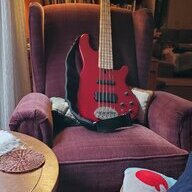
PS I'm playing a Schecter SLS Elite 5 and a Lakland Skyline 55-02

No, it doesn't make sense. Some people are "purists." I used to play with a guitarist who was very dogmatic: "fingers - guitar - amp." Anything more was contamination in his eyes.

But the fact is that he had to unplug his guitar from the amp to plug it into a tuner (disrupting the flow of the show), and his amp had EQ, reverb and an overdrive channel. What are those? They are circuits, that he was using to create the tone he wanted.

So the question is - if we're all putting our instruments' signals through circuits, what does it matter WHERE those circuits are located? They might be built into the instrument. They might be in boxes on the floor. They might be built into the box your amplification is in. So what? He could have had a tuner, EQ, overdrive and reverb in pedals on the floor and run his amp clean, or for that matter run them into a plain power amp.

It's the same thing.
 
Unless its active! The signal is then at line level, mono. Its useable at the console but I still think a decent Di is at bare minimum for signal delivery.
Most basses do not put out a line level signal...including most active basses. There are exceptions of course, but AFAIK they are fairly rare.

Pro line level is +4dBu. Consumer line level is about -8dBu. Mic level is around -40dBu or lower. Instrument level falls in between line and mic level. AFAIK output levels for basses typically falls between about -30dBu to -20dBu. Electronic keyboard tends to fall somewhere within hot instrument level to weak line level.

Additionally, the input impedance for line level inputs is too low for instruments. Typical input impedance for high-Z instrument is 1 Meg, but some devices such as Radial J48 are as low as 220K. Input impedance for line level is more like 10K or 20K.
 
I just completed my move to pedal board into the mixer and using IEMs. I had done it before but always preferred my rig. Now I am ampless on stage unless we are outside.

My setup is simple. I have two lines on my board because I play a bass guitar and an electric upright. Tuner into compressor into preamp/DI into the board. I played my first gig two weeks ago with equipment that wasn't 20 years old. Load in/load out is a dream.

Get a good DI and stand your ground!
 
Most basses do not put out a line level signal...including most active basses. There are exceptions of course, but AFAIK they are fairly rare.

Pro line level is +4dBu. Consumer line level is about -8dBu. Mic level is around -40dBu or lower. Instrument level falls in between line and mic level. AFAIK output levels for basses typically falls between about -30dBu to -20dBu. Electronic keyboard tends to fall somewhere within hot instrument level to weak line level.

Additionally, the input impedance for line level inputs is too low for instruments. Typical input impedance for high-Z instrument is 1 Meg, but some devices such as Radial J48 are as low as 220K. Input impedance for line level is more like 10K or 20K.
Agree! Thats why I say.. it'll work sorta, but the bare minimum to access the inputs on a console should be an active Di. Otherwise, the signal isn't strong enough to drive the channel strip.
 
  • Like
Reactions: jdthaddeus