• TalkBass has been independent since 1998. Add your voice.
    Create a free account to reply to discussions, view embedded media, and browse with fewer display ads.
    Join freeLog in
    Want zero display ads or expanded classifieds tools? Compare plans.

Double Bass New bass: is there a "break-in" period?

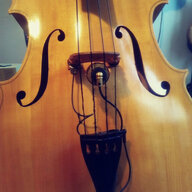
I just took delivery of a new Eastman VB95, and put a new set of Spirocore weich strings on it. (I'm a guitarist learning the double bass.)
Is there a "break-in period" where the bass improves with playing? I know that guitars certainly do that, and they even sell a contraption that attaches to the guitar and vibrates at a certain frequency, to hasten the "break-in period," supposedly.

To my ears, the low E sounds the weakest, but I suppose that's just physics, isn't it? Will the tone and volume improve over time, with a lot of playing? Thanks!

NOTE: The VB95 is a hybrid, with solid top and laminate back and sides.
 
  • Like
Reactions: Old Garage-Bander
Definitely yes on the break-in period, although a good setup can speed that up dramatically.

You'll have a break-in period too, the double bass is a very physical instrument and it's easy to over do it. Take it slow and study up on proper and safe postures.

Lessons are a great idea for non-autodidacts and if you are autodidactic try to find mentors who know double bass well and can point you in good, safe directions for the kind of playing you want to do.

TB/DB is also a great learning place for double bass, read, read, read.

Best of luck as you begin this journey!
 
  • Like
Reactions: RSBBass and AGCurry
+1 on all the wonderful advice previously expressed above. Your post caught my attention as I have also recently added a bass to my collection (which is all of 2 now) by the same company (Eastman), though a different model.

Per aforementioned suggestions, setup by a skilled luthier with a good ear is huge as is choice of strings. And, since you said you're just getting started, your playing technique and how you draw sound from the bass will improve the sound of your instrument as you yourself improve.

Have fun! (And when you learn all the notes in half position, let me know in case I need a sub).
 
Break-in- likely yes but as others have suggested adjustments could help. Consider a soundpost adjustment by a skilled luthier. But also, if you're a new player, just some time and patience.

Just following up, I'm not a big believer in a lot of break-in "hocus pocus" - a bass whose wood was sufficiently aged/dried when it was made shouldn't probably change a whole lot once the varnish has cured completely beyond adjusting to tension and setup changes (strings, soundpost) and gradually cycling through humidity and temperature changes, so you shouldn't assume that the bass is going to age like a Chateau Odeur de Pieds. You'll learn to get a better sound out of it over time, and you can make adjustments that will help you and it along the way.
 
I'm envisioning a small machine that clips onto the bridge and/or F holes and has 4 individual, rosin'd up wheels of some sort on an electric motor, facilitating unmanned continuous bowed long tone drones. A month of bowed long tone quadruple stops would/could/should settle the "do basses break in?" debate…. I'm sure there's an engineer amongst us with a 3D printer and maybe a surplus of Lego parts (?) who's up for the challenge!
 
  • Like
Reactions: AGCurry
I'm envisioning a small machine that clips onto the bridge and/or F holes and has 4 individual, rosin'd up wheels of some sort on an electric motor, facilitating unmanned continuous bowed long tone drones. A month of bowed long tone quadruple stops would/could/should settle the "do basses break in?" debate…. I'm sure there's an engineer amongst us with a 3D printer and maybe a surplus of Lego parts (?) who's up for the challenge!

I shudder at the thought of a double bass hurdy-gurdy.

Also known as "double stops" - not "chords".
Just FYI.
Thanks.

Ooh, do we get to dive into the nitty-gritty of what constitutes an actual chord now? Musicologists love to argue over whether dyads count, or if they just imply chords and triads are where you first get true chords.

Bonus points if we get really technical and comment on how double (and triple, and quadruple) stops really only relate to playing a certain number of notes simultaneously and may or may not actually constitute chords?

This possible discussion excites me more than that double bass-sized hurdy-gurdy scares me.
 
Ooh, do we get to dive into the nitty-gritty of what constitutes an actual chord now? Musicologists love to argue over whether dyads count, or if they just imply chords and triads are where you first get true chords.

Bonus points if we get really technical and comment on how double (and triple, and quadruple) stops really only relate to playing a certain number of notes simultaneously and may or may not actually constitute chords?

I take it a double stop is what one plays on a bass or another stringed instrument where one stops the strings twice. A double stop may be a chord or may be a part of a chord. But it is, independent of that, a double stop.
 
Ding. A double stop is just playing two notes simultaneously. Could be an octave, and nobody would call an octave a chord, since it isn't two distinct pitch classes.

Whether or not it gets the top vibrating enough compared to the alternating fifths and tritones to wake the instrument up quickly, though, your mileage may vary. I just like tritones because they make the dog howl.
 
  • Like
Reactions: garrett2
Any two or more tones played simultaneously is a chord. They can be the same note, or different.

In theory double stops are the same as chords, although most often double stops are associated with viol family instruments. Often more is implied, but double stops are essentially chords.
 
Any two or more tones played simultaneously is a chord. They can be the same note, or different.

Another definition! By far the less common, but I like the multitude of viewpoints.

In theory double stops are the same as chords, although most often double stops are associated with viol family instruments. Often more is implied, but double stops are essentially chords.

If we're simultaneously saying that even two notes of the same pitch class (so, unison or octaves) count as chords, then yes, a double stop will always be a chord, but one refers to harmony and the other just refers to technique, technically. As for viol family, they actually would do a lot more than just double stops, with the extra strings and flatter radius—it's the modern violin family (whether the bass is truly violin family or the cousin adopted into the nuclear group is another discussion) instruments that are stuck doing primarily only double stops before having to roll the notes instead.